Showing posts with label Cypress Quartet. Show all posts

Wednesday, January 20, 2010

Meeting Composers: Jennifer Higdon Comes to Town

This weekend, you get to hear a real live composer when she joins the Cypress Quartet for Market Square Concerts, Saturday evening at Temple Ohev Sholom.

So far, mid-state Pennsylvanians have heard Jennifer Higdon's music live with “Blue Cathedral” and her Percussion Concerto with the Harrisburg Symphony and the 2nd movement of “CityScape” entitled “river sings a song to trees” with the Lancaster Symphony in the past few years. The opening movement of “CityScape,” called “SkyLine” opens next week's Harrisburg Symphony concert, January 30th and 31st at the Forum. Several of her recordings, including "Blue Cathedral" and the “Concerto for Orchestra,” had been heard on WITF-FM including interviews with her on “Composing Thoughts” and “New Releases.”

The Telarc recording of the Concerto for Orchestra had been nominated for three Grammys including Best Contemporary Composition and won one for Best Engineered Recording. This year, the London Philharmonic's recording of the Percussion Concerto has been nominated for Best Contemporary Composition: we'll find out Sunday night when the Grammy winners are announced. (I'll be posting the winners on my blog, Thoughts on a Train.)

In addition to these two large-scale works, I've also heard the premiere of “Singing Rooms,” a very unusual combination of violin concerto and choral work. This past year, there've been two new concertos premiered, a Piano Concerto and a Violin Concerto (written for Hilary Hahn, which I heard in a radio-internet broadcast from the BBC when it was performed and recorded in London). There was a concerto for the cross-over group, the classically-trained Bluegrass string trio calling themselves “Time for 3,” a work she called “Concerto 4-3.” She's writing another concerto for the new music ensemble, “eighth blackbird,” which is set to premiere this June and there's an opera on her work-desk, due for a premiere in San Francisco in 2013!

Judging from that list of works, all composed within the past 8 years, you might be surprised that she writes a lot of chamber music, too. And that's how we'll hear her this weekend.

Jennifer Higdon is one of the most performed living composers writing today. Ellen Hughes described her as “the busiest composer on the planet” when she announced Jennifer Higdon's string quartet “Impressions,” written for the Cypress Quartet, will be on their program when they perform with Market Square Concerts – and not only that, the composer, despite her busy schedule, will be here to talk with the audience about the piece, what it was like writing it.

That program is this weekend – January 23rd, Saturday evening at 8pm, at the Temple Ohev Sholom in uptown Harrisburg, located on Front Street a few blocks above the Governor's Mansion.

Claude Debussy and Samuel Barber, whose quartets are also on the program, regret that they will be unable to attend.

*** ***** ******** ***** ***

You don't often get a chance to hear a live composer talk about the music he or she has written (well, true, you never get to hear a dead one, either, but you know what I mean). With music from the past, there are people who've written about the composer, about the music, about the times they lived and created in. But they can't usually tell us what was going on in composers' minds when they were composing those pieces.

New music – and “Impressions” was written in 2003 so that certainly still qualifies as “new” in the Art World – usually takes a few years or generations before that body of “context” can be... well, for lack of a better word, “historicized.” The context for New Music is all around us: it was written in our own time, times most of us have experienced and remember, it reflects things going on in our world (either artistically or historically) today.

In many cases, composers can be an esoteric bunch and there can be very little more boring for most people than listening to a composer talking to other composers about the “expert” details that lie beyond the comprehension or interest of most listeners. It would be the same, though, if you wanted to hear about space travel from a famous scientist who's come to town and ends up talking to other scientists about the finer points of physics. For most of us, the mind would probably quickly glaze over. (Actually, that happens to me when I hear “experts” talk about baseball, but hey...)

One of the things that I've always liked about Jennifer Higdon since I first met her back at the premiere of the Concerto for Orchestra in 2002, is how genuine she is as a person and how direct she is as a communicator, both reflected in the way she writes her music and in the way she talks about it.

(As an example, you can watch this video in which she and Hilary Hahn talk about the Violin Concerto.)

There is none of this scholarly mumbo-jumbo meant to impress other experts nor is it so vague (as others try to peel away the mystery of creativity) as to be pointless. Her music appeals to a broad range of listeners without being difficult enough to leave people wondering what they're listening to nor simplistic enough (as we expect genuinely popular works to be), empty of intellectual content for someone who wants something to sink their brain into.

If the role of an artist is to make it look easy, making us forget how much hard work and talent (not to mention luck) goes into what they do, listening to Jennifer Higdon talk about how she composed a piece of music might even leave you thinking, “Hey, I could do that!”

And she'd tell you, “you know, you're right!”

If only...

True, we all have the spark of creativity within us – it just takes some coaxing to bring it out and turn it into something. But there is still something intangible about turning it into something so tangible as a work of art.

So I hope you'll take this opportunity to come hear one of the best composers I know and one of the most talked about and performed composers today – you'll hear her music and find out that she hasn't so far, like so many dead composers, been turned into a marble bust fit only for reverence. She's just another normal human being. Who happens to write incredible music.

Dr. Dick

Monday, January 18, 2010

Claude Debussy's Quartet: Up Close & Personal with the Cypress Quartet

The Cypress Quartet will be playing in Harrisburg this Saturday evening at 8pm – not at the usual downtown locations for Market Square Concerts but at Temple Ohev Shalom in uptown Harrisburg at Seneca and Front Streets, a few blocks above Maclay Street and the Governor's Mansion.

The program will include two “only” string quartets – the only one written by Samuel Barber (the original home for his Adagio for Strings, better known in its version for full string orchestra) and the only one written by Claude Debussy.

In between, there's a more recent work written in 2003 specifically for the Cypress Quartet by Jennifer Higdon who will be present to talk about both her work and its relationship to Debussy's Quartet since she was called upon to write a “response” to it. Its movements are entitled "Bright Palette," "Quiet Art," "To the Point," and "Noted Canvas," all painterly terms (well, you get the impression...).

"Watch This Space" for an up-coming post about Jennifer Higdon and her string quartet, too.

This post is specifically about the Debussy Quartet, recycling an earlier post from Thoughts on a Train following a performance the Cypress Quartet gave at Lebanon Valley College in September of 2008.

Here they are, performing the first movement of Debussy's Quartet in G minor:


The Debussy Quartet was on their very first program twelve years ago, violinist Tom Stone had said in remarks before they played it. There was so much in the piece they discovered while first working on it – though he said jokingly, looking back at his colleagues, “that first performance was... uh, was kinda rough...” And ever since they’ve kept coming back to it and discovering more.

However many times they’ve played it in the years in between - and recorded it - this was the first time I’d heard them play it. It sounded to me like they were approaching it with the same excitement they’d have after having just discovered it for the first time. Except for one thing: they weren’t playing it like everybody else. They were bringing to this overly familiar war-horse something that often gets lost in the “yet-another-performance” syndrome that affects many performances and listeners – the “here-we-go-again,” “dig-out-the-tried-and-true” approach that, regardless of technical flawlessness, never manages to get beyond the surface of the music.

It’s not one of those things you can easily put a finger on, much less describe in words (not that that’s going to stop me). Without a score in front of me, could I say they were doing it correctly when others were not? Or were they adding things not in the composer’s written-down intentions that other groups hadn’t thought of? How much of this was their own interpretation – and how much “interpretation” is beyond what the composer called for or, at least, implied?

Ever since I was a kid learning to play the piano, I’ve heard the expression “the music lies between the notes.” It’s not just getting your fingers in the right places at the right times, playing the right notes in the right rhythms. Learning how to make music out of all that, finding what’s between those notes, is the performer’s real challenge, and then completing the equation by communicating that to the listener.

Rather than examine the score (the printed music, what the composer wrote), too many performers today listen to recordings (how what the composer wrote is interpreted) and then pick and choose what they feel best suits them. Imitating a performance might let a student know how it could go – since there’s really no single way it SHOULD go – but it doesn’t help a student figure out WHY it could go that way.

That’s what I liked about what I heard the Cypress Quartet doing with the Debussy.

Too many performances and recordings I’d heard play the piece as a lushly romantic wash of pretty sounds: Debussy, after all, was an Impressionist, a pigeon-hole he never liked but since it reminded people of those Impressionist painters of the day, there was no way to avoid it.

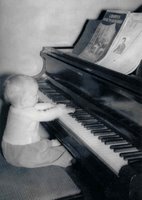
Debussy (see right, a photograph taken in 1893, with the composer at the piano, the year he wrote his Quartet) was also a slow, painstaking composer who agonized a long time over whether to use this chord or that chord. It’s got to be more than he was just unwilling to make a commitment: he was probably looking for the best sonority for that moment, not just slap-dashing notes down on the page because “oh, that sounds nice!”

Debussy has never been an easy composer for me to love: certainly, I like a lot of his music but it never really spoke to me. Part of this may be because he is, despite his dislike of the painterly term, most often inspired by the visual element and I am not. Most of his pieces have titles that suggest or prompt certain images in the listener’s mind, whether it’s a garden in the rain or a child’s toy. I am not a visually oriented person so it’s quite possible that’s why much of his music eludes me. As a like-minded friend of mine once put it, “I like La Mer: every time I hear it, it’s like hearing it for the first time,” but in the context and tone of voice implying it is also immensely forgettable.

But his only String Quartet, written in 1893 (the same year Brahms was writing his last piano pieces, Op. 118 and Op. 119, by the way) is simply that – an abstract string quartet where the movements are indicated by tempos like Animé et très décidé, not “Reflections of Moonlight on the Steps of the Temple.” But then, this is considered “Early Debussy” despite the fact he was 30 – making, I guess, derivative juvenalia like his Piano Trio written at 17 “Pre-Early” – yet all that is fairly relative when you consider when he wrote two of his more famous pieces: the piano piece Clair de lune from the Suite Bergamasque predates the quartet by four years; the Prelude to the Afternoon of a Faun was written the following year. Between these picturesque pieces, a string quartet, considered a German form in late-19th Century France, could seem the Odd-Piece-Out.

The Sonata Form was also essentially a German Form. And French composers felt, perhaps out of patriotism as much as anything, that it needed to be adapted their own way. French taste shied away from such Germanic things as fugal counterpoint (what Satie called “sauerkraut”) and the obsessive development one finds in so much German music: they preferred melody and color, perhaps, over rigidity of form and harmony.

But this is also part of the French Personality, more laid back and laissez-faire compared to the German (and specifically Prussian) attitude toward detail, exactness and promptness (a friend of mine from Berlin would be pointing excitedly at his watch because we were now two minutes late) . Ned Rorem would break everything down to be either French or German along similar guidelines, even other national stereotypes: the Japanese, to him, are German and the Chinese, French! (Think about it...)

So the French took their Sonata Form and put less emphasis on the development section and crafted memorable melodies that would come back in other movements – forgetting that Beethoven had done the same thing in a few key works like his 5th and 9th Symphonies – something they called “cyclical form,” even though it’s not really a form but a structural device to unite a multi-movement work. Part of the problems Germanic listeners have with this technique is that “it’s just the same tune!” They expected something to have “happened” to the theme by then, becoming transformed – you know, the way Mahler does in his symphonies (“good German symphonies, Mahler,” you could almost hear them adding).

So it’s surprising to realize that Debussy builds almost everything in this four movement work out of four basic pitches – G -F - D- F# – a motive which lies behinds the themes rather than being the theme itself. Consciously or not, these various themes will all sound different but still connected. There’s a subtly here that manages to create a great deal of variety while using the same material – things keep coming back in slightly different ways but it all sounds like something cut from the same cloth.

Debussy was famous for having flunked his harmony class at the Conservatoire – giving generations of students, including mine, the courage to say “if Debussy could do it...” What these same students forget is that his teacher, after marking up his papers with tons of corrections and comments, could still admit “everything is wrong but he is talented, there can be no doubt about that,” a qualification that could not always be made about my students who also forgot that at the time Debussy was 12. He had, certainly, even then, his own ideas about things, but that doesn’t mean he discarded the use of Rules completely, just Those Rules.

People sometime object, consciously or not, to the “impressionistic” music of Debussy because it doesn’t sound like the music they’re more familiar with, not that it’s “ugly and dissonant,” just “unsettling.” Dissonant, perhaps, but in the sense that chords that (according to the old rules) need to resolve in certain expected ways do not. When you are using a scale that is not the same as the traditional major or minor scale, you create harmony that does not move in the same expected ways: if it’s the whole-tone scale which doesn’t include that interval, the perfect fifth, which is at the root of all Classical Harmony, you create chords that don’t even sound like they need to go ANYwhere. And so performers create a sound that becomes static and directionless, as if “forward motion” in music could not be accomplished in other ways.

What the Cypress Quartet does, examining the printed music in front of them, is find the ways that Debussy replaces these traditional “classical” expectations with his own, how he moves the harmony forward by creating certain consistencies (whether or not he’d think of them as “rules”) and how he builds toward climactic points, using rhythm, tempo, texture, even the register the instruments are playing in and of course elements of contrast. Suddenly I’m hearing “structure” where before it was just pretty shapes and images, as if this “skin” were not holding together muscles and bones.

And I’m sitting there thinking, “huh, Debussy with structure! Who knew?!” This is the first time I’ve heard the piece where I thought it was worth listening to. (But then, there may have been some “French” listeners in the hall who were squeamish because to them it was too pedantic, too... German!)

It’s not like this is a revolutionary way of looking at music. “Analyzing” is a term I dislike because it implies the psychological obsession with detail (as in “he’s so totally anal”) that so often loses the overall picture to focus on the minuscule. It’s not like other groups don’t do this: they just find something different or maybe, if they find nothing compelling, they just play it the way they’ve heard other people play it.

*** ***** ******** ***** ***

You can hear them perform the Debussy Quartet along with Jennifer Higdon's “Impressions” and Samuel Barber's Quartet on Saturday, Jan. 23rd, at 8pm at Temple Ohev Shalom in uptown Harrisburg with Market Square Concerts.


- Dr. Dick

Tuesday, September 29, 2009

Cypress Quartet's "Beethoven" CD

Things have been busy – if not productive – at Dr. Dick, Inc, between Mendelssohn's World (writing 60,000 words, mostly in 2 weeks), getting caught up on composing, posting the latest installments of “The Schoenberg Code” and getting things ready to start writing a new parody, “The Lost Chord,” based on Dan Brown's latest, “The Lost Symbol.”

Meanwhile, I've been listening to the Cypress Quartet's first Beethoven CD, the start of a complete series which was released this summer and, at the rate of one disc a year, it seems, should be finished around 2015 or so... not sure I can wait that long but it's not the kind of situation where they go into a studio and – wham! - knock out all 16 quartets in a week or two.

They'll be playing on the January concert with Market Square Concerts – Saturday Jan. 23rd, 2010, at 8pm at Temple Ohev Sholom – and this week, they're playing at Lebanon Valley College's Blair Music Center, Thursday evening at 7:30. On the Annville program, they'll be performing one of the quartets from this new Beethoven CD – Op.135 – along with Griffes' Two Sketches on [Native American] Themes and Dvořák's “American” Quartet.

It was back at the very first of WITF's “Next Generation Festival” programs – was it in June of 1997? Ellen would have to help me with the date – that I first heard the Cypress Quartet. They performed Beethoven's A Minor Quartet, Op. 132, the one with the famous “Heiliger Dankgesang” (Holy Song of Thanksgiving) in the slow movement which at times can seem glacial and remote. Aside from feeling how well they were able to capture this moment of suspended animation, my fondest memory of this whole performance was watching a young boy (could he have been 10 or 12 years old?) sitting in the front row in rapt attention, leaning forward, his chin on his hand but his eyes intent on the players in front of him, then sitting back at the end, looking over at his mom with one of those wide-eyed “wow!” expressions you see too rarely combined with listeners of any age and classical music.

Obviously, these musicians had something to be able to capture the attention of this largely new audience, when you consider the reputation Late Beethoven Quartets have, usually spelling trouble for even the most experienced adult audiences' attention spans. What impressed me even more was, afterward, realizing this was the end of the quartet's very first season together. Such cohesion of concept and singular communication, translating four people into one organism, is rare in all but the most exceptional quartets who've been playing together for years, not only used to how they play individually but how they think.

So it seems natural they should begin their Beethoven Cycle not chronologically with the (supposedly) easier Early Quartets of Op. 18 but with the psychologically more challenging Late Quartets, the Himalayas of Chamber Music, beginning with perhaps the most difficult one to make work, the C-sharp Minor, Op. 130, and the very last of them, in F Major Op. 135.

I don't know if, as one reviewer said somewhere, "They have looked into Beethoven's soul," it's clear they've been looking into their own souls and finding a lot of in-put to shape their own interpretations of this music.

Let's just say – since I hate writing reviews in the first place, especially reviews of friends of mine – I like this recording a lot. I've listened to it just as I would listen to it in a concert, I've listened to it while following the score and I've compared it to a couple of other recordings I have with the Juilliard and Guarneri Quartets. In many ways, I can't really tell the difference between them: they may be a little different in the subtlety of their details, but basically, they all sound to me as of one level.

One of the great things about great art is the many different ways you can interpret it – on a technical level, on a philosophical or aesthetic level, on a personal level – and it's still the same work of art.

Basically, I listen to a recording or a performance and judge it on whether it works for me, expressing what I feel the composer was trying to say in the piece. There's not much to quibble with in the Cypress's recordings of these two great quartets.

Beethoven, for all his specificity in markings, still leaves questions that need to be settled: agreed upon if not answered. Writing the notes – and learning them – is only part of the music.

As an example, take the slow movement of Op. 135, marked “Lento assai, cantante e tranquillo [very slow, singing & tranquil].” It's a short hymn-like theme with four variations, the second, in C-sharp Minor, is marked “Piu lento [more slowly].” The last variation is similar, with a filagree over the theme's implied framework.

Of the three recordings I've listened to, the Cypress clocks in at 7:18; the Juilliard (from 1996), at 7:58; the Guarneri (a reissue of their late-1960s cycle, recorded in the first four years of their existence), at an incredible 8:42.

And yet it's all the same music, no repeats, no cuts: they're all playing the same notes. How slow is “slow”?

Even though I like the Cypress's slow movement very much, I quibble with their phrasing of the theme's second half, taking a breath between sub-groups of the phrase (m. 7-10, for you geeks with scores). The logic may be in taking a breath while dropping back from the crescendo to the initial piano [soft] dynamic but I feel by actually “breathing” there, they've interrupted the line of the phrase. Beethoven does this automatically in the hesitant C-sharp Minor variation, but they still add a 16th-note rest in their breath-taking. They don't do it at similar structural spots in the other variations, but then there are no “crescendos dropping back to piano” there, either.

The Juilliard stretches the phrasing at those points, too, but not so much: the bows don't seem to stop the sound as much, either.

Though the Guarneri's tempo is so slow it's hard to feel the subdividing 16th notes evenly, they play it “straight through” the phrase, no breathing but still stretching the tempo a tad. Curiously, they also go back to the much slower tempo of the 2nd Variation for the last one, even though Beethoven marks no change in tempo (now, that is a real quibble).

None of this “changes” the piece nor certainly “ruins” it – they're just different ways different performers hear it, at these moments in time.

It's things like this – and intonation – that keep quartets busy during rehearsals. It's not just playing the piece over and over again until you get it right: it's trying to find solutions (or perhaps a better word would be “realizations”) that make for a cohesive interpretation and overall sound. It's what makes a quartet want to come back and re-examine a piece they've played before, perhaps find new insight or try something different to see how it might work.

It's also what keeps the music from getting stale over the years. It's what keeps musicians alive by being able to look at the same landscape at different times but notice something they hadn't seen before and marvel at the richness of what could seem familiar to someone else.

Let's say I'm looking forward to hearing the rest of their Beethoven Cycle and I'm looking forward to hearing them play Op. 135 live Thursday evening at Lebanon Valley College.

I'm also looking forward, hopefully, to hearing them perform and maybe re-record them a decade or so from now: it would be fascinating to hear how their perceptions change and mature with them.

And of course, I'm looking forward to hearing them play Debussy and Barber and music by one of my favorite composers out there today, Jennifer Higdon, when they're in Harrisburg in January: should be a great way to warm up on a cold winter's day.

- Dr. Dick

Tuesday, August 25, 2009

Cypress Quartet's New Beethoven CD Launched

It's official - the Cypress String Quartet, who'll be performing in January as part of the new 2009-2010 season with Market Square Concerts, launches their latest recording, the first in a series of the complete string quartets by none other than Ludwig van Beethoven.

And Volume 1 consists of the String Quartet in C-sharp Minor, Op.131, and the very last one, the Quartet in F Major, Op.135.

Today, cellist Jennifer Kloetzel was interviewed on Vpype which I was able to access (at least for the brief time I was able to) through Facebook.

But if you couldn't watch the video live yourself, they've posted it on-line so you can view it whenever you want. So, since you're here now, click on this and, with any luck, it should work:

Watch this live broadcast from Jennifer Kloetzel (at Vpype Broadcaster)

If it doesn't, er... as it didn't the first time I posted it - try THIS LINK.

Vpype - which they pronounce V-pipe (I was trying to make something tongue-twistingly Slavic out of it - v'PEE-yeh... wrong...) - is another new format for broadcasting live on the internet. At the moment, it's "in Beta" and I'm gathering may only be available to Facebook Users -- so, uhm... well, it may be another reason to join the gazillion other people who are wasting lots of their time on-line there, and then add Market Square Concerts to your page! AND the Cypress Quartet, too!

I don't think the 'chat text' will be visible when you view it, but during the live broadcast, viewers could write in questions to ask Jennifer. You'll hear her say hello to me, in fact, when I asked my question about how many CDs and how long this project may take before all 16 quartets have been released.

It was at that point, the phone rang again - I never get any calls, so of course during the brief interview, I get two of them... - and by the time I got back to the computer, it was over! So I definitely want to tune in and hear the whole thing.

Tonight, there's a "release party" at their home base in San Francisco celebrating the launch! I'm going to celebrate by listening to the CD myself, back here in Harrisburg, and I'll post a 'review' here in a couple of days. I already listened to it once and I can tell you it's very good. Stay tuned to find out how good.

It's tough reviewing your friends - I've known them since they first appeared here with the first of the Next Generation Festivals Ellen Hughes, now Director of Market Square Concerts, had organized at WITF. The quartet'd been together less than a year but have come back to the area frequently since then, between subsequent Next Generation Festivals, residency concerts with Lebanon Valley College and just this past summer, one at the Pennsylvania Academy of Music in Lancaster. They're beginning their 14th Season together next month!

So, check out the Vpype interview (whether you can pronounce it or not), check out their website for more details about the CD (where you can also listen to samples) and check back in a couple of days for something kind of like a review right here.

And while you're at it, put Saturday, January 23rd, 2010, at 8pm on your calendar now for their Market Square Concerts performance - which will be held at Temple Ohev Sholom in uptown Harrisburg. They'll be playing the string quartets by Claude Debussy and Samuel Barber and a recent work composed for them by Jennifer Higdon who will be here for the performance!

- Dr. Dick