Monday, March 21, 2022

The 40th Anniversary Concert: Celebrating Art in Challenging Times


The 40th Anniversary Concert

Who: pianists Stuart Malina & Ya-Ting Chang; oboist Andreas Oeste; guitarist Jason Vieaux; violinists Peter Sirotin & Dawn Wohn; violist Timothy Deighton; cellist Fiona Thompson

What: Zev Malina (b.2002): From Jack's Notebook (world premiere); Robert Pound (b.1970): “The Dance of Death” for Piano Trio (2002); Jeremy Gill (b.1975): Oboe Quartet (2020); Avner Dorman (b.1975): Guitar Quintet, “How to Love” (2016)

When & Where: Wednesday, March 23rd, 2022, at 7:30 – Market Square Church in downtown Harrisburg.

Three of the composers – Robert Pound, Jeremy Gill, and Avner Dorman – will be in attendance and offer a Q&A Session at the end of the program. (Zev Malina, attending Rice University in Houston, actually has a role in a play that is currently on-stage at school, and so he's unable to be here in person.) Imagine going to your typical Classical Music Concert and having Mozart, Beethoven, and Brahms to meet and talk with after you've heard their latest music? What questions would you have had for them? 

* * ** *** ******** ***** *** ** * * 

There are many ways of celebrating an anniversary. Looking back over the past 40 years and offering artists or repertoire that figured prominently in the history is one way. But another way is to look to the future. Now, if the organization is able to commission new works from young composers, an expensive and often risky (and uneven) venture, that's one thing, and not always possible. But some people, expecting the equivalent of the Great Works of the Past, would be disappointed because these are composers and works that have not yet had the chance to prove themselves over Time. I remember beginning my graduate studies at the Eastman School of Music during its 50th Anniversary when they commissioned a large number of works from some of the world's foremost composers: like many an investment, some of them proved inspiring to us students; others were not so amazing (none, alas, were the equivalent of a work by Beethoven).

So here we have a program of four composers “with Central Pennsylvania Ties.” Zev Malina and Jeremy Gill are Harrisburg natives. Robert Pound has been teaching at Dickinson College in Carlisle since 1998. Avner Dorman, a native of Israel, is currently associate professor of music theory and composition at the Sunderman Conservatory of Music, Gettysburg College.

There's an exceptional challenge to celebrating anything these days, given the Pandemic and the World News – who expected, knowing “history repeats itself,” that the whole of the 20th Century would recap itself in just two years? – and, as we watch Russia's Invasion of Ukraine on the evening news, I am reminded of a famous quote by Leonard Bernstein, himself not immune to a sense of history and of protest against man's inhumanity to man, whether it was War or Social Injustice:

And so, as it happens, composers turn to create new music to look toward the future and maintain the continuity that has kept what we call “Classical Music” fresh and vibrant over the centuries.

* * ** *** ***** ******** ***** *** ** * *

Everything on this program has some inspiration from another medium: theater, literature; in the case of Jeremy Gill's Oboe Quartet, an earlier oboe quartet as a model, the one by Mozart (but with literary influences blended in with it from Gertrude Stein, among others). Let's begin with the first work on the program which found its inspiration... on a school bus!

First of all, Zev Malina's piano-duet, “From Jack's Notebook,” will be performed by his former piano teacher, Ya-Ting Chang, and Stuart Malina, the father of the composer (and also music director of the Harrisburg Symphony).

Now, a “piano-duet” or a piece for “piano four-hands” is a work for two pianists at one piano (rather than for two pianos). In the days before TV and even stereos (for those of us who remember sitting in our living rooms, listening to records), this was how people experienced music in their homes: making it live, themselves. Amateur pianists would pair up, one playing the upper part (primo), the other the lower (secondo) and the rest of the family or other guests would sit back as if attending an in-house concert. It was “social music-making,” an art that has been lost once recordings and things like radio came along and turned music into a passive activity. 

Usually, I write what has been written about a dead composer's work and quote lots of other (often dead) people to point out what's going on in the work's “biography” and how it relates to their lives. But with living composers, my job's a lot easier when they can write their own program notes. So here's what Zev Malina has to say about “From Jack's Notebook”: 

= = = = = = = =

“On the bus ride back to high school following a class trip, my friend Jack asked me to give him prompts for characters and scenarios to draw into his sketchbook. I was so charmed by the resulting sketches that I practically felt compelled to compose my own miniatures based on them. In “From Jack’s Sketchbook,” I sought to evoke the scene, mood, and tone of each drawing and to expand the tiny worlds Jack created.” – Zev Malina 

= = = = = = = =

These six vignettes are entitled “A creature escapes from a lightbulb” – “A contented potato” – “Spreading a shoe on toast like it’s butter” – “Waiting for a train that won’t arrive” – “A gnome under a watering can” – and “The last cashier in the world.”  

Zev Malina (c.) takes a bow 
Ya-Ting Chang wrote about working on this piece for Wednesday night's premiere:

“Zev’s father, as well as his former piano teacher, are proud of playing a small part of Zev’s musical journey. For this particular composition, if we will do it justice, hopefully the audience will find it imaginative, sincere, sophisticated, and accessible. Peter [Sirotin] was at our last rehearsal turning pages and found it to be full of humor and charm. All three of us noticed some stylistic influences of Poulenc, Ravel, Saint-Saëns, Mussorgsky, Prokofiev, Shostakovich, and Gershwin, none of which are literal, just evidence of his unusually wide reference. It is clearly Zev’s own language!”

And this last bit is something important to make note of, when listening to something unfamiliar and latching on to bits that sound familiar: a young composer is always trying to find his (or her) voice, and that is not a process which occurs as soon a composition begins. I'll come back to this later, but think of Beethoven – whose 250th Birthday Anniversary we did not get to celebrate (as planned) during the 2020 Lockdown – whose Op. 1, a set of piano trios and clearly not his first compositions, were published two months before his 25th birthday. To most of us, much of Beethoven's early music “sounds like Haydn,” but to a contemporary, a lot of people thought the young man had gone far beyond the classical propriety of The Old Man (Haydn, after all, called his student “the Young Turk”). But compare that to music Beethoven wrote when he was, say, 41 – the age Avner Dorman was when he composed the Guitar Quintet that concludes this concert's program – like the 7th Symphony he began that year, and you'll realize how much a composer can “evolve” stylistically over a period of what is actually only 16 years!

So if Zev Malina is "borrowing" – paying tribute to or absorbing what other composers he likes (as Stravinsky once said, "good composers borrow; great composers steal") – this is all part of the process. A composition student's job, basically, is to be a sponge, and absorb everything he likes and even try some he doesn't: eventually, figuring out how to build on this foundation, some of these influences will fall by the wayside or become so absorbed into that elusive “own voice” as to be no longer recognizable. That's how a composer like Stravinsky may go from his most famous work, The Rite of Spring (written when he was 31), to those middle-period "Neo-Classical" pieces like the Symphony in Three Movements (when he was 63) that may sound like the 18th-Century-with-wrong-notes, to the austere serial pieces of his final years like The Flood (when he was 80) and yet still always "sound like Stravinsky."

You can listen to the Harrisburg Symphony's premiere performance of Zev Malina's "Suite for Orchestra" (with all its fully intended stylistic evocations), conducted by Stuart Malina and recorded in October, 2019.

* * ** *** ***** ******** ***** *** ** * * 

Speaking of evocations and influences. 

Robert Pound
Since Robert Pound's piano trio is entitled “The Dance of Death,” you may be forgiven if you're thinking, “ah, Franz Liszt wrote a set of variations on the Dies irae called Totentanz” (literally, the Dance of Death). But that's like reading the headline and skipping the article: in fact, it was not just inspired by August Strindberg's play, “The Dance of Death,” written “in the blackest pessimism” in 1900, but was intended to be the overture for a staged production of the play in 2002. 

You can listen to a performance's soundfile, here. 

The composer writes this for the program notes: 

= = = = = =

Strindberg’s play The Dance of Death depicts a husband (the Captain) and wife (Alice) locked in a loveless marriage. Alice’s cousin Kurt visits the couple. Horrified by the emotional malaise pervading their household, Kurt initially attempts to be an optimistic moderator for them. However, Alice and the Captain enlist Kurt in their ruthless scheming against one another and make him their battlefield.

Director Karen Kirkham commissioned this score, and our numerous and lengthy discussions helped shape it. The intimate nature of the play called for an intimate ensemble. We wanted the instrumentation and music to reflect the fin-de-siècle decadence of the play’s setting and tone. Obviously, the piano trio affords the possibility of linking each character with a musical instrument. I extended these connections to the music as well. Alice and the Captain are represented by the violin and cello respectively. Each part has its own intervallic and rhythmic qualities. The violin and cello melodies interlock in a waltz, but not comfortably because the typical waltz rhythm has been skewed differently for each instrument. Only when the piano enters does the music take on a more comfortable, steady lilt, and only temporarily. The present one-movement work served as the overture for the play in the Jean Cocteau Repertory Theatre production. Episodes were extracted from this overture to provide underscoring for the action.

As a whole, the overture depicts the play’s complete plot musically. The eerie beginning and end of the piece illustrates the alienation and frigidity of the couple; the violin-piano duo depicts the plot between Alice and Kurt against the Captain; and the extended cello solo portrays the pantomime in which the Captain, suspecting their alliance against him, dismantles various symbolic props of the home’s decor in alternating fits of rage and regret. By the end, little has changed between the unhappy couple.  – Robert Pound 

= = = = = = =

Given the nature of a composer finding inspiration, exploring mostly literary influences in this program, how many pieces of music can you name inspired by economics (Beethoven's "Rage Over a Lost Penny," aside)? In 2005, Robert Pound wrote a 13-minute orchestral work for the Atlanta Symphony entitled "Irrational Exuberance," taking its inspiration from an expression by Fed Chairman Alan Greenspan about the unbridled enthusiasm of Wall Street Investors! You can listen to his interview with NPR's Morning Edition, here.

* * ** *** ***** ******** ***** *** ** * * 

(photo/Regina DeLuise)
Jeremy Gill's music should not be unfamiliar to Harrisburg audiences, and this Oboe Quartet, not his latest work, will be the 12th of those compositions listed on his website which I have heard here, due in large part to laudable support from the Harrisburg Symphony and Market Square Concerts. An oboist himself, Gill wrote this, a work inspired by Mozart's Oboe Quartet (one of the jewels of the oboe repertoire), for oboist Erin Hannigan and her colleagues of the Dallas Symphony Chamber Players who premiered it there in November of 2020. 

Here is a video of that premiere performance, masks and all: 

= = = = = = = 

My Quartet for Oboe and Strings is modeled on Mozartʼs only oboe quartet, which he composed in 1781 for the virtuoso oboist Friedrich Ramm. Both works are in three movements totaling roughly 15 minutes of music in which the oboist plays a concertante role.

I am often inspired by literature when I compose. Novels are my go-to inspiration, but this piece references three works of non-fiction, made explicit by the title of each movement. “A Sense of Banditry,” my first movement, paraphrases a line from Anne Carsonʼs essay “On the Sublime in Longinus and Antonioni” from her 2005 collection Decreation. She writes how it is “exciting and dangerous” to “loot someone elseʼs life or sentences and make off with a point of view.” Of my three movements, this is the one most closely modeled on Mozartʼs, and sounds a bit as if Mozartʼs music were reflected in the aural equivalent of a broken mirror.

“Exciting and Peaceful” is Gertrude Steinʼs assessment of Paris in her delightful autobiographical Paris, France. A kind of love letter to her adopted home town, it was published in 1940 on—this quotation notwithstanding—the day Paris succumbed to Nazi Germany. In the case of my second movement, “exciting and peaceful” evokes the expectant stillness of night and is reminiscent, in character though less in detail, of Mozartʼs slow movement, with its combination of baroque-inspired reserve and operatic pathos.

The third movement of Mozartʼs quartet features a famous and curious passage in which the oboist plays in 4/4 while the strings persist in the movementʼs general time signature of 6/8. This rare occurrence of polymeter in a classical work lasts only 13 bars, but in my third movement I make polymeter its raison dʼêtre. Throughout, the strings play in 5/8 while the oboist, most often notated in 2/4, dallies with measure divisions of 3, 4, 6, 8, 9, and even 16. My title, “Slide,” is taken from a musical game that Kyra Gaunt describes in her musicological study The Games Black Girls Play. Gaunt says that Slide (the game) trains girls “to perform at least two different rhythmic orientations at once,” and that such games “are as much a social and phenomenological formula as they are motor-rhythmic formulas that contribute to musical events.” Although my “Slide” is only vaguely related to the specifics of the game, Gauntʼs description feels like a lovely summation of what we do as musicians in general—play (often) complex “games” that encourage social adhesion as well as provide aesthetic pleasure.  - Jeremy Gill 

= = = = = = = 

While I mentioned Stravinsky's quip about borrowing versus stealing earlier, the idea something can sound like something else – was Brahms' using a passage from Schumann's Rhenish Symphony in his own 3rd Symphony a conscious tribute to his mentor or is it just that there are only so many notes to go around? – delves into the creative psyche that can prove a fascinating and ultimately inconclusive adventure, whether it's revealing or (depending on your viewpoint) a waste of time. But inspiration, conscious or not, often leads to intriguing potential: and in one sense of New Music looking ahead into the future, we often find inspiration from the past a not uncommon “jumping-off place” for a composer's creativity.

It's perfectly logical for a composer whose instrument was the oboe (in addition to the piano) to look at Mozart's gem of a masterpiece to see what he can see (or hear, in this case). It's not a measure-by-measure imitation of the piece – “doing it my way” – and it's certainly no arbitrary coincidence (again, thinking of Brahms' response to someone pointing out the “similarity” between the Big Theme in the finale of his 1st Symphony and the “Ode to Joy” from Beethoven's 9th: “any ass can see that!”). I like how the composer describes the effect, refracting Mozart into his own music, so it “sounds a bit as if Mozartʼs music were reflected in the aural equivalent of a broken mirror.” And of course, to highlight the obvious, the first movement is entitled “A Sense of Banditry.” 

It's not just a quotation for some nostalgic effect – there was a big craze for “quotation” in new music back in the 1970s and '80s which often sounded more gratuitous than generative – and of course the idea is not entirely recent: if folks like Poulenc and Respighi could hornswoggle lute pieces from the 1600s into their music in the 1920s as a way to counterbalance the lush influences of 19th Century Romanticism, earlier composers (waaaay earlier) would use fragments of Gregorian Chant as the basis (if not the bass) of a new style called Polyphony as far as back as Leonin and Perotin in 12th Century Paris.

* * ** *** ***** ******** ***** *** ** * * 

Ah, that elusive word: Inspiration.

A composer, I have found from listening to and talking with so many of them over the decades, is always looking for inspiration but it usually works best when you're not waiting for it. We think of Beethoven walking in the fields, or Brahms pacing around his room, waiting for inspiration to strike: how do they come up with those beautiful melodies?

Elliott Carter, known for his complex musical style, composing right up to a few weeks before his death just shy of his 104th birthday, once said in a live-concert's Q&A (and I'm paraphrasing), “If you set yourself a challenge or a question – the instrumentation for a particular piece, or 'how do I want this to take shape?' – inspiration will come as you try to solve it.”

And inspiration can come from any number of possible sources. We've seen how a work by Mozart from almost 240 years earlier inspired Jeremy Gill to write his own Oboe Quartet. Robert Pound took a tragic plot that is tragically still compelling today, in this case a direct commission for incidental music for a production of the play. And Zev Malina had a happier inspiration in his friend Jack's suggestion for some ideas for a few quick sketches while sitting in a school bus which he then decided should be set to music (with or without a wink - I suspect with - toward Mussorgsky and his "Pictures at an Exhibition"). 

Which brings us to the last work on the program, a guitar quintet by Avner Dorman, inspired by a book entitled “How to Love.” 

= = = = = = =

Avner Dorman, at a rehearsal
Since writing Letters from Gettysburg in 2013 [setting letters written by a Union Soldier wounded at the Battle of Gettysburg who died a few days later], Avner Dorman has become increasingly alarmed at the gulf between the healing language of Abraham Lincoln’s Gettysburg Address and the divisive political rhetoric voiced in today's United States. Contemporary political discourse, he observes, has been infected by sentiments rooted in pre-Civil War times that had remained dormant for many decades.

“For me,” [he] concludes, “the central lesson that can be learned from Letters from Gettysburg, is that, ultimately, conflict and disagreement hurts people and families. It’s much easier to fight over an ideology when we forget that the people who suffer by it are individuals and families - people we can all identify with. It’s so easy to cast a whole group of people as “the enemy.” But we must remember that every person has thoughts, feelings, and loved ones. If we could only remember that, our political discourse today would become much more compassionate and empathetic.”  – Gettysburg College News 

= = = = = = =

So it shouldn't come as a huge surprise that he found inspiration in Thích Nhất Hạnh's How to Love (published in 1945) which became the Guitar Quintet he composed a few years later, in 2016. There are four movements: (I.) I am here for you; (II.) I know you are there, and I am happy; (III.) This is a happy moment; and (IV.) You are partly right.

= = = = = = =
The title of this work is taken from the book of the same name, written by Thich Nhat Hanh, a Buddhist monk and peace activist from Vietnam. Each movement is titled after one of the six mantras that he outlines at the end of the book. The movements are repetitive in a variety of forms — chaconne, theme and variations, passacaglia — reflecting the repeating nature of a traditional mantra. The first movement, "I am here for you," begins with a open, flowing gesture in the guitar that calls to mind a sense of presence that continues, as the gesture transforms throughout the movement. The second movement, "I know you are there, and I am happy," celebrates that happiness of being with the one you love. The third movement, "This is a happy moment," is an aria, a love song celebrating the joys present in everyday life. The final movement, "You are partly right," is the most conflict-driven of the piece, and therefore the most dramatic. As the author of the text explains, we can say "You are partly right," both in response to praise and admiration as well as in criticism or disagreement. The movement progresses through conflict to the recognition and reconciliation that we must embrace imperfection in order to love each other fully. — Avner Dorman

= = = = = = = 

Given the times we live in, not just this past month, this message may be more apt than ever (considering the book was initially published in 1945).  

Unable to find a video of the Guitar Quintet for this post, I'll post something with a slightly different inspiration by Avner Dorman, the Presto that concludes his 2011 Sonata No. 3 for Violin and Piano, Nigunim:

= = = = = = =

When the 92nd Street Y and Orli and Gil Shaham approached me to write a new piece for their Jewish Melodies program, my first thought was to write a piece that would explore the music of the ten lost tribes... I decided to explore the music of various Jewish traditions from different parts of the world and how they relate to larger local musical traditions.

To my surprise..., I found that there are some common musical elements to North African Jewish cantillations, Central Asian Jewish wedding songs, Klezmer music, and Ashkenazy prayers. Though I did not use any existing Jewish melodies for Nigunim, the main modes and melodic gestures of the piece are drawn from these common elements... [In addition to other influences,] the fourth [movement] is [also] inspired by Macedonian dances.

= = = = = = =

Here is that fourth movement, recorded at its premiere in 2011: 

= = = = = = =

Given these times we've been living through for the past few years, it will be interesting to see what new works these composers will provide for future audiences. Just think: if you attend Wednesday's concert, you can ask three of them questions not only about how their inspirations turned into the music you've just heard but also what future plans they may have and how, given composers interacting with society and being influenced by the world-at-large, the events of these years might (or might not) engage their creativity in the near future. 

You may hear critics saying things like "Classical Music Is Dying," a tiring old mantra I've been listening to since I was 13 and attending my first Harrisburg Symphony concert. The Pandemic has made "live concerts" something of a challenge lately and "live concerts" in the future may be very different from what we were experiencing only a few years ago. But people will experience live music somehow, musicians will continue to perform it somehow, and composers will continue to write for them – somehow. That hope, certainly, is worth celebrating.

– Dick Strawser 


Friday, February 11, 2022

Stephen Hough: How to Survive the Year That Would Never End

Who: Pianist Stephen Hough
What: a program that includes Schumann's Kreisleriana, some Chopin – the 3rd Ballade, the 2nd Scherzo, and a couple Nocturnes – as well as Four Bagatelles by Alan Rawsthorne and his own Partita  
When: Tuesday night (February 15th) at 7:30
Where: at Market Square Church in downtown Harrisburg.

(Mask wearing, photo ID and proof of vaccination or a document of COVID-19 recovery from a licensed healthcare provider will be required to attend.)

Mr. Hough's appearance in Harrisburg is part of a residency in which he will perform Camille Saint-Saëns' 4th Piano Concerto with the Harrisburg Symphony this weekend, Saturday at 7:30, and Sunday at 3:00 at the Scottish Rite Auditorium in uptown Harrisburg; and also hold a Master Class at Messiah University on Monday, February 14th, from 5-7pm, which is free and open to the public.

= = = = = = = 

Ever since I'd started hearing about the British pianist Stephen Hough, I think the common denominator in most articles and interviews was the word "polymath." Now, as one afflicted by various anxieties associated with the word math, I found this a daunting descriptor (how does one treat someone who's a "polymath"? with over-the-counter medications?). Perhaps Renaissance Man would sound more benign but given the gender-specific trash-heap of recent history, polymath has become the new Renaissance Person. 

In addition to being a concert pianist, recording artist, and teacher, Stephen Hough is also a composer. These days, people take note of this as few performers are also composers – just as few composers are also performers. Yet, going back to the 18th Century, embracing Bach and Mozart and most of their colleagues, and especially through the 19th Century's Age of Virtuosos, it was understood performers also composed: it was part of the job, even if all you did was write a few bits of music for your own concerts (and look what Paganini did for the world of violin-playing with what few pieces he did compose for himself). And while Hough's list of over thirty published works includes a Cello Concerto for Stephen Isserlis, several choral works (including two Masses), song cycles and, most recently, his first String Quartet for the Takacs Quartet last year, he also includes his piano pieces, among them four sonatas and several short transcriptions, in his own recordings and recital programs. On this program, he performs his Partita, composed fairly recently in 2019.

He also has published a novel. Now, lots of us may write novels, but damn few of us get them published. The Final Retreat “explores the inner world of a priest dealing with sex addiction and religious despair.” He's also published a collection of essays and “musings,” Rough Ideas, in 2019.

In 2008, he won an international poetry competition.

He also paints. And not just a few daubs to while away what free time he may have: he had a solo exhibition at a London gallery in 2012.

Among other things, not only does he like to talk about perfume, he's written a little book about it, Nosing Around, in 2014. Having converted to Roman Catholicism when he was 19, twice in his life he considered becoming a monk: his book, The Bible as Prayer, was published in 2007. While it may seem an odd segue, he has enjoyed having a Twitter account, but also writes lengthier posts and articles for various publications and for a time regularly maintained one of the more intelligent blogs involved with culture and the arts (for instance, this post about “problems playing the piano”). 

So it should come as no surprise that, in 2001, Stephen Hough received a McArthur Fellowship (a.k.a. “Genius Grant”), at the time the first classical music performer to win the honor. 

* * ** *** ***** ******** ***** *** ** * * 

Not to begin at the beginning, let me mention Hough's Partita first. The title may be familiar to fans of Bach and various of his suites, sonatas, and partitas for violin or keyboard, and Bach's works may make us associate a certain technical brilliance with the “form.” But initially, it's not really a “form,” as such, more a kind of loose collection of usually dance-inspired movements; in other words (with apologies to Shakespeare), a suite by any other name...

About this work, composed in 2019, the composer has written: “Having composed four sonatas for piano of a serious, intense character I wanted to write something different for my Naumburg commission - something brighter, something more celebratory, more nostalgic. This Partita is in five movements. Its outer, more substantial bookends have an 'English' flavour and suggest the world of a grand cathedral organ. The first of these alternates between ceremonial pomp and sentimental circumstance, whereas the final movement, taking thematic material from the first, is a virtuosic toccata - a sortie out of the gothic doom into brilliant Sunday sunshine. At the centre of the work are three shorter movements, each utilising the interval of a fifth: a restless, jagged Capriccio of constantly shifting time signatures, and two Cancion y Danzas, inspired by the Catalan composer Federico Mompou.”

While the graphic on this video shows Stephen Hough at the piano, he is not the pianist in this performance. It was made by Albert Cano Smit from a live Carnegie Hall performance in October, 2019.

I. Overture (0:00) – II. Capriccio (at 3:52) – III. Cancion y Danza I (5:30) – IV. Cancion y Danza II (7:20) – V. Toccata (9:03).

= = = = = = =

To the unaccustomed eye (or ear), this program might seem “eclectic” but Hough is never one to throw together a program with a bit of this and a tad of that, something Romantic, something Modern, to create the usual varied chronology. Two of the composers are English, writing between 1938 and 2019; and the “other” two are contemporaneous 19th Century Romantics: Chopin's 2nd Scherzo was written in 1837 and Schumann's Kreisleriana in 1838. Indeed, all the works, here, by Chopin and Schumann cover barely a decade. For a little perspective, keep in mind Beethoven – whose recent 250th Anniversary was yet another victim of the Pandemic – had died only ten years earlier, in 1827.

Alan Rawsthorne may be an unfamiliar name to American audiences, but he belongs to that generation of English composers coming of age Between the Wars. Born in 1905 (around the time Richard Strauss had described England as “a land without music”), he was a native of Lancashire in the Northwest of England – Haslingden, to be exact, close enough to towns familiar to fans of British TV shows like “Last Tango in Halifax” and “All Creatures Great and Small.” Hough, incidentally, was born in Heswall in what was then part of Cheshire, just a short distance from Liverpool, and not far from Manchester where he would later study. As it happened, Rawsthorne, giving up on the study of dentistry (“thank God,” he told a friend, “before getting near anyone's mouth”), also attended music school in Manchester. Given how many Americans think of London as “Downtown England,” this would practically make Rawsthorne and Hough neighbors...

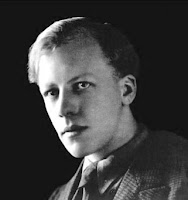
Alan Rawsthorne
The Four Bagatelles were written in 1938 for Gordon Green, a friend he had first met when he arrived in Manchester in 1925 as a future dentist, before dedicating himself to music. Green described him as “strikingly handsome: slim with blonde hair, pale complexion, exceptionally broad forehead and an oval face narrowing steeply towards the chin.... There was a hint of Modigliani about the head and the face was Chopin-like, but with a mouth even more firmly moulded than Chopin's and without the disfigurement of Chopin's too large aquiline nose. His conversation was the most alert I have known.” He also mentioned Rawsthorne was apparently enough of a pianist to perform Falla's Nights in the Gardens of Spain and Brahms' “Handel” Variations. In fact, in 1929, his predilection was for Brahms – many of England's late-19th Century composers were heavily influenced by Brahms – but after traveling in Europe and studying with the great pianist Egon Petri in Poland, one summer, then in Berlin, his stylistic interests changed to Bartók and Stravinsky. But the horizons were darkening – these are the grim years before World War II officially began – and soon, everything would change. At the time, Rawsthorne was living in London, struggling to earn a living and gain recognition as a composer. His first composition to make it into print was a Concertante (No. 2) for Violin & Piano in 1937.

As if the geography of Northwestern England wasn't a small enough world, one of Stephen Hough's teachers would be Gordon Green (who also, incidentally, taught John Ogdon). And Hough would include Rawsthorne's Bagatelles on a recording of English piano music twenty years ago.

Each of the Bagatelles is based on the same ten-note theme. “Just over a minute apiece, they manage to say much in little,” according to critic Sam Jacobson who reviewed Hough's performance of this program in Cincinnati in November of last year. “The percussiveness of the opening was tempered by the wistfulness of the succeeding piece, and the closing Lento was perhaps the finest in its languid nostalgia.”

* * ** *** ***** ******** ***** *** ** * *

More familiar names like Schumann and Chopin hardly need much of an introduction, nor does the music, familiar or not, need any help from me for you to better enjoy it. But given some of the “associations” between composers and artists and their influences, along with the Times They Lived In, let me mention that, Schumann wrote his suite of “character pieces” based on E.T.A. Hoffman's fictional kapellmeister, Kreisler – no relation, as some time-challenged people have assumed, to the violinist named Fritz – in 1838 and Chopin, his 2nd Scherzo the year before. 

For those who wonder if all these great names we hear on concert programs today ever had any connection in real life, Chopin was the artist Schumann the Critic hailed with the classic line, “Hats off, Gentleman, a Genius” (a comment usually assumed to be about young Brahms). While Chopin appears in the imaginary cast of another of Schumann's glorious suites, Carnaval, Schumann dedicated Kreisleriana to Chopin. The report is, after receiving his copy of the score, the only comment Chopin made about it concerned the design of the title page... (ouch). Still, the following year, after completing his 2nd Ballade (which he'd been re-working over a period of a year or two), he published it with a dedication to Robert Schumann.

In Schumann's collection of “character pieces” – the term ambiguously describes “a musical composition expressive of a specific mood or non-musical idea” as opposed to an abstract form or dance, whether it's a “rondo” or a “minuet” – he doesn't so much tell Hoffman's story about the mercurial musician, Johannes Kreisler (the subject of three novels he wrote before 1814), as depict in music his “various, often kaleidoscopic moods” reflecting the character's apparent bipolar personality. Given Schumann's own conflicts with mood swings that used to be called “manic-depression,” it's small wonder he was attracted to this character. He wrote to his future wife, Clara Wieck, “I'm overflowing with music and beautiful melodies now – imagine, since my last letter I've finished another whole notebook of new pieces. I intend to call it Kreisleriana. You and one of your ideas play the main role in it, and I want to dedicate it to you – yes, to you and nobody else – and then you will smile so sweetly when you discover yourself in it.” He reported that, basically, he wrote the entire suite in four days.

Though Martha Argerich may be a controversial choice (she usually is), I'll just post an excerpt, here, as an example of the opening character's manic nature with its lyrical contrasts. While Schumann avoids descriptive titles like those he uses in Scenes from Childhood, the opening tempo is marked Äußerst bewegt (extremely animated): too often it is so animated as to be out-of-control. The idea is that it should be almost out-of-control... (Not sure what J.M.W. Turner's painting has to do with it, but such is YouTube.) As with any music this dramatic, it would be impossible to tell you not to realize your own personal inner-cinema.


To continue with Mr. Jacobson's review: “In lesser hands, Schumann’s 35-minute Kreisleriana can meander and wander, but Hough’s reading was of singular direction and purpose in spite of the work’s kaleidoscope of moods. In the commanding opening, the darkly passionate material was given quite a workout. At times I found his tone a bit harsh, but this evened out as he better adjusted to the instrument he was provided. This is music of enormously wide contrasts, embodying the opposing Florestan and Eusebius personas Schumann crafted [in several of his works and writings], perhaps in reflection of his bipolar condition. Hough was keen to emphasize these contrasts, authentically capturing its mercurial temperaments. In the sharp rhythmic gestures that punctuated, Hough used limited pedal to yield a strikingly dry tone, saving the more liberal pedaling for the lyrical sections in the interest of further maximizing contrast. Another highlight came in the fugato passage of the penultimate movement wherein the pianist achieved a pointed clarity, in no way compromised by its breathless vigor.”

* * ** *** ***** ******** ***** *** ** * * 

Chopin has figured prominently throughout Hough's career, and his recent recording of the Complete Nocturnes, made during the Pandemic, has been winning a great deal of acclaim. Alex Ross, writing in last month's New Yorker, said that in the liner notes “Hough remarks the Nocturnes are a 'corpus of some of the finest operatic arias ever written.' The observation is hardly novel; Chopin’s love of bel-canto opera has been noted innumerable times. Yet I’m not sure if any pianist on record has fleshed out the link as thoroughly and as persuasively as Hough has.” After comparing Hough's to two other acclaimed recent recordings, he places him, ultimately, in the same company as “the robust elegance of the younger Arthur Rubinstein, the grandeur of Claudio Arrau, the fine-spun melancholy of Ivan Moravec, the vibrant lyricism of Maria João Pires, the unaffected poetry of the late Brazilian Nelson Freire. I have no hesitation about placing Hough in that company. On many moonlit nights, his version will be the one I reach for first.” 

(You can find the CD, here; and it's available for download from Hyperion where you can also sample each of the nocturnes.)

[Initially, every mention of Hough's program listed only "Two Nocturnes" with no two works specified: since he'd just recorded all of them, I supposed he would choose any two he felt like playing that night, but Ya-Ting Chang informs me he's doing these two: the F-Sharp Major Nocturne, Op. 15 No. 2 (here, with Yundi Li) and the E-flat Major Nocturne, Op. 9, No. 2 (another pianist/composer you might've heard of, here: Sergei Rachmaninoff), both composed in the early-1830s.]

“Character Piece” is certainly too weak a term to apply to some of Chopin's single-movement works of larger scope like his Ballades and Scherzos. True, they fit the definition as Schumann applied it (or perhaps as it's applied to Schumann), being non-abstract and ostensibly inspired by “non-musical” ideas. The term ballade refers to "a narrative poem created by a poet in imitation of the old anonymous folk ballad," especially popular in England early in the 19th Century, however Chopin viewed his use of it as a form of inspiration.

Supposedly, this particular work, composed in the summer of 1841, was inspired by a dramatic poem, Undine, subtitled Ballada, by Adam Mickiewicz, one of the greatest Polish poets of Chopin's generation. (During the last months of his own life, Chopin visited the ailing Mickiewicz and “soothed his nerves” by playing some of his piano music for him. Mickiewicz would live until 1855; Chopin would die in October of 1849.) 

The poem's title in Polish is Świtezianka. You can read Dorothea Prall Radin's English translation here, but be warned, she translates the water nymph, usually called Undine (or Ondine) in German or French, as “The Nixie.” She turns out not to be a playful sprite the young man encounters on the lakeshore of Świtez: 

"For a thousand years shall your spirit wait
  By the side of this witnessing tree,
And the fires of hell that never abate
  Shall burn you unceasingly.”

He hears, and he walks with a wandering tread,
  He gazes with wandering eyes;
Then a hurricane out of the deepwood sped
  And the waters seethe and rise.

They seethe to their depths and the circling tide
  Of the whirlpool snatches them down
Through its open jaws as the seas divide:
  So the youth and the maiden drown.

Incidentally, some think this poem was, instead, the inspiration for the Second Ballade, also full of suitably dramatic contrasts, which, as I mentioned, Chopin dedicated to Schumann in direct response to Kreisleriana's dedication to him. You can certainly listen to either Ballade as pure music, inner-cinema or not. Romanticism so often leads us poor mortals down many foolish, emotional paths: just because Beethoven referenced reading Shakespeare's Tempest while writing a certain piano sonata of his, people spend far too much time ascribing this theme to Prospero or that passage to Miranda and Ferdinand when, in fact, it may have been the sheer magic of the play's tale that inspired the composer to something purely musical rather than literally theatrical.

In this performance, Yundi Li is the pianist, recorded live in Carnegie Hall in 2016. 

Curiously, given the maddening ambiguity of musical terminology, when we see Scherzo, we think of the light-hearted and often earthy dances Beethoven used to replace the time-worn courtly minuet of the previous generation: it comes from the Italian for “joke.” But Chopin wrote four works he called scherzos. Rather than the usual expectation, an early editor described them as “gestures of despair and demonic energy.” When the first scherzo appeared in 1833, Robert Schumann, as one of Germany's most influential critics, wondered “How is 'gravity' to clothe itself if 'jest' goes about in dark veils?”

Of this particular piece written in 1837 (keep in mind, a year before Schumann wrote his Kreisleriana), Schumann compared it to a Byronic poem, "so overflowing with tenderness, boldness, love and contempt." One of Chopin's own students wrote the composer told him the renowned sotto voce opening was a question and the second phrase, its answer: "For Chopin it was never questioning enough, never soft enough, never vaulted enough. It must be a charnel-house." Hardly much of a joke...

I admit a fondness for Yundi Li's Chopin, so here he is again, this time from the Chopin Competition of 2000, with the Scherzo No. 2 in B-flat Minor.


* * ** *** ***** ******** ***** *** ** * * 

When the 2020-2021 Season was first announced, I was excited to see a pianist of Stephen Hough's caliber coming to Harrisburg, and dismayed when, understandably, the Covid-19 Pandemic and its ensuing lockdown postponed his recital, along with everything else. So what was the impact of all this on the life of the artist? While some of us may have perfected our procrastination skills, how did he occupy his time? What did he think about as he looks ahead to the future?

Here is an interview from Musical America's series, “One to One” with Clive Paget, recorded about a year ago, already one year into the Pandemic and just as he was resuming performances (the night before this was taped, he had performed Brahms' 1st Piano Concerto for a virtual concert with live musicians in a concert hall, but alas, without a live audience present).

To conclude, he says, considering one very important fact many of us became aware of at the end of that interminable first year, “...without the arts, you wonder 'well, why are we on the planet at all? – what's the point of living,' unless we have that nourishment. And whatever religious side or not you see to this, it's an ecstasy, it's lifting us out of ourselves, it's contemplation, it's transcendence. And I think we need to get that into the bloodstream of politics, too, so that our politicians say, 'you know, we need to put money into the arts because the arts gives us back more than we could ever possibly give it.'”  

And so, here we are, now hoping for whatever nourishment we can find in this second interminable year, still waiting for it to be over, whatever "normality," new or re-imagined, awaits us at the end of this labyrinthine tunnel.

- Dick Strawser 

Monday, January 3, 2022

Love Is a Cabaret, Old Friend: Tempesta di Mare and "English Orpheus"

1698 Publication honoring Henry Purcell as the English Orpheus

Who: Tempesta di Mare, Chamber Players from the Baroque Orchestra of Philadelphia; joined by members of Harrisburg's Gamut Theatre
What: English Orpheus, a light-hearted cabaret on the eternal theme of love, with songs and instrumental music by Dowland, Blow, Purcell and Handel, as well as poetry by Shakespeare and others ranging from the well-known to the less well-known.
When & Where: Wednesday night (Jan. 5th) at 7:30 at Market Square Church in downtown Harrisburg
COVID NOTE:  Mask-wearing is required to attend this performance regardless of one's vaccination status.
[Subscribers and patrons who may want to stay home, can request an audio and video recording of the performance by emailing info@marketsquareconcerts.org. The access link will be sent 10 days after the performance and will be available for 30 days. 
Best Regards,
Peter Sirotin & Ya-Ting Chang, Market Square Concerts Co-Directors]

= = = = = = =

Now that we have survived another Holiday Season, past Thanksgiving, Hannukah, Christmas, New Years Eve and are running headlong into the new and even more unknowable New Year of 2022 amid the on-going Pandemic, here we are with the first program of that New Year at Market Square Church on Wednesday Night, January 5th, at 7:30.

The program is billed as “A Cabaret of Love” called “English Orpheus,” its creative concept originated by the group's lutenist, Richard Stone. It will be performed by the “early music ensemble,” Tempesta di Mare Chamber Players, a Baroque orchestra from Philadelphia who take their name from Vivaldi's famous set of concertos subtitled “The Storm at Sea.”

Here they are, performing excerpts from a Handel Trio Sonata (Op.2, No.5):


Consisting of pairs of recorders and violinists, a cellist, a lutenist, a player of that curiously English Renaissance keyboard instrument called the virginal (see below), not to forget a tenor, the ensemble will be joined by two actors from Harrisburg's Gamut Theatre, Alexis Dow Campbell and Robert Campbell directed by Clark Nicholson, reading selected poems and texts associated with the theme of The Program.

Welcome: Overture: Symphony from Rinaldo – George Frederic Handel
Song: “Look down, harmonious saint” – Handel
Recitation: “Orpheus with his lute” from Henry VIII – William Shakespeare
Song: “Strike the viol, touch the lute” Henry Purcell
Interlude: Ground in G minor – John Blow
 
Love Sought & Denied: Recitation: “As Amoret with Phyllis” – Carr Scrope (accompanied by Praeludium – John Dowland)
Song: “Oh, turn not those eyes away” – Blow
Recitation: “A Hymn to the Moon” Mary Wortley (accompanied by A Prelude – Davis Mell)
Song: “Loving Above His State” (Poor Celadon) – Blow
 
Love Rewarded & Betrayed: Recitation: Sonnet 128 – Shakespeare (accompanied by “John, come kiss me now” – William Byrd)
Song: “Sweeter than Roses” – Purcell
Interlude: “The King of Denmark, His Galliard” – Dowland
Recitation: “A Hue and Cry After Fair Amoret” – William Congreve (accompanied by “Simple Simon” – Jacob van Eyck)
Song: “Sorrow, stay” – Dowland
 
Break-up & Consolation
Recitation: “Since there’s no help” – Michael Drayton
Song: “The Self-Banished” – Blow
Interlude: Sonata in Four Parts, No. 3, in A minor – Purcell
Song: “Music, for a while” – Purcell
 
Farewell
Prelude: “Farewell, an in-nomine” – Dowland
Recitation: Feste’s Song, from Twelfth Night Shakespeare (accompanied by “Feste’s Song” – traditional)
Song: “Now, oh now, I needs must part” – Dowland

And what better way of introducing the program than by quoting the notes by the ensemble's artistic directors, Richard Stone and recorder-player Gwyn Roberts:

= = = = = = =

From time to time Tempesta experiments with alternate approaches to presentation, like No Strings Attached (2008), staged operatic vignettes by Monteverdi and Handel acted out by bunraku puppets, or our talk show from the Telemann 360° festival (2017). One performance form that has long stood on our to-try list has been cabaret. We have no illusions on hitting the high bars that the likes of a Noel Coward or Liza Minelli could make out of an evening with their inimitable forms of cabaret. But we do hope that, in our own nerdy way, our one-act experimental presentation of spoken word, song and instrumental music will stand apart from the traditional, classical recital form, and possibly even turn out as a successful iteration of its kind.

We have programmed English Orpheus along an arc of emotional themes, without consideration of chronology or even of composer groupings. Our programming followed the dictum of Giulio Caccini (1551–1618), one of the founders of the movement that defined baroque music: “prima la parola”, words first. Lyrics that expressed the themes that buttress our arc took center stage, though all in settings by some of England’s best composers. 

We placed two restrictions on our programming. First, all the featured music had to be in English. Second, we limited the music to four composers—John Dowland, Henry Purcell, John Blow and George Frideric Handel—who were compared to the likes of Orpheus, Amphion and Apollo during their lifetimes. We allowed exceptions to the rule for the music that accompanies the recitations, such as “Simple Simon” and the song from Twelfth Night.

Orpheus and Amphion were more than musicians in classical Greek and Roman mythology; they were superheros, and music was their superpower. Orpheus’s singing charmed the king of the underworld to restore his deceased bride to life. Horace speaks of Amphion, who “built Thebes’ citadel, moved stones at the sound of his lyre, and set them where he wished with its charmed entreaty.” Both learned to play the lyre from Apollo, patron god of music. 

One “English Orpheus” acknowledgement for lutenist John Dowland (1563–1626) appears in the dedication of a pavane by the Landgrave of Hesse to “Joanni Doulandi, Anglorum Orphei” in the publication A Variety of Lute Lessons (1610). 

John Blow (1648–1708) and his one-time student Henry Purcell (1659–1695) were colleagues and lifelong friends. They borrowed material nearly exclusively from each other from the 1680’s onwards, with Blow more often the originator and Purcell the borrower. Poet John Dryden (1631–1700) called Purcell “our Orpheus”, while poet and orator George Herbert (1593–1633) marked Purcell’s death with the words, “thus Orpheus fell.” Of the teacher, Thomas D’Urfey wrote, “So whilst Apollo’s Race can Sing, / Great Blow will be true Musick’s King.”

Following the publication of Orpheus Britannicus (1698), a posthumous anthology of Purcell songs, Blow released a songbook of his own, Amphion Anglicus (1700). Blow knew that posterity would grant his friend the greater fame as attested by the parallel titles of the songbooks. The Orpheus/Amphion pairing reads as the master happily adopting the moniker of the less famous musical hero in deference to his stellar disciple. 

Written comparisons of George Frideric Handel (1685–1759) to Orpheus were a constant through his career, but perhaps the most iconic is by sculptor Louis-François Roubiliac (1702–1762), portraying a relaxed Handel, absorbed in thought while plucking the emblem of Orpheus, the lyre. This was England’s first lifesize statue of a living artist, a German who became a naturalized Briton, and was installed in Vauxhall Garden in 1739.

– Richard Stone & Gwyn Roberts

= = = = =

Here, tenor Jacob Perry joins the chamber players for Henry Purcell's "Strike the Viol, Touch the Lute" from his ode, Come Ye Sons of Art.

While ordinarily I would be writing about the historical context of a given composer and the various compositions on the program, in this case, given the concept of the presentation, let me give you a kind of vague time-line to place each person on the program, composer or poet, in some chronological context rather than in concert-order – a different layer of context – along with the various rulers of England for some additional historical placement. While we think of the Age associated with Elizabeth I's reign, even if we never get beyond Shakespeare, or that her successor James I brought about the “King James Bible,” it might also be interesting, without going into too great detail, to realize what was going on in between those decades of English history and the years that saw the Renaissance evolve into the Baroque and the heady days of Handel and his Water Music, as the Stuarts and the Restoration (with the execution of one king and the deposing of another) gave way to a string of Georges bringing us up to the time of the American Colonies. While this program begins musically with Handel, he is the last of the line, here, chronologically. And let's not forget that he died in 1759 when a three-year old boy named Mozart was only a few years away from writing his first compositions.

= = = = = = =

William Byrd – c.1539/1543-1623
Queen Elizabeth I – reigned 1553-1603
John Dowland – 1563-1626
Michael Drayton (poet) – 1563-1631
William Shakespeare (poet) – 1564-1616
Jacob van Eyck – (1590-1657)
King James I – reigned 1603-1625
Davis Mell – 1604-1662
King Charles I – reigned 1625-1649 (executed)
John Blow – 1648-1708
Oliver Cromwell's Republic – 1649-1659
Carr Scrope (poet) – 1649-1680
Henry Purcell – 1659-1695
King Charles II – reigned 1660-1685
George Frederick Handel – 1685-1759
King James II – reigned 1685-1688 (deposed)
Queen Mary II – reigned 1688-1694 w/her husband William of Orange (“William & Mary”)
King William III ruled alone until 1702
Mary Wortley (poet) – 1689-1762
Queen Anne (Mary II's sister) – reigned 1702-1714
King George I – reigned 1714-1727
King George II – reigned 1727-1760
= = = = = = =

Normally, in the modern-day world of Classical Music Programming and Standard Repertoire, we'd find ourselves limited to music from the time of Bach and Handel, through Mozart and Haydn in the 18th Century, from Beethoven and Schubert through the 19th Century, maybe a nod toward the 20th Century, and now taking more notice of our own times (at 22 years, the “New Century” isn't really that new any more, is it?).

So if we look at the basic dates on this program, we might consider it “Early Music” and lump it all together as “Old.” I've talked to many music-lovers over the decades who, enjoying Classical Music and often avid supporters of the Arts in the local community as they are, would be hard-pressed to think that Brahms and Mahler could overlap and even have known each other or that Mozart and Tchaikovsky weren't more than a few decades apart. If you, as I did, grew up during the Viet-Nam War and all this country went through during its course, it's sometimes confusing to realize that recent college graduates who weren't born then consider it all Ancient History. Perspective, like Time, is everything...

This program covers artists – beyond the ever-timeless Trad – whose careers ranged roughly between the 1550s and the 1750s. But that covers 200 years. So, from perhaps looking at these names and their more-or-less distant fame as being “limited” to Early Music and stereotyping them as more or less similar, let's imagine if the evening's repertoire consisted of music with a similar, more recent historical range. Instead, it could cover music from Mozart's “Haydn” Quartets to, say, Philip Glass's Koyaanisqaatsi. And how much variety is there in the music we listen to from those two centuries in between?

* * ** *** ***** ******** ***** *** ** * *

The Elizabethan Age: the 16th Century

The earliest-born of our personalities is the composer William Byrd whose actual birthdate is vaguely ascribed to somewhere between 1539 and 1543, give-or-take. Born during the reign of King Henry VIII, Byrd then would've been born somewhere before the king's marriage to Wife No. 4, Anne of Cleves, and around the time he'd married Wife No. 6, Catherine Parr. More important was his devotion to the Catholic Church, despite the turbulent on-again/off-again years of Henry's English Reformation and – overlooking the brief cameo of Henry's son, Edward VI, who became king when he was 9 and died at 15 – and Henry's two daughters, Queen Mary I (who was Catholic and married to the Defender of the Faith, Philip II, King of Spain), and then the enforcement of anti-Catholic measures during the reign of Anne Boleyn's daughter, Queen Elizabeth I. At times, simply being Catholic meant automatically you could be considered an Enemy of the State.

In 1572, Byrd became a member of the Chapel Royal, a body of musicians who accompanied the court and saw to the rulers' spiritual needs – and yet it was during the 1570s that his involvement with the Catholic church evolved. He composed a great deal of religious music, much of which had “a strong Catholic undercurrent” which, along with his associations with prominent Catholic families, got him suspended from the Chapel in the 1580s, placed on a watch list with his house frequently searched.

Perhaps to curry favor with the Protestant aristocracy, he turned to instrumental music for keyboard (such as the virginal) and for viols; and published two books of secular songs – “consort music” – for voice or voices with the accompaniment of a “consort” usually of viols. Yet later, in the 1590s, he also wrote three settings of the Catholic mass while still writing works for the Anglican service. The creator of at least 470 compositions, Byrd clearly was a complicated man who lived in complex times and yet managed to, in the long run, having lived into his 80s, become regarded as one of the greatest musicians of his day and one of the leading composers of the English Renaissance.

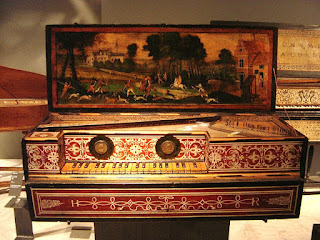
(By the way, what exactly is a “virginal”? Given Elizabeth I as The Virgin Queen, does the instrument's name refer to its pure, chaste sound or that it was intended to be played by demure young ladies to wile away the hours at home? Actually, sorry to disappoint: it's from the Latin virga or rod, referring to the mechanism by which a rod attached from the end of the key to a plectrum (or “jack”) then plucks the string. The instrument was placed on a tabletop; later, legs were added to create a larger, more resonant instrument. Popular especially in England during the Renaissance, it was a “private” instrument since its sound often could not reach the opposite side of a room, much less work in a concert hall – keeping in mind, in those days, concert halls did not yet exist. The term “virginal” could also be applied loosely to any keyboard instrument, whether harpsichord, clavichord, or “spinet.”)

Flemish virginal on a grand scale, 1583

Of course, nothing says “Elizabethan Age” like the name, William Shakespeare, undoubtedly the most famous writer – poet and playwright – in the English language. And yet we know so little about him, actually; and what we do know – like, what is that bit about the “second-best bed”? – is not only vague but mysterious for someone so famous. Given the program, I'll mention that the three works representing him were written between 1601 and 1613, spanning the last years of Elizabeth I's life and the start of her successor's reign, James I. By the way, James was the son of Elizabeth's primary rival, her cousin Mary Queen of Scots, whom she had had executed for plotting to overthrow her: did those who first saw Macbeth in 1606, only a few years after Elizabeth's death, see the three witches' prophecy that Banquo's children would become kings of Scotland following his murder as political commentary on the children of Mary Queen of Scots now becoming Kings of Scotland and of England?

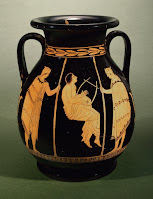
Orpheus Vase, 430 BC
Anyway, the famous song-text “Orpheus with his Lute” opens the third act of the play Henry VIII which was first produced in 1613, over sixty years after the death of the historical king and just ten years after the death of his daughter Elizabeth. The scene begins with Queen Catherine of Aragon commanding one of her ladies to sing a song that might disperse her sadness.

= = = = = = =
Orpheus with his lute made trees
And the mountain tops that freeze
Bow themselves when he did sing:
To his music plants and flowers
Ever sprung; as sun and showers
There had made a lasting spring. 
 
Every thing that heard him play,
Even the billows of the sea,
Hung their heads and then lay by.
In sweet music is such art,
Killing care and grief of heart
Fall asleep, or hearing, die.

= = = = = = =

It is a text that would inspire many musicians in future centuries, the perfect evocation of the legendary Orpheus of Greek mythology and of the power of music. And it will appropriately be followed by a work by Henry Purcell who was memorialized as “The British Orpheus” by his own colleagues when he died at the end of the 17th Century.

Shakespeare's “Sonnet 128,” from a set first published in 1609, deals with “The Dark Lady” whom the narrator (presumably but not necessarily the poet himself) observes playing the keyboard instrument known as the virginal, “captivated by her back swaying with the melody. Like Romeo [in the play of 1597], he longs for a kiss, but in this sonnet he envies the jacks (wooden keys) that the lady's playing fingers "tickle" while trilling the notes. Perhaps he also envies the other men (Jacks) standing around the lady. Surely, this is an amusing scene to the narrator because he secretly is having an affair with the dark lady. He decides not to envy those keys—although he would like to be tickled as they are—but hopes instead to receive a kiss on his lips.” Suitably, this recitation will be accompanied by William Byrd's set of variations on the traditional song, “John [another Jack?], come kiss me now.”


The play Twelfth Night is a comedy set on the festival that ends Christmas' twelve nights (back in the days when Christmas began on Christmas Day and, golden rings and leaping lords aside, they weren't hoisting dead, dried-up trees, now devoid of decorations, out to the curb on December 26th and putting away the holiday music for another year). Twelve drummers notwithstanding, the festivities were dominated by a Master-of-Ceremonies called “The Lord of Misrule.” And so the play appropriately “combines love, confusion, mistaken identities, and joyful discovery,” however improbable the theatrical conventions make some of those details seem to us. Written around 1600 or so, it was first performed publicly on Candelmas, Feb. 2nd, 1602 (the official end of the Christmas Season), but reportedly performed privately at Queen Elizabeth's 12th Night celebration at Whitehall Palace on January 6th, 1601. (Incidentally, while she died in 1603, Elizabeth's health did not begin to decline dangerously until 1602. One hopes the old girl – she was only 69 when she died – enjoyed these revels.)

(Speaking of misrule, if you are a fan of that odd-ball BBC comedy seen locally on PBS, Upstart Crow, Shakespeare's complicated artistic life as well as what one might guess about his personal life is often lampooned to the point of absurdity but, the more I watch it, I wonder, conjecture aside, how close to the truth it might be? In one episode, Will realizes he needs to bring in the adoring crowds, and so should “invent the musical,” coercing the popular singer Thomas Morely into supplying some tunes. Keep this in mind as you read through this next bit about another popular musician of Shakespeare's day. Imagine one of of those what-if brain-storms where John Dowland could write the songs for Shakespeare's Taming of the Shrew: The Musical? Perhaps far-fetched but also possibly closer to the truth than we might think. Not that Shakespeare ever wrote a musical comedy, but music – both songs and dances – had a prominent role in his plays, as did, for instance, bits of comic relief in the midst of his tragedies (just think of the porter's brief monologue, answering the castle gate immediately following the murder of the king in Macbeth!)

Certainly, one of the most popular musicians of the era was John Dowland. An exact contemporary of Shakespeare, his career found him working for a British ambassador in Paris in the 1580s where he converted to Catholicism – like Byrd, this also caused some trouble politically (was his application for an appointment to the Court of Queen Elizabeth denied because of his religion?) but he was not as open about his religious practices as many others. In 1592, he became a lutenist to the King of Denmark who so enjoyed his music, he paid Dowland an astronomical salary, making him the highest paid courtier in Copenhagen. But he apparently abused his popularity there and was dismissed in 1606 as “not an ideal servant” and returned to London. He had been publishing his music in London from the 1590s on, despite living in Denmark, and though he became a lutenist at the Court of James I in 1612 – around the time Shakespeare's Henry VIII – not much music exists from his last decade or so. His last paycheck from the Court was dated January 20th, 1626, and his burial was recorded on February 20th.

Like Christopher Marlowe, another great playwright and contemporary (and friend) of Shakespeare's, Dowland, despite his religion, was employed as a spy by Elizabeth's minister, Sir Robert Cecil, who had developed the equivalent of a Secret Police and espionage network for the Royal Court (he was the one who uncovered the infamous Gunpowder Plot of 1605, intent on blowing up Parliament and assassinating the new king). As a Catholic at the Court – even the Queen called him “a man [fit] to serve any prince in the world, but [he] was an obstinate Papist” – Dowland was occasionally on the receiving end of bribes and plots from exiled Catholics on the Continent bearing money and guarantees of safe-passage from the Pope, but he remained loyal to his Queen.

His primary musical influences were the popular dance music of the day and the sad “consort songs” that often brought his audiences to tears, despite his being a generally happy personality, himself. In this sense, he was much like a “rock star” today, writing more for fame (and fortune), perhaps, than, like William Byrd or John Blow, as an artist. Even Shakespeare, while writing his tragedies and histories, was mindful of the need to “bring in the audience” with his comedies like 12th Night or The Merry Wives of Windsor.

Michael Drayton, another contemporary of Shakespeare's, published a volume of spiritual poetry in 1590 that earned a public order from the Archbishop of Canterbury that it be destroyed, and only 40 copies survived (not a great review). Nonetheless, he published sixty-four sonnets in 1594 under the title, Idea's Mirror, of which No. 61, “Since there's no help,” has become his most famous work. His “smooth style” foreshadowed several of the later Elizabethan poets: and keep in mind, Shakespeare's sonnets were published in 1609, some 15 years later.

* * ** *** ***** ******** ***** *** ** * *

The 17th Century, an Age of Execution, Republic, and Restoration

In an age when kings believed themselves ordained by God – the “Divine Right of Kings” – King Charles I, son of King James I, was overthrown and executed following a series of Civil Wars, a very complex and violent period of English history. During the subsequent ten years of Republican rule, Oliver Cromwell, leader of the Puritan opposition, became a virtual dictator, and even after his death, it took two more years, his son following in his footsteps, before the Republic was overthrown and Charles I's son was brought to the throne as Charles II in 1660, beginning an age known as “The Restoration.” The age also saw two disasters in quick succession: The Great Plague of London in 1665 in which, at its peak, 7,000 people died in one week; and the Great Fire of London the following year, destroying over 13,000 houses including 82 churches.

Our next composer, chronologically, John Blow was born less than a month after Charles I was executed; and the little-known poet and courtier, Carr Scrope, about eight months afterward. Both went on to positions in the reign of Charles II, his brother, James II (who was deposed but managed to escape to France), and James' daughter Mary II (ruling with her Dutch-born husband, William of Orange).

Scrope, a minor aristocrat, was a courtier of short stature but “great wit” who “wrote with ease” and was popular among those hanging out with the glib King Charles II in London. While today, anyone who maintains a blog would consider himself a writer (ahem...), in those days, anyone who could put clever words into clever lines considered himself a poet. (One source described him as a "versifier" which is to "poet" what "fop" would be to "fashion icon.") Beyond being the butt of satire from rivals out to discredit those popular with the King, Scrope is probably best known for not much of anything. Perhaps the most interesting thing about him might be the fact he was buried in 1680 in the church, St. Martin-in-the-Fields, belovéd of 20th Century music lovers for its musical association with the Academy, a chamber orchestra which, over the decades, seemed to have recorded the complete works of just about everybody under the legendary Neville Marriner.

While the Elizabethan Age included many illustrious names among its dramatists, poets, and musicians, there are tons of (to us) unknown names for every famous one, whether it's Dowland, Byrd, Shakespeare or others too many to represent on such a program. Suffice it to say of Davis Mell, he was a clockmaker and a violinist, good enough to have not only played in the King's “Four-and-Twenty Fiddlers” (Old King Cole aside, copied from the French court's similarly numbered band) during the reigns of both Charles I and Charles II, but also to have led the ensemble for a while. A number of the pieces he wrote for the kings' entertainments were published in 1659.

John Blow is far more important, even if today he is remembered more for his association with Henry Purcell. He was an organist at Westminster Abbey (where he is buried) – he retired to make way for his student, Purcell – and later became a member of the Chapel Royal to Charles II and music teacher to the royal children (an odd position considering Charles had no legal heirs but a dozen illegitimate ones). Blow's masque – an early not-quite-a-modern opera – Venus and Adonis was staged in 1683 (in which Charles' current concubine sang the role of Venus, and her daughter by the king appeared as Cupid); in 1685 he became “one of the private musicians” to King James II. He became the choirmaster at St. Paul's and later returned to Westminster Abbey; in 1700, he became the newly-created Composer (-in-residence) to the Chapel Royal under William III (Mary II's surviving husband). He wrote over a dozen settings of the Anglican service plus more than a hundred anthems, fifty songs, and thirty odes for royal occasions. But he is best known for Venus and Adonis and the influence it had on Henry Purcell who composed what is arguably the first opera in the English language, Dido and Aeneas (and still in the repertoire today), no later than 1688, about five years after his teacher's work.

And so, a brief discourse on Henry Purcell, undoubtedly the greatest English composer before... well... considering Great Britain's lack of producing anyone comparable to Mozart, Beethoven, Wagner or Brahms which led Richard Strauss to call England “the land without music”... And if Benjamin Britten who died in 1976 was considered the “first internationally acclaimed British composer,” Henry Purcell is in rare company as the “Greatest English Composer” before the 20th Century and the likes of Elgar, Vaughan Williams, Holst, and William Walton as well! And it was Britten's love of Purcell's music – not just his “Variations on a Theme of Purcell” better known as “A Young Person's Guide to the Orchestra” – that brought Purcell to the attention of a much larger, modern audience.

Purcell was born in the slums of London in 1659, the middle of three sons. His uncle was a chorister in the king's Chapel Royal and who, after Purcell's father's death, took charge of the boys' education (Daniel, the youngest, also became a prolific and respected composer in his own right). Henry, according to legend, began composing at the age of 9, and, after attending the Westminster Abbey school and studying with John Blow, wrote his first setting of a psalm (for Christmas Day) which was performed when he was 19. Despite dying at the age of 36 – eight months after writing music for the funeral of Queen Mary – Purcell has a catalogue listing some 860 works. He was buried next to the organ in Westminster Abbey and lauded by his colleagues as “Orpheus brittanicus,” The English Orpheus.

In addition to Dido and Aeneas, he composed a great number of masques, odes, and incidental music for stage plays. Among his instrumental works are several trio sonatas – confusingly listed as “sonatas of three parts” and “sonatas of four parts” even though they're all “trio sonatas” meant to be played by four musicians (two violins and continuo which consists of two players, a cellist and a keyboardist, normally with a harpsichord or organ, hence four performers).

The Trio Sonata No. 3 in A Minor, from the second set (“Ten Sonatas in Four Parts”), is the earliest work by Purcell on the program. All twenty-two of these sonatas were written around the same time, about 1680, though not published until 1683 with a dedication to the king, Charles II. Purcell was greatly influenced by musical trends in France and Italy, though he never traveled there himself. While the earliest trio sonatas, for instance, date from 1607 with the Venetian Salamone Rossi, it is quite possibly Arcangelo Corelli's various sonatas that provided the impetus for Purcell to add a particularly English touch to the genre. Even though Corelli's weren't published until 1683, we know they were written by 1681, possibly earlier and may have been “hot-off-the-copyist's desk” arriving in London with some traveling musicians. It's not inconceivable that, impressed by this new style, Purcell was immediately inspired to examine the possibilities for this combination himself. Of course, there could have been other sonatas by other composers he'd come across earlier, but the opportunity for such cross-fertilization is not uncommon in the musical world. Bach, after all, was inspired by the discovery of concertos by Vivaldi and went and “did likewise.”

Each sonata is usually a collection of short movements, often continuous. One, my favorite, the G Minor sonata from the Set in Four Parts(Z.807), is a single-movement chaconne, not to be confused with the “Chaconny” also in G Minor (Z.730). Here is the one on the program, the sonata in A Minor (Z.804):


Of the “songs,” the earliest of the three on the program, “Music, for a while,” comes from the incidental music for the play Oedipus, written in 1692. “Strike the Viol, Touch the Lute” is part of the 1694 ode, Come, Ye Sons of Art. And “Sweeter than Roses” is a song from music for Richard Norton's play Pausanias, Betrayer of his Country about the Spartan general killed by his own people for his treachery. While Purcell and others may have contributed a great deal of music, instrumental and vocal, for certain plays, so much so they were sometimes referred to as “semi-operas” – (originating as a play to which music is added and, in many cases, filled in, would these constitute Upstart Crow's reference to “the first musical”?) – in the case of Pausanias, Purcell provided only one song and one duet for the 1695 production just months before he died.

William Congreve, born in 1670, and recognized as a leader of “Restoration Comedy” and especially the “Comedy-of-Manners,” bridges the gap into the new century: Purcell supplied incidental music for the 23-year-old Congreve's first play, The Old Bachelor, in 1693 (in this case, 9 dances and two songs). Described as a “sexual comedy of manners,” the play was a huge success, running for an unprecedented two-weeks at the Drury Lane Theater. I cannot find a date for the poem representing him on this program – “A Hue and Cry after Fair Amoret” – but he may be more familiar to us today through two famous quotes most often attributed to Shakespeare (as a teacher of mine said, “if a quote doesn't come from the Bible, it's probably Shakespeare”): (1.) usually rendered as something like “Music hath charms to sooth the savage breast” (though, given the image of Orpheus winning over the spirits of the underworld with his music, “savage beast” may be understandable if not simply a more prudish substitution) and (2.) likewise slightly misquoted, “Hell hath no fury like a woman scorned.” Both originate in his 1697 tragedy, The Mourning Bride. He is also credited with originating the expression “you must not kiss and tell,” a line from his comedy, Love for Love, first produced in 1695. Though he lived until 1726, he essentially retired in his mid-30s to rest on his laurels.

(Incidentally, Jakob van Eyck, who's setting of “Simple Simon” accompanies Congreve's poem, technically belongs to the Elizabethan Age, born in 1590, and is not technically British. A Dutchman and blind from birth, he was a carillonneur, organist and recorder player who in 1644 published a collection of 143 pieces for recorder called “The Flute's Pleasure Garden,” ranging from arrangements of dance tunes and folk songs to several original works, including a set of variations of John Dowland's “Flow my Tears.”)

* * ** *** ***** ******** ***** ** * *

The 18th Century

And so, Purcell's death and Congreve's retirement bring us to a new century and a new shift in England's history, both political and cultural. With the last of the Stuarts, Queen Anne who was Mary II's sister had, like Elizabeth I before her, no immediate heirs (despite her seventeen pregnancies) and so the crown descended to her German cousin, George the Elector of Hanover who became King George I in 1714.

The story of George Frederic Handel (or Georg Frideric Händel) is much too involved for a short survey like this, so let me stick to a few pertinent facts. Born in Germany, he is technically not a British composer, though the majority of his career was based in England. And how could anyone who wrote The Hallelujah Chorus not be English?

After being appointed to the court of the Elector of Hanover in 1710, Handel almost immediately took a leave-of-absence to study in Italy, granted begrudgingly with certain conditions. It didn't win him any favor with his German employer when he decided he would follow up on an invitation to visit London where he produced his opera, Rinaldo, in 1711. A setting of a popular story set in the First Crusade and involving a tale of love, war, redemption, and a good deal of magic, it was a huge success, and so Handel decided to stay in England and seek his fortune there, reneging on his agreement with the Elector. If you consider what today we might call karma, how impossibly small the world must have seemed to the young Handel to find, in 1714, just a few years later, that, on the death of Queen Anne (despite having had seventeen pregnancies, she had no heirs), the crown went to her German cousin, George the Elector of Hanover – Handel's former boss. Hence the famous story of his writing The Water Music in 1717 as a way to regain the new king's favor.

Written later in his career, during the reign of George II, Handel's song “Look down, Harmonious Saint” became a short secular cantata in 1736 (setting a text from an Ode to St. Cecilia, the Patron Saint of Music). It may have been originally intended for the choral ode, “Alexander's Feast,” but was added to the “Feast's” 1736 Covent Garden performance when the latter proved too short for a full evening's entertainment. It famously also required a number of instrumental concertos inserted into the lot to make a complete go of it.

Chronologically the last of our creative personalities on the program is also the token female on the list – not surprising, given the times and culture, despite the number of queens who ruled England during these years. Mary Wortley (a.k.a. Lady Mary Wortley-Montagu) – a name I was completely unfamiliar with until I saw this program's musical menu – had in her day a presence far more interesting to our own than one might expect, given the slender verse by which she's represented, so please excuse the digression.

While she was a girl growing up in her family's grand houses, she gave herself an education usually denied women by sneaking into the family library and “stealing” her education “away from the eyes of a despised governess. By the time she was 16 she had written two volumes of poetry, a short novel, and taught herself Latin.”

In London, she became a “popular socialite” at home in both of the “mutually hostile” courts of the present king, George I, and his son, the future George II. In 1715, she contracted smallpox and nearly died – her brother did not survive. The following year, her husband was appointed the British Ambassador to the Ottoman Empire.

Writing over the history of these years, I was struck by a few facts given our own time today. As we approach the anniversary of the “Attack on the Capitol” on January 6th, I am reading about Elizabeth's house spy Robert Cecil who uncovered plans to blow up Parliament in the Gunpowder Plot of which Guy Fawkes, in charge of the explosives was only one of a dozen named conspirators attempting to assassinate James I and place his 9-year-old daughter on the throne as a Catholic queen. There was the Great Fire of London in 1666, which I'm reading about while watching news reports of the fire in Boulder, Colorado; and of course the Plague of 1665 as we continue to reel our way into a third year of the Covid-19 Pandemic. But this, I must admit, is the strangest and most unexpected parallel which I cannot help but mention:

While living in Constantinople, Lady Mary Wortley-Montague's own family was afflicted by smallpox and she “was pleased to discover inoculation against smallpox was widespread in the Ottoman empire. The method was to introduce the smallpox virus to an uninfected person, thereby providing immunity from the disease. Lady Mary had the British Embassy’s surgeon inoculate her young son.

“Back home in 1721, while a global smallpox epidemic was killing people from Britain to Boston, she had him inoculate her daughter (born in Turkey), and publicized the benefits of inoculation against bitter hostility, including physical violence. Opponents of the procedure derided it as oriental, irreligious, and a fad of ignorant women, so Lady Mary's fame for it was both mixed and short-lived.”

While art may be timeless and inexplicably connect us through the ages, there is also something to be said for history (especially since Art is not created in a vacuum), even if it's only an adaptation of another quote about history repeating itself (whether we ignore it or not). It may be a more serious note to end this post, considering the cabaret nature of the program and its focus on love, and the parallels between The British Orpheus and the figure of Greek Mythology – let's not forget, in the end, Orpheus was torn to pieces by a band of roving (not to mention, raving) Maenads, his body parts thrown into the river, his head continuing to float downstream, still singing. After all, music also has the power to bring us together and give us strength and hope.

- Dick Strawser