Wednesday, March 10, 2021

The Verona Quartet and Beethoven's Op.131: Classical Music's This Week Ahead

This Sunday, March 14th, isn't just the day you set your clocks ahead for Daylight Saving Time. It's also the day you can attend a concert by the Verona Quartet at Whitaker Center at 4:00 EDT (that's Eastern Daylight Time). Returning to Harrisburg following their 2017 appearance here with Beethoven's 2nd "Razumovsky" Quartet, they're now here as winners of the latest Cleveland Quartet Award and performing Beethoven's C-sharp Minor Quartet, Op.131, along with some of the "Cypresses" of Antonin Dvorak and the 2nd Quartet by Karol Szymanowski. 

For more information about Covid-19 protocols and ticket availability, check the Market Square Concerts website. 

The Verona Quartet

I've written about these last two works in the next post, but in this one, we'll focus on one of those legendary Late Quartets Beethoven composed in the last years of his life.

For a live performance of the complete Op.131 with the Danish Quartet (courtesy of the Chamber Music Society of Lincoln Center), you can scroll down to the bottom of the post if you not interested in reading the post itself.

And now for something completely different...

* * ** *** ***** ******** ***** *** ** * *

Announcer's Voice [off-camera] – When we think of the Pandemic and all its effects on our daily lives, one of the many things we may not have considered is the rather hefty impact it's had on the International Beethoven Year, which officially began with his 250th Birthday Anniversary on Dec. 16th, 2020, though many institutions had begun playing his music even more than usual throughout the year. With this month's concert by the Verona Quartet, since it includes a work Beethoven himself thought his “most perfect single work,” this edition of the Market Square Concerts Blog will be our Mini-Beethoven Celebration. So join us, now, as Dr. Dick talks about "Beethoven's Op.131" with his guests on CLASSICAL MUSIC'S THIS WEEK AHEAD.

Dr. Dick – Thanks, and thank you for joining us. So I thought we'd gather a few people here for a kind of socially distanced round table about Beethoven and his Late Period in particular and his C-sharp Minor Quartet, Op.131 specifically.

A few years before all this 250th Anniversary business began – Beethoven hardly needs a Big Anniversary Year to get lots of attention – critic Alex Ross wrote in the New Yorker Magazine that “Beethoven is a singularity in the history of art—a phenomenon of dazzling and disconcerting force. He not only left his mark on all subsequent composers but also molded entire institutions.”

He goes on to describe how the orchestra developed because of the symphonies Beethoven had composed, so different in content and the necessary technical skills required in his teacher Haydn's days. Or how the string quartet changed from the 18th Century idea of a violinist with three other string players to four players on a more equal footing, thanks to Beethoven's technical demands on the individual players and on the ensemble's need to play as one unit. 

Herr Beethoven, thank you for taking the time to join us. Did you ever think, when you were composing these works, what impact they might have on the future of music?

Ludwig van Beethoven [peering into the camera] –

Dr. Dick [aside to technician, off-camera] – (Can someone tell Beethoven to unmute himself?)

Beethoven [looking around] –

Dr. Dick – Well, okay then. Maestro – may I call you "Maestro"? – if you had one thing you'd want to tell a listener to your C-sharp Minor Quartet 250 years after you were born, what...? Oops [Beethoven's screen goes blank]...

So, uhm... let's begin instead with Jan Swafford who's written a wonderfully readable biography of Beethoven that, even at 940-some pages, I admit, is still not as “complete” about some things as I'd hoped. In addition to putting the facts of his life together, or as much as any biographer can do these days, you offer many wonderful insights into the man and the Genius we, today, regard him to be.

Dr. Swafford, what is it that led Beethoven to what we call his “Late Period” which includes works like the 9th Symphony and these five amazing string quartets?

Jan Swafford – I'm sure I could write another 900 pages just about that alone, especially thinking about Beethoven and his Legacy in this, as you put it, Beethoven Year That Didn't Really Happen...

Dr. Dick – So, what kind of impact did these works have on composers, on audiences in the future?

Swafford –

Dr. Dick – That's something most of us today would probably agree with: “He was after something else.” And the question is still open.

Ludwig Spohr, one of the most popular composers of the early-19th Century, a contemporary of Beethoven's, wrote about a performance he was giving of one of the Late Quartets, back when they were still new, and he realized he was losing the audience. As he put it, “his accompanists” clearly didn't understand this complex music. So he stopped the performance and suggested instead they play one of his own quartets – to a much better effect.

Johannes Brahms – If he's considering the other three players “his accompanists,” perhaps he was the one who didn't understand this music... (He had called them 'indecipherable, uncorrected horrors,' remember...)

Dr. Dick – And anybody who's attended classical music concerts, read program notes or music appreciation books will know the story of Johannes Brahms and the impact this “tread of the giant behind him” had on his own development as a composer. Welcome, Herr Brahms! Now, the influence of Beethoven inhibited your own development as a composer, leaving you struggling for over twenty years over what would become your first symphony.

Brahms – Ja, and not just that symphony – also, my first string quartet and what had started out to be my first piano quartet, too (it finally got published third). Each of them over twenty years in the oven, waiting...

Dr. Dick – What was it that... well, affected you so strongly about his music?

Brahms – Well, look at it this way, I could've been like every other young composer coming down the pike, then, and written a whole bunch of symphonies trying to figure out how you write a symphony. These days, I think you folks call it “on-the-job training”? When you have a friend of yours calling you Beethoven's Heir – [a visible shudder] – that really does a number on your self-confidence. Nothing was going to be good enough.

Richard Wagner – (grumbling) Still wasn't...

Dr. Dick – Ah, Herr Wagner, thank you for joining us. I was trying to find that statement you wrote about Beethoven's Op.131 String Quartet back in 1870...

Wagner – Oh, that old thing? That was for his Centennial Year and, yes, I was asked, as one of the greatest living composers of the modern day to say a few words about the greatest composer of an earlier age. Let me think... [clears his throat] oh, yes...

= = = = = = =

“Tis the dance of the whole world itself: wild joy, the wail of pain, love's transport, utmost bliss, grief, frenzy, riot, suffering, the lightning flickers, thunders growl: and above it the stupendous fiddler who bears and bounds it all, who leads it haughtily from whirlwind into whirlwind, to the brink of the abyss - he smiles at himself, for to him this sorcery was the merest play - and night beckons him. His day is done.”

= = = = = = =

Brahms – A tad over the top, as usual, Herr Wagner, just as I'd expect from you... Always good for a healthy dose of hyperbole, our Richard...

Wagner – (Ah, what was that, Cosima?) Sorry, I have another cake ready to come out of the oven... Gotta go. [screen goes blank]

Brahms – (Oh God, please not another prequel to The Ring...?)

Dr. Dick – That reminds me of something else Alex Ross wrote in that article, that “the joy of listening to Beethoven is comparable to the pleasure of reading [James] Joyce: the most paranoid, overdetermined interpretation is probably the correct one.”

Brahms – Can't say I've ever had the pleasure of reading Mr. Joyce. Any good?

Dr. Dick – Wagner also said the opening fugue – and Wagner was never one to be kindly disposed toward fugues – the first movement of Beethoven's C-sharp Minor Quartet "reveals the most melancholy sentiment expressed in music.”

Oh good, I see Franz Schubert has been able to join us... You were another composer greatly influenced by Beethoven, especially his late music... and a contemporary of his. You were even a pallbearer at his funeral in 1827. What I find fascinating is, at the time (this would be, say, starting in 1824), he was still writing these Late Quartets when you were already working on expanding your own sense of structure and development of content in those last symphonies, string quartets and piano sonatas of your own.

Franz Schubert –

Dr. Dick – Umm... Herr Schubert, you can unmute yourself now?

Schubert – Hmm? Oh... okay, is that it? ...Right, well, things for me changed even before those quartets. I remember how many of us young composers hated stuff like his 7th Symphony, back when we were teenagers and studying with Salieri.

Dr. Dick – Yes, you wrote some not very flattering remarks in your journal at the time...You mentioned "eccentricity which combines and confuses the tragic and the comic, the agreeable with the repulsive, ...so as to goad people to madness instead of soothing them with love, to incite..."

Schubert – Okay, cut me a break. I was like 19 and still writing like Haydn. There were those who'd wished Beethoven never stopped writing like Haydn, for that matter, but we all eventually, if we're honest, move out from under the past to find our own voices, I think. I know that's what I started to do when I was 25...

Dr. Dick – With the B Minor Symphony, the one you left unfinished in 1822? Followed by the Wanderer Fantasy?

Schubert – Illness can do that to you, make you think the Deep Thoughts. And Beethoven was always sick then and had become almost totally deaf. I mean, how could he write the 9th Symphony when he couldn't hear what he was playing on the piano? The image had a very profound impact on me, just like the music he was composing, now – so different from before.

Dr. Dick – You'd composed your own last quartet, the G Major (we call it D.887), at the same time Beethoven was writing the last two of his Late Quartets in 1826 – but except for Op.127, they weren't published until a year later, the year Beethoven died. Yet you were actually one of the first people in Vienna to hear the Op.131 Quartet, weren't you?

Schubert – Speaking of illness... Yeah, I'd heard about it but it wasn't being performed in public, yet, not in Vienna. And Karl Holz, a friend of mine, was a friend of Beethoven's too – he told me Beethoven himself had told him this was his favorite of these quartets. Since he played 2nd in Schuppanzigh's Quartet (they were playing it privately at the time), I asked him – Holz – if I could hear it, but I was too sick to be moved. So they made a house call. It made a hugely powerful impression on me, very haunting...

Dr. Dick – What kind of inspiration did it give you, this amazing music?

Schubert – I remember saying something like “after this, what is left for us to write?” But after all, I died five days later, you know...

Dr. Dick [trying not to say something sentimental like "Sorry for our loss"...] – It always surprises me that the opening of Op.131 is this slowly unwinding fugue, so unlike the tempest of the Grosse Fuge he'd written shortly before starting this one. Such a complete opposite of mood and expansiveness that...

Schubert – Well, Beethoven was never one to write the same thing twice [he reaches for another beer], even if the first four notes of the subject – the theme, you know – are the same, just transposed and in a different order. And Stravinsky said the Grosse Fuge was “an absolutely contemporary piece of music that will always be contemporary,” something like that. I forget who it was was arguing one night that Beethoven invented atonality with that one...

Dr. Dick – Wait, you know about atonality and Stravinsky?

Schubert – Oh sure, we all hang out at that tavern he runs – kind of a Club Après-Vie... Ooops, gotta go – don't want to miss Last Call. [screen goes blank]
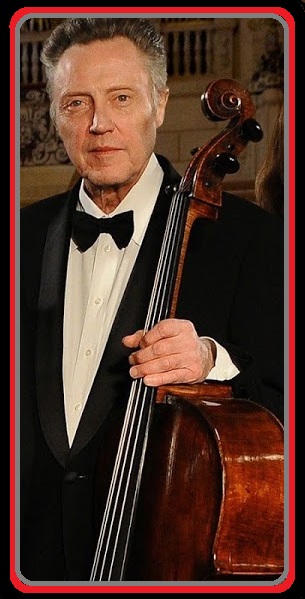
Dr. Dick – Ah, okay, well, thank you, Franz, for those wonderful insights. My last guest, now, might come as a surprise...

Christopher Walken – Why, because I'm following a bunch of dead composers...? Oh, sorry, thought the mute was on...

Dr. Dick – Well, considering the wide range of roles you've played in movies throughout your career, finding you as a cellist in a movie where the real main character is Beethoven's Op.131 – yeah, I think that'd be kind of surprising? Here's the trailer for A Late Quartet before its release in 2012.

= = = = = = =

= = = = = = =

I know I enjoyed the film – I mean, what classical musician wouldn't want to see an intelligent, decently made, well-acted, and knowledgeable film about classical music that isn't full of idiotic Hollywoodisms – though I tend to agree with one critic, the guy in The Guardian who wrote, “The actors play Beethoven like they're embalming a corpse, approaching the music far more reverently and glumly than real musicians do.” Don't musicians, especially old friends – even ones occasionally at odds with each other – joke around backstage before going out and playing seriously?

Walken – Well, you know what Beethoven said to one of his critics: “What I shit is better than anything you have ever thought.” No – the truth is that no matter what the movie is about, when good actors get together there’s a playground aspect to it. Whenever we got together as a quartet, those days could be fairly hilarious.

Dr. Dick – But you don't play an instrument – in real life?

Walken – When I was a kid, I played the piano a bit, some guitar lessons, but my hands are clumsy, you know? So of course I got to have lots of cello lessons. String instruments are particularly difficult – it’s both hands, bow strokes, body language. I never learned to play, but I learned how to fake it a little bit. Philip Seymour Hoffman, the 2nd violinist in the quartet, got to the point where he could play, somewhat. He had a natural aptitude.

Dr. Dick – It was Beethoven's favorite among these Late Quartets, he thought it was his one perfect work. After spending so much time with this music, how did you feel about it – any differently after the movie was finished than what you'd thought of it before?

Walken – You know, I really have to run, I'm sorry – we're doing a cooking video, another "At Home During Isolation" thing, next: we're cooking a chicken, I think... [the screen goes blank]

Dr. Dick – Ah, well, thank you for... uhm, stopping by. [Notices all the screens are blank, sighs]

Beethoven remarked to a friend around the time he'd begun working on it he wanted to find "a new manner of part-writing and, thank God, less lack of imagination than before."

And while we think of it at times as a sprawling but still tightly-constructed work – regardless of its seven movements, it's basically a four-movement work with a few interludes thrown in – Beethoven described it in a letter to his publisher that it was “stolen together from a miscellany of this and that” – which is how most critics have always heard it, more sprawling than tightly constructed.

“We know,” one anonymous critic wrote, “there is something there, but we do not know what it is.”

So basically, every musician who comes to it to learn how to play it – play one's own individual part, then play it as a group of four musicians – who must come to terms with what Beethoven told them about the notes and with what Beethoven didn't tell them between the notes; and every listener who comes to hear them play it, whether it's for the first time or, who knows, maybe it's for the last time, maybe we've come a little closer to figuring out what's there, about discovering what it can be.

Technician (off camera) – You done yet?

Dr. Dick – Uhm, yeah, I guess that about... [screen goes blank]

* * ** *** ***** ******** ***** *** ** * * 

Here, then, without interruption (well, except when the audience applauds after the scherzo, not the first time an audience has gotten caught by one of the greatest fake-out finales in Classical Music...), is a live performance by the Danish Quartet of the complete String Quartet, Op.131, by Ludwig van Beethoven:


Stay tuned for a future post about the other works on the first half of the Verona Quartet's program which, don't forget, is this Sunday, 4pm EDT at Whitaker Center.

- Dick Strawser (with apologies to anyone whose sanity was affronted by my attempt at a little so-called fan-fiction humor...)

* * ** *** ***** ******** ***** *** ** * *

Speaking of "fan-fiction" and an imagination that sometimes gets too fraught with "What If...?", you can celebrate the Beethoven Year with Dick Strawser's third 'classical music appreciation comedy/thriller' in The Klangfarben Trilogy. 

Imagine, if you will, the possibility of a newly discovered Beethoven string quartet, a companion to the Serioso he called the Giocoso; plus the untold story of Beethoven, his Immortal Belovéd and their great-great-whatever-granddaughter. Prepare to enter The Labyrinth of Klavdia Klangfarben.

Monday, February 15, 2021

"Around the World in 80 Minutes" with the Sinta Quartet: All Aboard!

The Sinta Quartet returns to Harrisburg 

Pandemic Travel Guide
Live concerts and the once seemingly ordinary idea one could attend them have not been the only social casualties during the Pandemic: travel, by and large – at least safe travel – has been another. So, when many of us might be paging through Xavier de Maistre's Journey Round My Room for the umpteenth time, here comes a saxophone quartet with an offer to take us on a round-the-world trip in just 80 minutes (not days)! 

We'll go from Schubert's Vienna to Glazunov's Russia (by way of Paris), to Budapest with Ligéti's Bagatelles and Argentina with a Frenchman's Tango, from Ireland to Bulgaria and eventually into the Realm of Science with music inspired by machines and even (Sheldon Cooper would love this) physics.

And you can join us at Whitaker Center on Wednesday night, Feb. 17th, 2021, for the tour's departure at 7:30. Of course, some restrictions, per the usual Covid-19 protocols, apply – check the website for details – but at least the forecast is hopeful: Wednesday's the one day this week free of this latest round of unending snow, ice, and general wintry crap we've been dealing with lately...

While 2020 felt like an interminable year (and may not, to some, seem over even now), I can't believe it's been six years since the Sinta Saxophone Quartet made their first appearance on a Market Square Concerts program they called “No Strings Attached” (you can read about that, here).

As you can judge from that title, it was a program of transcriptions from the string repertoire: quartets by Shostakovich, Dvořák and Samuel Barber, the “Holberg Suite” of Edward Grieg. I admit I had been a bit dubious about the venture, given the fact a saxophonist – much less four of them traveling in a pack – has little to choose from when putting a concert program together. It is unfortunate that Beethoven died without ever hearing a saxophone (oh wait, never mind...), or that Mahler or Strauss, who might have, never called for one in their orchestras (though Mahler used a mandolin and cowbells; and Strauss tone poems often look like the musical equivalent of Noah's Ark).

Imagine if, being a saxophonist instead of a clarinetist, Richard Mühlfeld's playing had inspired Johannes Brahms at the end of his career, what the Old Man might have added to the saxophone repertoire?

But it begs the point: what does a fairly new kind of ensemble (historically speaking) do to find music it can perform? Either it arranges already existing works, the players compose their own original works, or it creates a new and original repertoire by holding competitions for new works or commissioning composers (usually younger and more adventurous) to take up the challenge.

By now, the saxophone quartet is no longer a “new and adventurous” challenge, but still, as a college student writing a duet for friends playing the saxophone and the euphonium in 1970, I was told by more than my composition teacher it was a waste of time unless I could rework it for clarinet and cello! Needless to say, that was its one and only performance, but what the heck, it was fun.

So now the Sinta Quartet returns to Harrisburg with a program including several new works (some of whom might still be considered young; or at least younger than Glazunov), some commissions, some competition winners. At a time when most of us might be considering whether we should spend the evening in the living room or the den, they're giving us a vicarious chance to go beyond our bubble in a program called “Around the World in 80 Minutes.” 

(I am glad, however, given the weather we've been having and it is February, they did not choose to bring along Chris Evan Haas' Polar Vortex: you can listen to its 2nd movement, “Bloodthirsty Blizzard,” here.)

* * ** *** ***** ******** ***** *** ** * * 

Seattle-born David Kechley's Rush, a short five-minute curtain-raiser, gets us aboard with a quite literal bustle of adrenaline, as if sorting out tickets, luggage and figuring out where we should settle in for our trip.

David Kechley
Kechley, born in 1947, is Professor of Music Emeritus at Williams College (you can read the details of his performance and academic pedigree here) and his compositions have been commissioned and performed around the world. As Lucy Miller Murray describes the music for Rush in this concert's program notes, “Within its brevity are contrasting moods from the humorous to the ominous.”

There's a similar kind of bustle (and ominousness) in the opening of Franz Schubert's one-movement string quartet known as “Quartettsatz” (which, in basic English, means “Quartet Movement”). Since we'll hear the arrangement at the concert, I chose the original, performed here by the Daedalus Quartet (you might recognize cellist Tom Kraines from January's MSC program):

Having heard the Sinta Quartet's performance of Shostakovich's overly ominous 8th String Quartet the last time, the natural quality of the transcription and their musicality in bringing it off made me wonder if somewhere Shostakovich hadn't somehow written a saxophone quartet of his own. So I'd be looking forward to hearing how they handle Schubert's style this time.

Given there's a second movement Schubert started and then abandoned mid-phrase, technically that makes this the “Unfinished Quartet.” If you've ever wondered what it'd be like to ask long-dead composers some questions about the music that's so familiar to us, here is my “fantasy interview” with Franz Schubert (1797-1828) reposted from 2013:

(w/apologies to an unknown artist)
Dr. Dick: Good evening and welcome to Dr. Dick's Market Square Concerts Blog Live. I'm sitting here with Franz Schubert, one of the world's most favorite composers. Welcome to the blog, Mr. Schubert. Your Quartettsatz in C Minor is usually described these days as a one-movement string quartet – which isn't exactly the case, is it?

Franz Schubert: Well, no, not really. You see, I had this habit of leaving things incomplete for one reason or another. You know, my friends used to joke I was so lazy, if I dropped a page while I was writing, I'd just start composing the next piece I had on my mind.

Dr. Dick: They said you composed like an apple tree bears fruit. And yet we're so glad to have at least a few of the windfalls...

Schubert: (What's that supposed to mean...?)

Dr. Dick: Uhm, while your most popular symphony is undoubtedly your “Unfinished Symphony,” there are actually several symphonies you left incomplete, in one way or another – at least four others including one you were working on at the time of your death, not just the famous B Minor Symphony. 

Schubert: Yeah, dying is a pretty good reason for leaving something unfinished, but I'd started working on that B Minor Symphony in the fall of 1822.

Dr. Dick: The popular argument is you realized the work was superb enough to stand on its own as a two-movement piece...?

Schubert: Where do you come up with these things? I mean, that's a nice argument, thank you, except there's a sketch for the start of the 3rd movement, a scherzo – and I just suddenly stopped working on it. I don't know why, I just thought it was, you know... maybe not good enough, I guess. 

Dr. Dick: And the same is true of this “Quartettsatz” – you started a second movement, an Andante in A-flat Major of, what...? 41 measures, and it, too, just stops.

Schubert: Yeah, well, I had this problem with concentrating, I guess. (He takes a sip of beer.) By the way, these dumplings are really very good – could you get me the recipe? (He reaches for another one.)

Dr. Dick: So this single, brief quartet movement – the first movement of a most likely four-movement work in the traditional manner – was written in December of 1820 when you were a month or so short of turning 24... 

Schubert: Who are you calling “short”?

Dr. Dick: I mean, when Beethoven was 24, he hadn't written his first symphony or a published string quartet!

Schubert: That was Beethoven's problem, you know – he was too... uhm, what... methodical? Sketching and sketching... he'd spend months, years working on these ideas of his. Me? I'd rather knock off a few songs and then go out drinking with Schober and the guys...

Dr. Dick: But curiously enough, there's one of these “unfinished symphonies” you were working on at the same time as the “Quartettsatz” – along with another opera that also remained incomplete. This symphony's in D Major (given the Deutsch Catalog No. 708a, and it was only discovered in some Viennese library in the 1970s) – you started it in December of 1820 also and then abandoned it sometime after the New Year. And then, a few months after that, you began another one – also left incomplete – but that one would have been on a much grander scale, judging from you did write down of it.

Schubert: (Shrugs his shoulders) Like I said...

Dr. Dick: And then there was the matter of Teresa Grob's wedding on November 21st, 1820. You wrote some of your first songs for her when you were teenagers and were apparently, well... quite the item in the neighborhood. But her father thought you were an unlikely husband for her, being just a poor musician and teacher. So what happened?

Schubert: Oh, her father found her some master-baker and they finally got married – right there in the church where she first sang my music... 

Dr. Dick: And then a few weeks later, you wrote this “Quartettsatz,” right? It makes you wonder what was going through your mind at the time...

Schubert: Right. (Say, are you going to eat the rest of those dumplings...?) 

Dr. Dick: I'm sorry we're out of time, now, so thank you, Franz – may I call you Franz? – for stopping by to talk about your music. This has been Dick Strawser for Dr. Dick's Market Square Concerts Blog. 

= = = = = 

Gabriel Pierné

Gabriel Pierné may be a less familiar name than Schubert's – for most of my life, the only thing of his I think I'd ever heard was a trifle called “March of the Little Lead Soldiers” which is something that could color your attitude about anything else he might've written – but his “Introduction et Variations sur un Ronde Populaire,” written in 1936 for Marcel Mule's quartet, has survived to become a staple of the saxophone quartet repertoire. The introduction is interrupted by brief glimpses of the “ronde theme” which then becomes a full-out dance on which Pierné builds a series of delightful variations. 

Incidentally, a "ronde" (literally, something "round") is a Renaissance-era country dance, a "round-dance" as opposed to the neither French nor Renaissance thing called a "square-dance."


= = = = =

From Vienna and Paris, we're off to Budapest and the music of György Ligéti (in Hungarian, that would be pronounced zhorzh LIH-geh-tee despite the accent mark). With his Six Bagatelles for Wind Quintet (arranged communally by the Sinta Quartet), it would seem, first of all, we're on closer ground, transcription-wise, than we'd be with the Schubert: at least it's wind instruments to wind instruments (it's also, interestingly, from a group of five down to a group of four). It would also seem to be another bit of “light music,” since the usual idea of a “bagatelle” is a miniature, some kind of trifle. But as often happens with music – like the Schubert – there is more here than meets the ear.

Ligeti in Middle-Age
Consider that Ligéti, a Hungarian Jew born in what is now the Romanian part of Transylvania, was called up for military service in 1944 by Hungary's Stalinist regime toward the end of World War II when he was 21. Shortly afterward, his 16-year-old brother was sent off to a Nazi concentration camp; both his parents were deported to Auschwitz. Only his mother survived.

After the war, Ligéti resumed his studies in Budapest and began a string quartet around the time he turned 30. Knowing it would be banned, he wrote it, as composers who write for themselves rather than popular appeal often say, “for the desk drawer.”

As Lucy Miller Murray notes, “It is this part of his life that caused Alex Ross, in his recent and brilliant TheRest is Noise, to group Ligéti with composers who produced 'artworks that answer horror by rejecting it or transcending it.' Despite the horrors of World War II, Ross said, Ligéti 'found it in him to write music of luminosity and wit.'

Writing these “bagatelles” just before the dark times of another historical calamity to haunt Hungarian history, the Revolution of 1956, Ligéti was now a professor of theory at the Budapest Conservatory where one of his own teachers had been Bartók's friend Zoltan Kodály. With these groundings, it's not surprising to hear bits of Hungarian folk song plus the stylistic stamp of Bartók and Stravinsky.

= = = = =

We'll end the first half of our tour with a stop in Ireland and two “traditional tunes” arranged by Dan Graser, Green Groves of Erin/Flowers of Red Hill.

Without going into detail about the fascinating use of folk music as a source of inspiration to composers – it goes back to Medieval times when one could argue many Gregorian chants employed well-known tunes-of-the-day to bring a sense of familiarity to illiterate worshipers unused to this idea of liturgical music – so, if you're looking to expand your repertoire (say, for saxophone quartet), folk songs are as good a “source material” as anything and if nothing else are guaranteed to be copyright free.

* * ** *** ***** ******** ***** *** ** * *

Glazunov in Paris
Alexander Glazunov is credited with composing the first quartet originally written for saxophones in 1932 (though you might want to check out Jean Baptitse Singelée's quartet of 1857, here, as far as historical accuracy is concerned). The Sinta Quartet will be playing just the 2nd Movement, a set of variations on a Russian Hymn (speaking of using “found material” as a starting point), but it gives us a chance to experience a visit to Russia by way of the Paris where Glazunov was living at the time (even though, like many emigrees after the Russian Revolution and its horrific Civil War, it is doubtful he ever considered it “home”). 

When Glazunov died in 1936, it was remarked this took many people by surprise since he had been out of the musical limelight so long and his music was so old-fashioned, most everyone thought he had died long ago. As if the Russian chant doesn't give it a sense of timelessness already, even here, in one of his last works, two variations are written specifically “in the style of” Schumann and Chopin.

(in this video, they play only three variations, including “Chopin” but not “Schumann”.)

= = = = =

Thierry Escaich
French composer and organist Thierry Escaich, born in 1965, was a student at that bastion of conservatism, the Paris Conservatoire, and succeeded the great Maurice Duruflé as organist at one of the great churches of Paris. Four years before that prestigious appointment, he composed his Tango Virtuoso, a brief five-minute work he described as a “pedagogical work” (which, I suspect, means it was written for a performance competition). It's far from a student piece!

Whatever Duruflé might have thought of it, it's not the first work a Frenchman has composed inspired by things Spanish or Latin-American.

= = = = =

One of the things composers have learned from Bela Bartók was not only how to use folk music in a classical format, but how to use folk music's basic fingerprints to create your own completely original material, what he referred to (when he used it in his own string quartets, for instance) as “imaginary folk music.”

Annika Socolofsky (photo by Emory Hensley)

In this case, composer and vocalist
Annika Socolofsky, the youngest composer on the program (born in 1990), says of her brief (but for all its brevity, intense) work for saxophone quartet, “Bulgarity”:

“Inspired by the rhythmic ferocity of Bulgarian dance music and the Bulgarian saxophone legend Yuri Yunakov, Bulgarity is energetic explosion of virtuosity. Pulsating meters, dense ornamentation, and wandering modes make this piece distinctly Balkan in character. Although passages are reminiscent of the folk idiom, all material is original.” It is also the winner of the 2013 Sinta Quartet Composition Competition.

An American composer born in Edinburgh, Scotland, her interest in classical and folk music as a teacher at Boulder's University of Colorado campus goes beyond the traditional boundaries of both worlds: her research encompasses “country music” as well.

“For me in particular,” she says, “Dolly Parton is a master of combining text with vocal sensitivity in her songwriting. I learn something new every time I listen to her. Folk music isn't always looked at in the same regard as classical music, but I've never felt that way. When I'm writing or performing my pieces, I'm thinking of them in the same way I experience country music: how can I tell this story most directly, most personally so that it will touch real people out there in the world?"

= = = =

And what can be more “out there in the world” today than technology? While the pun on “ex machina” goes back to the theatrical world of Ancient Greece, machines have ruled modern imaginations for... well, long before the days of the Industrial Revolution and the invention of things like the loom, ever since Man dreamed of finding ways of lessening his workload. More recently, especially with the advent of robots and computers, we might think about machines “taking over” the world and not just in the world of science fiction.

In the mid-1920s, Soviet composer Alexander Mosolov wrote a mercifully brief piece called “The Iron Foundry,” which you can check out,here (if you think that's loud, you should be sitting in front of the brass and percussion sections), a style often referred to as “futuristic brutalism,” taking Beethoven's descriptive “Pleasant Impressions upon arriving in the Countryside” from his Pastoral Symphony into a whole new world barely 120 years later. As another example, consider Gunther Schuller's delightfully chaotic “TwitteringMachine” from his seven pieces inspired by Paul Klee (it even winds down).

Marc Mellits on a balcony
No ear-plugs will be needed for Baltimore-born, Chicago-based Marc Mellits' set of seven machines for saxophone quartet he calls “Ex Machina.” They'll be performing four of them; this video by the Sinta Quartet includes two you can hear on their Whitaker Center concert, the 1st and last (“funky” – nothing like a funky machine, right?). 

In them, you can hear some of the same musical traits you could hear in those works by Mosolov and Schuller: steady ostinatos and patterns (relentless in the Mosolov but going a bit awry in Schuller's account of the Twittering Machine) and periodic but sometimes subtle shifts and contrasts but not the standard sense of “development” or even necessarily the “digression and return” we would expect in more traditional Classical Music. These sounds, not surprisingly, are also part of the modern landscape in the musical style usually referred to as “minimalism” (but I will digress). Commentators have described Mellits' music as “an eclectic combination of driving rhythms, soaring lyricism, and colorful orchestration.”

= = = = =

So, as we began with a rush to get on board, let's end with the briefest bit of the fastest way to travel today – well, if you were a molecule working at the Hadron Collider. And in this case, specifically, the sub-atomic particle known affectionately as Z(4430). If you can't understand that, don't worry: you don't need to to enjoy this piece of music by Roger Zare. In fact, it will probably take longer for you to read that Wikipedia entry, to say nothing of understanding it, than it would be to listen to the entire piece. The music, despite the physics behind its inspiration, is nothing so nearly scientific as that, even for Wikipedia. Just think of it as the 21st Century answer to "The Flight of the Bumblebee"...

Roger Zare
As the Quartet's website describes it, this was “originally written as an encore to Zare's larger work for saxophone quartet, LHC. Z(4430) is just over a minute long. It depicts the short life of the subatomic particle named Z(4430), discovered in 2014 by the LHCb experiment at CERN, as it explodes into existence, moves around unpredictably at extremely high frequencies (clearly heard in the soprano part), and explodes back out of existence.”

The composer uses the motive E-E-D#-C as the main motive for this briefest of pieces depicting the short life and intense velocity of this particle. By applying numbers to the pitches of a chromatic scale starting on C with C as 0, you will find the D is 2, E is 4 and so on up to B as 11. In that sense, the numbers of the particle, 4430, become E, E, D#, and C – hence the motive that brings our little particle to life and sends it on its existential way.

And which, then, brings us maybe not back to our point of departure “by a commodius vicus of recirculation,” but to the end of our tour (and concert) all the same.

– Dick Strawser


Monday, January 11, 2021

A Musical Journey into a New Year: Music for Violin & Cello

 
Juliette Kang & Thomas Kraines (at home), 2020
 

As we turn the corner on a year few of us can ever imagine invoking as “The Good Old Days,” Market Square Concerts first program of 2021 – Wednesday, January 13th at 7:30 at Harrisburg's Whitaker Center – will feature violinist Juliette Kang and her husband, cellist Thomas Kraines. They'll be performing a wide range of music from the Baroque of Bach and Handel (by way of late-19th Century Halvorsen), to the early-20th Century of the well-known Maurice Ravel and less-well-known Ernst Toch to 21st Century composers like Anna Weesner, Nansi Carroll, and Thomas Kraines. If that last name looks familiar, reread the caption of the photograph above.

Given the Virus we are forced to live with, those attending the concert will be able to practice social distancing due to the large size of the theater. Additional safety precautions stipulated by Gov. Tom Wolf’s guidelines will also be in place. If you prefer staying home out of caution, the option of purchasing access to high-quality video or audio recordings a week after the concert is also available.

Juliette Kang is an award-winning Canadian-born violinist who became first associate concertmaster of the Philadelphia Orchestra in 2005, having been a soloist with the San Francisco and Baltimore Symphonies and the Boston Pops, not to mention the Czech Philharmonic, the Vienna Chamber Orchestra and the Hong Kong Philharmonic. She won first prize at the 1994 International Violin Competition of Indianapolis and was presented in recital at New York’s Carnegie Hall. She and Thomas Kraines were married in 2001.

Thomas Kraines graduated from the Curtis Institute of Music and the Juilliard School and, along with performing with Ms. Kang, plays with the Daedalus Quartet, as well as the Philadelphia-based Network for New Music, the Arcana Ensemble and the improvisatory ensemble Great Blue Heron. He has performed his own compositions in collaboration with, among others, Awadagin Pratt (in the locally produced “Next Generation Festivals”) and the English Symphony Orchestra.

"Passacaglia for Violin & Cello" by Johan Halvorsen (after George Frederic Handel)

The Classical Music World is full of “borrowed music” – Bach used Lutheran chorales as the basis of many of his otherwise highly original works; Mozart and Beethoven improvised keyboard variations on famous opera arias of the day just as Franz Liszt would turn them into virtuosic piano fantasies in another generation; 19th and 20th Century composers would “modernize” older music like Bach or even folk songs and dances, bringing them to a wider, more popular audience. Call it “cross-over,” if you want.

And so, a Norwegian violinist recently turned composer and conductor, and freshly returned to Norway after an international career as a soloist and concertmaster from Leipzig to St. Petersburg, took the last movement of George Frederic Handel's Keyboard Suite in G Minor (HWV 432) and turned it into a virtuoso duet for violin and viola.

Technically, it's more than a simple transcription since there's probably more Halvorsen in it than there is Handel. Calling it Handel/Halvorsen is a bit disingenuous, given its “explorative” (some say “exploitative”) nature, so it's often credited as “Halvorsen after Handel.” Whatever it is, it's become a popular show-stopper for string duos around the world.

Card Party at the Griegs (1888)
Written in 1893 for violin and viola, the same year he became principal conductor of the Bergen Philharmonic, it is safe to assume it's the only piece the world knows by Johan Halvorsen. It may not credit his compositional talents, but he was also a son-in-law of Edvard Grieg (in the photo, taken five years earlier, he's in the center, playing cards with Nina and Edvard Grieg on the left, and fellow composers Frederic Delius and Christian Sinding to the right).

As violists are often forced by necessity to commandeer cello repertoire – all it takes, given the tunings of their strings, is to play it up an octave – so in this case, it's fair play for a cellist to take Halvorsen's viola part down an octave.

To begin, here is Handel's original, performed on the harpsichord – and here is Halvorsen's adaptation of it, played in a classic performance as an encore following a concert with the Israel Philharmonic in 1997, with Itzhak Perlman and Pinchas Zukerman:

= = = = = = =

Three Pieces for Violin and Cello by Thomas Kraines

Thomas Kraines, composer
These are the first pieces of his I'd heard at one of those “Next Generation Festivals,” a series of concerts produced by WITF and organized by Ellen Hughes, back in the day. Every time I hear a new work Tom's written, I keep hoping he'll find more time in his busy career to spend composing. While the Pandemic's lockdown may provide the time and the isolation, it also has its economic impact on the artists' world, which this past year has not been emotionally conducive to positive creative work. I'm just glad he and Juliette are able to bring their “domestic bubble” from Philadelphia to Harrisburg to be able to perform live for us.

The composer wrote these program notes about his “Three Pieces”:

“These character pieces are among the first things I ever completed, since deciding, at the end of my 20’s, to start writing music. Of course there was a practical aspect to writing for the combination (I’m a cellist married to a violinist), but I also wanted to explore the obvious similarities and subtle differences between the timbres of the two instruments. In this, I looked mostly to Ravel’s unmatched Sonata for Violin and Cello. Depending on my mood, I sometimes hear my pieces as derivative of the Ravel, and sometimes as an homage.

“The first movement is a gentle boat piece in an asymmetrical meter (so the boat rocks a little more to one direction than the other), structured as a simple A-B-A with the return to the A section slightly altered. I clearly remember the feeling of the accompaniment figure under my hand at the keyboard; it doesn’t lie as well on the string instruments, but still has a certain charm.

“The second movement began life as a solo cello piece. I wrote the opening melancholy melody, then couldn’t figure out where it might go until it became clear that another voice was necessary. An impassioned melodic fragment which shows up later in the movement came from a setting I was considering making of the Randall Jarrell poem Well Water.

“This movement is also notable for some daring, perhaps ill-advised experiments with left-hand pizzicato. The final movement was inspired by our dog at the time, Preston the terrier. Structurally the movement is similar to the first, but in character wildly different: manic, neurotic, and playful. Preston died at a ripe old age in 2014, and was a much slower (though still neurotic) dog for the last few years of his life, but this piece still reminds me of his adolescent personality.”

– Thomas Kraines

= = = = = = =

Divertimento for Violin and Cello, Op 37, No. 1 by Ernst Toch

Ernst Toch was a prolific composer born in Vienna who today is known largely for a “musical joke,” a pleasant diversion for speaking chorus from 1930 called The Geographical Fugue (I remember “singing” this in high school – it would be perfect for a flash-mob, btw).

Born in 1887 into a non-musical family, he was a child prodigy who was not surrounded by music from birth, unlike Mozart or Mendelssohn, and remained largely self-taught. In 1909, he won a prize that allowed him to study in Germany – his first-ever composition lesson went something like this: “his teacher stammered, 'you wanted to study with me? I was going to ask if I could study with you!'” (He was 21). Shortly afterward, he was appointed a Professor of Composition in Mannheim where he was interrupted by World War I, drafted into the Austrian army, serving at the Italian Alpine front. Afterward, he returned to Germany to teach, then went to Berlin in 1928.

Then, most “brief bios” will mention “in 1933, he left Germany for the United States.” This overlooks the fact Toch, born a Jew, escaped Germany during the early years of Hitler's emerging control when the Nazis were already persecuting Jewish artists. When he (and incidentally Richard Strauss) represented Germany at an International Conference in Florence, Italy, instead of returning to Berlin Toch fled first to Paris, where he sent his wife an “all-clear” telegram that read, simply, “I have my pencil.” She was able to join him and then, by way of London, they went to New York where he taught, and then to Hollywood in 1936 when his friend George Gershwin arranged for him to write music for a film (talk about good luck!). Given the “eeriness” of his “modern style,” he was soon typecast as a “specialist” in horror films and chase scenes...

But all of that postdates the music on our program: after writing a cello concerto and his 11th String Quartet, he composed two divertimenti for string duos in 1925. Op. 37/1 was for Violin and Cello and Op. 37/2 was for Violin and Viola. Ostensibly, I imagine, these short works could be played consecutively by members of a string quartet (had he been Darius Milhaud, he would have written them so they could also be played simultaneously). Shortly after them, he composed a piano concerto. Honing his craft writing a great deal of chamber music and more assured in his style, he was now beginning to branch out into larger-scale orchestral works. He did not begin the first of his seven symphonies until 1950.

The Divertimento for Violin & Cello (Op.37/1) is in three short movements with divertingly alliterative titles: Flott, Fliessend, and Frisch (or “Afloat,” “Flowing,” and “Fresh”).


Among Toch's students, in addition to André Previn, is Pulitzer-Prize-winning composer Richard Wernick who later taught at the University of Pennsylvania in Philadelphia between 1968 and 1996. The Network for New Music in Philadelphia held a concert this past Saturday (Jan. 9th) to celebrate Wernick's up-coming 87th birthday and the program began with his Suite for Unaccompanied Cello performed by Thomas Kraines.

= = = = = = =

"Sudden, Unbidden" by Anna Weesner

Anna Weesner at work
Growing up in New Hampshire, Anna Weesner currently lives in Philadelphia, where she is an Associate Professor at the University of Pennsylvania. She'd studied flute as an undergraduate at Yale and composition there with Jonathan Berger and Michael Friedmann. She went on to complete a D.M.A. at Cornell University, studying with Steven Stucky, Roberto Sierra and Karel Husa and also with John Harbison and George Tsontakis. (Just to keep track, Stucky, Husa, and Harbison are also Pulitzer-Prize-winning composers.)

Written in 1998 originally for string quartet, Ms. Weesner's “Sudden, Unbidden” has been adapted for violin and cello. Juliette Kang and Thomas Kraines recorded it in their living room this past July:

Like a constantly unfolding quilt-like fabric, the piece is built up of a handful of contrasting and constantly juxtaposing elements, fragments that appear and reappear, often dramatic or suspended in nature – technically you could call it “moment form” or “cellular” – where gestures (rather than melodies or chord progressions) create their own psychological contexts that will, as they progress, remind the listener of previous moments or cells, reflections giving it an overall unity which the first-time listener might overlook.

In her program notes for this concert, Lucy Miller Murray writes, “a challenging work, it is a thoroughly modern piece bearing a certain darkness suggested in its title. Along with that darkness and modernity, however, is a rhythmic excitement and an emotional impact we associate with earlier music. Its virtuosic challenges are impressive.”

= = = = = = = =

"Spiritual" for cello solo by Nansi Carroll

Nansi Carroll on the cover
“American composer Nansi Carroll is Music Director of St. Augustine Church in Gainesville, Florida, Artistic Co-Director of A Musical Offering, and a faculty member at the University of Florida, Stetson University, and The Walden School. Her brief “Spiritual for Cello Solo” might be described as a theme and variations because of its tempo and character changes throughout. One might also perceive it as a fantasy because of its freedom of form and improvisational nature.” – Lucy Miller Murray.

While I couldn't find anything on-line pertaining to the solo cello piece she wrote entitled “Spiritual,” several other works based on or arranging spirituals by her surfaced, and I'm quite taken with this one, a more substantial work that I recommend you “check out.” It's a duo for soprano saxophone and bassoon in three movements which also deals with many of the same compositional concerns explored in the violin and cello duets on this program. 

[Added later: As sometimes happens, I'll do a "search" for something and find nothing. And then, when you least expect it, that thing you were searching for shows up a couple weeks later completely out of the blue: and it had been posted in April, 2020. So here, even though it's technically "after-the-fact" as far as this recital is concerned, is Tom Kraines playing Nansi Carroll's "Spiritual for Solo Cello," based on Gonna Tell God All My Troubles.]

= = = = = = = =

Two Two-Part Inventions by Johann Sebastian Bach

It's hardly necessary to go into biographical detail about Bach or his music in general, especially with two short works that probably don't last more than 4 or 5 minutes, combined. Suffice it to say, speaking of exploring the challenges of writing two separate linear parts – in this case originally for a keyboard (the right hand versus the left hand) – Bach wrote his Inventions (the 3-Part ones are called Sinfonias) as teaching pieces for his two oldest sons who would grow up to become composers themselves: Wilhelm Friedemann and Carl Philip Emanuel – not just in how to play two independent parts like this but also how to compose them.

On this program as a kind of “palate cleanser” before the Ravel, we'll hear two of them played by violin and cello: here, in the keyboard original, is No. 8 with Andras Schiff or Glenn Gould; and No. 6 with Schiff or Gould. Take your pick or listen to both: they're very short – and very different interpretations of the same notes.

= = = = = = =

Sonata for Violin and Cello by Maurice Ravel

You may be familiar with a lot of Ravel's music but this particular work may be a little different from what you'd expect – not just the leaner texture of two stringed instruments but also lacking the typical harmonic voluptuousness one usually associates with Ravel's earlier music.

Ravel (at home) 1921
This is clearly a neo-classical work, partly because of the nature of its medium – a violin and cello duet giving it a limited texture, considering what we're used to with Ravel's piano or orchestral music, even his string quartet writing. Plus the work belongs to the period immediately following his horrendous experiences on the battlefront of World War I, written between 1920 and 1922. The first movement initially appeared under the title “Duo: Tombeau de Debussy.” Dedicated to the older composer's memory – he'd died of cancer during the German bombardment of Paris in 1918 – Ravel then added three more movements.

Ravel's lean and, as one writer described it, “ruthlessly linear” style picked up the tone and economy of Debussy’s last works, particularly the cello sonata and the violin sonata, both with piano. Ravel wrote of his own tribute, a sonata without piano, “the music is stripped to the bone. Harmonic charm is renounced, and there is an increasing return of emphasis on melody.”

In this performance, we hear members of the Chamber Music Society of Lincoln Center, Yura Lee (who, contrary to the video's billing, is playing a violin) and cellist Jakob Koranyi.
It opens with quiet arpeggiations of alternating minor and major triads which becomes a recurring element throughout the entire piece: like a “theme,” it will be heard in various guises in each of the four movements. A secondary motive, consecutive sevenths (at 0:54 of the video) will also be featured prominently in all movements. In a Classical or Romantic sense, there might've been full-blown tunes, recognizable and even hummable, something a listener could easily recognize. But in the 20th Century, themes like this became less significant and the growth of a work – its form – could more often be built on a more cellular level with short motives that might not be “recognizable” but might be sensed as “something I've heard before” which then binds the work together, at least sub-consciously.

Wild pizzicatos and gnashing, sudden dissonances characterize the second movement; the slow third movement starts off with chant-like austerity in simple rhythms, a respite from the scherzo's frenzy.

In the last movement, the bustling energy returns, imitating a four-part fugue in the pile-up of entrances, even though it's only two instruments.

Given the times we're living in right now, inside another kind of war where we watch the death toll from the Pandemic mount steadily on the daily news – not to mention what we saw unfold on live TV, January 6th at the Capitol – remember what Ravel had witnessed during World War I as well as his having lived through the Pandemic of 1918-1919, the so-called “Spanish Flu.”

Because he was only 5'3” and already 40 years old, Ravel had not been found “suitable” for military service, rejected also as an aviator. Instead, he enlisted as an ambulance driver at the Battle of Verdun, one of the longest battles of World War I with an estimated 741,231 casualties on both sides and considered “one of the most horrific battles” in history.

Two years later, he began composing this music.

– Dick Strawser