Wednesday, July 16, 2014

Summermusic 2014: String Trios, Part Two - Beethoven & Schubert


 (This is a continuation of an introduction to the first program of for this year's Summermusic. You can read Part One here.)

As I mentioned in my introductory post (which you can read here), Beethoven had planned on going to Vienna, leaving his provincial hometown of Bonn behind, to study with Mozart. He had been to Vienna briefly, may have met Mozart, even may have played for him (the remark Mozart was supposed to have made about hearing him play is probably apocryphal, that “this youth may some day make a noise in the world” – Beethoven himself never mentioned having met Mozart).

Fanciful Painting of Beethoven playing for Mozart (pub. 1919)
Still, for many young musicians who knew what was going on in the greater musical world, Mozart was a name to reckon with even if Haydn was more famous and, on the whole, more successful.

Unfortunately, Beethoven couldn't stay in Vienna. He would be only 16 then, called back to Bonn after barely two weeks there once news arrived that his mother was dying.

Family obligations and a lack of financial backing delayed a return to Vienna, and Beethoven, who was developing more as both pianist and composer. One of the works he composed, the E-flat Major Piano Quartet (on of those “WoO” Pieces – never published and known by this abbreviation for “Work without Opus”) was clearly modeled on Mozart's G Major Violin Sonata K.379 – this is the one famous for Mozart's not having had time to write out the piano part in time for the scheduled performance, playing from a score which included the violin part and blank measures for the piano: no, he did not “make it up on the spot” as I've heard people say – he was merely remembering what he'd composed in his head before he'd gotten to the mundane process of writing it down, in itself no small feat). Published in 1781, it became the inspiration for several of Beethoven's themes for this piano quartet in 1785 – at least, his way of writing them – and though he never published it (perhaps because he felt it too imitative of Mozart's style), he did use certain ideas from it in no less than four of his Viennese piano sonatas, including the famous Pathétique. As many young composers have done before and since, Beethoven learned compositional details by imitating what he admired. It is quite possible other sonatas from this set of Mozart's supplied inspiration for the other two piano quartets Beethoven composed at the same time.

By now, things looked good to plan a return trip to Vienna for the following year – 1792. Unfortunately, Mozart had died in December of 1791.

But the pull of going to Vienna to prove himself and to find his career was too great to put aside: so instead, he went to Vienna to study with the next-best-thing – the great and more widely acclaimed Franz Josef Haydn.

And so that is how Count Waldstein's words came true: that he “might yet receive Mozart's spirit from Haydn's hands.” Beethoven arrived in Vienna within a year of Mozart's death. Unfortunately, Haydn turned out to be a not very good match for the young man from Bonn. It was doubtful if Haydn was really all that good a teacher in the technical sense: he seemed to miss many mistakes in Beethoven's counterpoint assignments, a fact much tittered about by Albrechtsberger who later took up Beethoven's lessons when Haydn took off for his second trip to London.

So Beethoven did was he could to “learn” from Mozart – by hearing his music, studying his scores and playing his concertos (he was well known for his performance of Mozart's C Minor Concerto which, presumably, influenced his own C Minor concerto a few years later).

Did he “imitate” Mozart's E-flat Divertimento when he came to write his own string trios?

It's unlikely he was unaware of it. There are four other trios before the C Minor one on this program, and it might be more effective to listen to them in chronological order to see how similar these earlier ones are to their possible model.

Here is the opening movement of the first string trio, Op. 3, with the autograph score!

= = = = =

= = = = =

Even here, this is obviously already Beethoven, not a slavish imitation of Mozart's style.

And while we don't know exactly what order the Op. 9 trios were written, it's quite possible the C Minor, like the third of the piano trios in the same key, was not the last to be completed.

While Beethoven might have “imitated” Mozart by taking his Quintet for Piano and Winds in E-flat, K.452 of 1784 and “doing likewise” in what became his quintet for the same instruments in the same key (Op. 16 of 1796-97), he might by now have assimilated enough of Mozart's style into his own not to need direct models.

Beethoven, perhaps before 1800
All of Beethoven's string trios were composed between 1796 and 1798 – the first two published as Op. 3 and Op. 8 (notice the Quintet of 1796 is Op. 16: opus numbers are never a source of chronology in Beethoven's works) and the last three as Op. 9. Even the first of Op. 9 still sounds like “entertainment” music, the divertimento style of the courtly classical composer typical of the 18th Century. It is the C Minor trio that steps beyond this and becomes a work more recognizable as the “mature” Beethoven. Indeed, this is the most “advanced” work Beethoven had so far composed – but that would change.

The first movement of the C Minor String Trio - like Mozart's E-flat Divertimento - opens with a brief unison statement. But from there, it goes off in a direction clearly Beethoven's. But there's much more Mozart beneath the surface than may seem obvious to the casual listener.

= = = = =

= = = = =

The following year, he would begin work on his first six string quartets which would mark the high-point of “Early Beethoven” and point the way forward into the new century.

* * ** *** ***** ******** ***** *** ** * *

Though the last in chronological order, Schubert's one movement String Trio in B-flat, D.471 (to distinguish it from another String Trio also in B-flat Major, D.581, a complete, four-movement trio written the next year) is second on the program and perhaps it's better that way. You can hear the more direct influence of Mozart on Schubert rather than Beethoven's intervening take on Mozart (written almost two decades earlier) which would have little or no influence on Schubert at this time.

= = = = =

= = = = =

Franz Schubert at 17
Compared to Mozart (and even Mendelssohn, later on), Schubert got a late start, though anyone who could compose “Gretchen am Spinnrade” at the age of 17 and the famous “Erlking” the next year, is no slouch in the prodigy department.

Like Mozart's early works, Schubert's are derivative of the age he lived in – barring Beethoven – and while many do not seem terribly innovative, even those two songs are enough to make us realize that here is a true and (already) original talent.

As a boy, Franz Schubert won a chance to sing in what became known as the Vienna Boys Choir – yes, that Vienna Boys Choir – in 1808. He had already “auditioned” for Antonio Salieri, the court composer – yes, that Antonio Salieri, the one “accused” of murdering Mozart – the year before. He already sang well (he was first in the auditions that year) and played the violin and piano. He had also begun composing, apparently had been as soon as he could read music: none of these compositions have survived – the first work in the catalogue, a piano duet, was written in 1811.

In the years leading up to 1816, young Schubert had written four masses, four symphonies (a fifth would be written in the weeks following this string trio), maybe a dozen or more string quartets (not all completed) for the family quartet to play – amateurs making their own music, what people did before the invention of TVs and sound systems – and some 248 songs.

One could hardly think these masses and symphonies and especially the quartets belong to the same years Beethoven was composing his 7th and 8th Symphonies and his last violin sonata which preceded a horrendously dry period which didn't seem to lift until he had regained some self-confidence with the popularity of Wellington's Victory in 1815 and eventually beginning what we call his “Late Period” with the Hammerklavier Sonata of 1818.

Salieri, as a teacher, was probably even more conservative than he was as a composer. Even during Mozart's day, he was considered a reactionary and the 25 years after Mozart's death didn't seem to change Salieri's viewpoint. He was a proponent of Italian lyricism and was genuinely not interested in Schubert's settings of German poems – which may be one reason many of the songs sound so completely different from most of his instrumental and choral works, especially those that he showed to his teacher.

In June of 1816, Salieri was celebrating the 50th Anniversary of his arrival in Vienna as a 16-year-old boy tagging along with his teacher Florian Gassmann, a student of the famed Padre Martini (who would also figure in the training of the teen-aged Mozart very briefly and who, incidentally, also figures in the list of those teachers I mentioned in Jennifer Higdon's compositional legacy in the previous post, here). Gassmann, by the way, had come to Vienna to produce his operas – which Mozart thought were so terrible, some of them not even making it as far as three performances, he wondered if Gassmann's goal wasn't to kill off German opera before it had even begun.

Nonetheless, in 1816, Salieri was in an expansive and reflective mood and for a celebratory gathering of his pupils, Schubert – just another of his students, though the only one whose name we'd recognize – wrote a small cantata (D.407) which they were to perform for their master at a “jubilee dinner.”

This brings to mind two diary entries. Now, Schubert was not a regular journal-keeper, but at this particular time, he made several entries over a period of a few days.

On June 13th (1816), he noted a visit to a musical salon where he was one of the performers. He doesn't say where this was or how much he was paid (if at all), but he heard a Mozart string quintet, “so to speak one of his greatest minor works.” As Elizabeth McKay writes in her biography,

= = = = =
“[h]e enthused over the beauties of the music and the unforgettable impression it made and praised the playing of the leader of the quartet [sic]. In the context of his aesthetic approach to music, he wrote of its power to raise the spirits, to lighten darkness with hope and confidence, bringing 'comforting images of a brighter and better life...'. For Schubert this was, as he began his entry: 'A clear, bright, fine day' which 'will remain [with me] throughout my whole life... O Mozart, immortal Mozart...'.”
(– Elizabeth McKay, “Franz Schubert: a Biography,” (p.61) Clarendon Press (Oxford) 1996.)
= = = = =

Schubert then performed a set of variations by Beethoven (presumably Op. 34 of 1802) and sang two of his own songs.

More telling is the entry he jotted down after returning home from Salieri's party and the performance of his cantata three days later:

= = = = =
It must be fine and enlivening for an artist to see all his pupils gathered around him, each one striving to give of his best for the master's jubilee, and to hear in all these compositions the expression of pure nature, free from all the eccentricity that is common among most composers nowadays, and is due almost wholly to one of our greatest German artists; that eccentricity which combines and confuses the tragic with the comic, the agreeable with the repulsive, heroism with howling and that which is most holy with harlequinades, without distinction, so as to goad people to madness instead of soothing them with love, to incite them to laughter instead of lifting them up to God. To see such eccentricity banished from the circle of his pupils and instead to look upon pure, holy nature, must be the greatest pleasure for an artist who, guided by such a one as Gluck [who had been one of Salieri's mentors], learned to know nature and to uphold it in spite of the most unnatural conditions of our age.
(quoted in McKay, ibid, p.63.)
= = = = =

The reference to “one of our greatest German artists” is a way of introducing Beethoven into the conversation without mentioning his name. Aside from the fact Schubert had just been celebrating the music of Salieri (and the influence of Gluck, long out of fashion in modern Vienna), remember the “craze” for Beethoven had fairly much petered out after his 7th Symphony: dealing with renewed symptoms of his deafness, Beethoven wrote no major works (counting Wellington's Victory as a “not major work”) since the end of 1812. When he would start producing new and what we consider “great” works again would not be until 1818, and even then, this Late Period style left more people confused than enthusiastic.

(While it might be only as a suggestion for light summer reading, I have my own purely fictional account of Beethoven's troubles at this time of his life in an excerpt from my novel, The Labyrinth of Klavdia Klangfarben, dealing with “The Tale of the Master and His Belovèd” which, I repeat, is entirely fictional.)

Incidentally, it's interesting to note that the next day, June 17th, 1816, Schubert wrote in his journal “today I composed for money for the first time... a cantata for the name-day of Professor Watteroth,” a highly respected law professor in Vienna. This cantata, Prometheus, unfortunately, has become lost, but imagine that Schubert, having already composed 450 works, has finally earned some money from his compositions!

That September, Schubert began writing a string trio, D.471, what is considered a one-movement work. However, there is also the start of a second movement which was abandoned after a few measures, so the work was neither a one-movement assignment or a work complete in one movement. Like many pieces he would begin – most of his operas, more than one symphony, as well as the “Quartetsatz” in C Minor – it would remain incomplete.

This was followed by his second commission, a cantata for a family “sponsor,” Joseph Spendou, who was the administrator of a charity to distribute money to the widows of school elementary schoolteachers which, that fall, was celebrating its 20th anniversary. Then there were some short choral pieces for his church choir, some piano pieces (including a sonata), some songs on Goethe's Wilhelm Meister poems, plus a new symphony – his 5th, the one “without trumpets and drums” – for his friends in an amateur society who frequently got together to read through orchestral music (Schubert led the viola section).

All of this during the month of September, 1816. And all of which espouse the ideals he heard in the music of Mozart, if not those championed directly by his teacher, Salieri.

However, Schubert's attitude toward Beethoven would change considerably as he also matured into his own “late period.” More of that when we hear the E-flat Piano Trio on Sunday's program and the incredible C Major String Quintet on the last program on Wednesday evening.

– Dick Strawser


Summermusic 2014: String Trios by Mozart, Beethoven & Schubert, Part One

The first program for this year's Summermusic is 8 pm on Friday evening at Market Square Church.

(You can read more about them in Ellen Hughes' article with the Patriot-News here, and in the initial post for this series, examining “inspiration” in the selection of the programs, here.)

All three works on this program – string trios by Mozart, Beethoven and Schubert – were written within a span of 28 years.

This would be not much different, if they were written in our lifetimes, to hear a rather derivative work composed by a promising student who might become a major name in a few more years, something he'd written earlier this year, along with a significant work by a well-known and much respected (if not financially successful) composer who died 25 years ago in 1989, a work written in 1986.

In between, there's a composer who's gone on to become one of the most innovative new names in the music world (though fallen on difficult times at the moment – written out? his fame has certainly already crested) but at the time was doing some startling things that set tradition-loving audiences back then on edge. An early work, it was written in 1995 back before anybody had ever really heard of him.

So the Mozart Divertimento in E-flat (K. 563) would be the equivalent of the one written in 1986... Schubert's String Trio in B-flat (D.471) would be the newest piece, written in 2014... and the Beethoven String Trio in C Minor (Op. 9, No. 3) would have come out just three years before his first real success, a set of string quartets and a symphony, written before the New Millennium.

Taking our time machine back to 1816, however, we'd be aware that Mozart had died in 1791 at the age of 35, just three years after this Divertimento; that Beethoven, a 27-year-old late-bloomer, had began his three string trios of Op. 9 in 1797, and was still unknown; and that Schubert, still a teen-ager, legally, when he was studying with a man named Antonio Salieri, started work on a string trio that might have been a composition assignment at a time when he was also unknown (and who, if the stories are accurate, would never really become well known in his lifetime).

* * ** *** ***** ******** ***** *** ** * *

While we don't come into this world with a “use-by” date stamped on our left butt-cheek, the term “mid-life crisis” is fairly vague when it comes to someone who died in their early- or mid-thirties. Mozart was hardly “middle-aged” when he was 17 or Schubert, when he was 15 (the earliest works we have by him come from a few months after his 13th birthday, a late-bloomer, compared to Mozart, whose first piece was jotted down when he was 5).

So it's amazing to consider that, between his 13th Birthday and his death a few months before he'd turn 32, Schubert produced almost 1,000 works – mostly songs and many short piano pieces, but also lengthy masterpieces like the “Great” C Major Symphony, those last three piano sonatas, two great piano trios (the E-flat Major trio's on Sunday's program), and the C Major String Quintet (on next Wednesday's program), all written in the last two years of his life.

If Beethoven died as young as Schubert did, we would know him as a student of Haydn's who'd composed a very nice set of six string quartets and a symphony that showed a great deal of promise. He didn't become “BEETHOVEN” as we think of him today until he'd written his Eroica Symphony (which the Harrisburg Symphony will be playing on its first concert this season) when he was 33. So if he'd only lived as long as Mozart, then, we'd know Beethoven as someone with considerable potential and then play the game we so often play with Mozart and Schubert – “What if...?

Of course, we know who Beethoven became – and he only lived to be 57, by the way – but we don't often think where he came from, so this program gives us an opportunity to put him in context. And in a fairly limited context: the rarified textures of a small ensemble that never became as popular as the string quartet and which never amassed the repertoire an additional player would bring to it.

Mozart's trio represents the culmination of a way of thinking about art – the balance and proportion that are the hallmarks of the Classical Age (at least, generally).

Beethoven's represents a way of thinking about that way of thinking about art by going beyond the acceptable limits of musical propriety, something he would do more openly in his later works but which were already evident to his contemporaries in his first piano trios, his Op. 1: we think of them as “Haydn-esque,” but Haydn thought the world wasn't ready for the C Minor Piano Trio and supposedly suggested it be held back a while (in any event, he suggested placing it third in the group so as not to put people off as the opening piece in the collection). As it was, they were published in 1795, at least a couple of years after they'd been completed.

As you listen to Beethoven's string trio after the Mozart, remember they're separated by only 9-10 years.

Schubert's, the last of these to be written – he was 19 at the time – would seem to ignore everything Beethoven was implying possible. And keep in mind, Beethoven began his trio the year Schubert was born. But Schubert, aside from still being a student, was more typical of Beethoven's contemporaries. If we examine other composers active in Vienna during his lifetime, Beethoven was never a composer who then everybody started imitating. In fact, many composers openly disliked Beethoven's “advancements” in music, including Schubert. Carl Maria von Weber, one of the more significant composers of the Early Romantic School, heard Beethoven's 7th Symphony (from 1812) and thought he was “ripe for the mad-house.” Though acclaimed and “popular,” Beethoven was not the idol he'd become to later generations.

And so, with Schubert, we'll hear what much of Vienna thought was “good music,” as if 20 years of Beethoven had never existed.

(Oh, and by the way, speaking of limitations, these three composers' works on this program not only represent a span of 28 years – they also represent only a small part of what today is downtown Vienna, not what was going on elsewhere in the musical centers of Europe. It is because of the concentration of composers like Haydn, Mozart, Beethoven and Schubert in the Imperial capital of Vienna that we can properly proclaim there was no other musical center like it at the time. And of these composers – and many after them – Schubert was the only one who could call Vienna his hometown.)

* * ** *** ***** ******** ***** *** ** * *

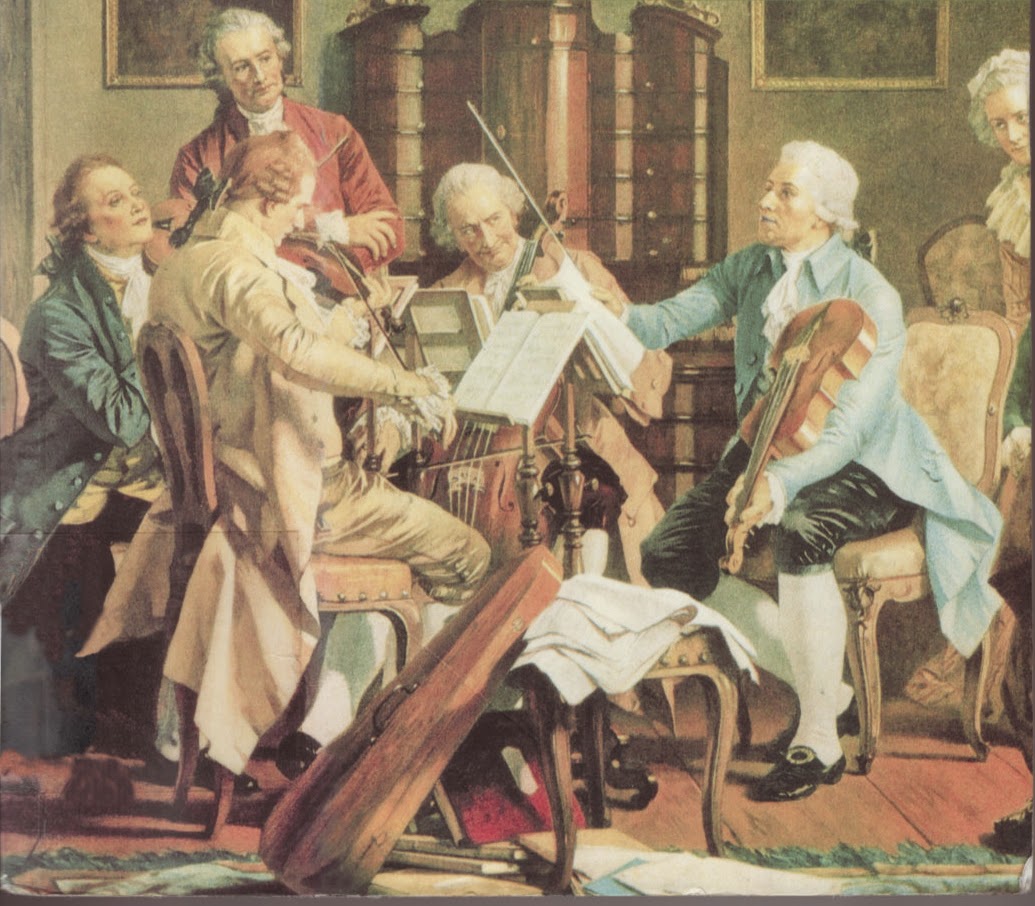
(Mozart (in light blue) playing the viola)
Since this post is primarily about the influence of Mozart on Beethoven and Schubert, I needn't spend a lot of time on the development of Mozart's style and how he came to write this particular piece.

Usually, we associate “divertimento” with a piece meant for light entertainment in the late-18th Century, something diverting and often used synonymously with “serenade” which at least specifically referred to an evening's entertainment. Another term we might come across for such music was “cassation.” Anyway, the scoring for such pieces could range from small orchestras to small ensembles – many such dinner-party pieces were for wind octets.

This one, composed in September of 1788, happens to be for string trio and while it seems a lengthy work for a concert piece, its six movements were very much like the serenades Mozart composed for Salzburg, multi-movement pieces which often lasted between 45-50 minutes. Lightness here refers to mood rather than content: it is a well-crafted piece and by no means a quick knock-off for mindless background music.

Here's the first movement of Mozart's "Divertimento" with the Grumiaux Trio (the score is an arrangement for piano):
- - - - -

- - - - -

The story behind it is fairly straightforward: Mozart, very talented at living beyond his means (he was never a very good manager of reality in general, always a sore spot between him and his often contentious father), was forced to borrow money from friends to make ends meet. Many of these letters survive and if nothing else show Mozart in an entirely different light, whether his straits are genuine (at least to that extreme) or he was also talented at turning the right phrases to win over his friends. The begging Mozart is a very different image from the otherwise care-free bon vivant we have from other sources.

But then his music so often has these two extremes even in a single phrase: all it takes, at this time in music history, is to suddenly inflect a lowered sixth scale degree to open up a whole world of emotional turmoil, a harmonic dissonance – this shadow of the minor key – that was so unusual to the music of the day. It didn't originate with Mozart: he borrowed it from Carl Philip Emmanuel Bach, the most famous of Bach's sons, whose “empfindsamer” or expressive style was full of such devices which rarely failed to cause an emotional twinge in the more attentive listener.

Whether this “divertimento” was written to pay off a debt or not, it was dedicated to Michael Puchberg who was one of Mozart's “frequent lenders,” a fellow Mason and a successful textile merchant. There are nineteen of these “begging letters” that have survived from Mozart to Puchberg, many of which were written after this string trio. It was suggested Mozart composed it for a dinner party Puchberg was giving and the viola part was written for Mozart himself to play. The other performers were probably Masonic brothers.

The 4th Movement, Variations:
- - - - -

- - - - -

In the last variation, beginning at 6:15, one can imagine Mozart having fun with the lot of the typical violist, playing a simple hymn tune in what sounds like “whole notes” in a counterpoint exercise while the first violinist gets to play rapidly running notes. Then, at 7:00 in the transition to the ending, the viola gets to whip off a few measures of his own rapidly running notes as if to say, “see, I can do that, too.” I can just imagine Mozart looking over at his violinist and smiling...

The last movement is one of those tunes of such child-like simplicity – similar to the last piano concertos' finales – that bring to mind the image of Mozart as the child who never grew up. Let's say, perhaps, the man who never lost track of his inner child:

- - - - -

- - - - -

By the way, Mozart composed his Divertimento just six weeks after he'd completed the Jupiter Symphony, the third of three symphonies he composed in the summer of 1788 for no reason at all – all in an unbelievable span of six weeks.

Writers about music often point to certain passages in Mozart – and this trio is full of them – which “point forward to Beethoven.” This is hardly justifiable, considering Mozart had no idea who Beethoven was - even if he did meet him or hear him play that spring of 1787 - or where he would take the musical style that was Mozart's creative voice.

We must keep in mind – especially in this concert's context – that Beethoven is looking back on Mozart. While he studied with Haydn and took the string quartet and symphony in directions Haydn never dreamed of (unless he had nightmares), Beethoven often took what Mozart had hinted at in his melodic and harmonic fingerprints and took them a few steps further. Somehow, I think the composer of the D Minor Piano Concerto (K.466) and Don Giovanni would have approved.

For Part Two - Beethoven and Schubert - click here.

- Dick Strawser

Monday, July 14, 2014

Summermusic 2014: An Inspiration of Chamber Music

Hard to believe that we're in mid-July already and that this season's Market Square Concerts' Summermusic series begins on Friday!

But that's the way the calendar rolls, and that means three different programs of chamber music will take place – in-doors, btw – over the following six days:

Friday the 18th at 8pm: Market Square Church with three string trios by Mozart, Schubert and Beethoven.

Sunday the 19th at 4pm: Market Square Church with Schubert's Piano Trio in E-flat and Schumann's Piano Quintet in E-flat

Wednesday the 23rd at 6pm (yes, six o'clock!): Civic Club of Harrisburg (on Front Street between Forester and State Streets) with C Major String Quintets by Mozart and Schubert

You can read Ellen Hughes' preview of the series in her column in the Patriot-News, here.

Among the performers will be Market Square Concerts' artistic director, violinist Peter Sirotin and executive director, pianist Ya-Ting Chang with pianist Stuart Malina (perhaps you're familiar with him as the conductor of the Harrisburg Symphony), plus violinist Leonid Ferents, violists Michael Stepniak and Nicole Sharlow (a.k.a. Principal 2nd Violinist with the HSO), and cellists Cheng-Hou Lee and Nadine Trudel.

Peter Sirotin (photo by Jeff Lynch)
Peter said, “I am very much looking forward to it because I get to perform some of my absolute favorite pieces of chamber music with wonderful musicians from US, Canada, Australia, Russia and Taiwan.”

On the Facebook page, he explained an idea behind this summer's programs: “Inspiration" - Someone or something that gives you an idea for doing something. (Cambridge Dictionary). MSC Summermusic 2014 concerts will explore how work of one genius becomes an inspiration for another. Mozart inspired Beethoven, Schubert inspired Schumann, Matisse inspired Picasso, Newton inspired Edison... Who or What inspired you?”

“The idea of presenting three programs,” he continued, “exploring how some great works become catalyst for creating others came to me last summer. After presenting two eclectic festivals filled with underperformed great repertoire I thought it would be great to show listeners how some similar ideas are explored by different composers.”

At each concert, he will explain some of his ideas about these inspirational connections.

You can read Peter's own blog-post about the up-coming Summermusic series, here!

It's a fairly narrow range of composers – from Mozart (1788) to Schumann (1842) with stops at only Beethoven and Schubert in between – but it helps point out something many listeners may not be aware of: the interconnectedness of many of our greatest composers and the music they've left us.

While Beethoven studied with Haydn, he did so only because Mozart, whom he'd hoped to study with after leaving his provincial hometown behind him, had died less than a year earlier. Even a friend of Beethoven's, Count Waldstein (who would later have a piano sonata dedicated to him) wrote before his departure, “you go to realize a long-desired wish... if you continue to strive, you may yet receive Mozart's spirit from Haydn's hands.”

And it was primarily Mozart's works that the young Beethoven studied: one example is his Quintet for Piano and Winds which he clearly modeled on Mozart's Quintet for Piano and Winds, K.452, (both heard in previous Summermusic seasons) following the old dictum, “go and do likewise.” And so, before tackling the string quartet – his teacher Haydn was not only the Father of the Symphony, he was also single-handedly responsible for the evolution of the String Quartet – he wrote a series of string trios as a kind of preparation. And it was Mozart's “Divertimento” K.563 for string trio that served if not as a direct model, at least as... well, an inspiration.

And then there's Schubert as a teen-ager, assigned to write a string trio by his teacher Antonio Salieri. Did Mozart serve as a model? He only wrote one movement (he began a second but abandoned it), but then he had a habit of leaving not just one symphony "unfinished"...

So what is inspiration?

Curiously, Peter's idea for this program was itself an “inspiration,” something we often regard as “an idea out of the blue,” maybe happening when we least expect it, because otherwise it seems inexplicable.

Is it the product of our mind working subconsciously on a kernel of an idea that suddenly appears like the proverbial light bulb (allbeit the old-fashioned pre-swirlie light bulb)?

Any of us can be inspired – by something, someone, an event, a saying, someone's actions: recalling advice a teacher gave you or that your father told you long ago; seeing a story on the news that leads you to volunteer for, say, the food bank; tasting something from a recipe that didn't quite meet your expectations but suddenly you think adding some... what, lemon juice? – may help bring out the flavor you're looking for (I remember somebody telling me, “the first soufflé did not happen by accident”).

Of course, with artists, it can open up innumerable possibilities: a visionary painter (long before Rembrandt) reveals a way light strikes the background and suddenly hundreds of other painters are experimenting with the play of light; a few hundred years later, French Impressionist Claude Monet takes this play to the extreme when painting the facade of a great cathedral and composer Claude Debussy, whose studio was full of those little postcards one can find at art museums, miniatures of great paintings, finds a musical way of depicting this same kind of play of light by breaking through the boundaries of centuries of musical rules.

Is there much difference between what inspires a composer and what influences a composer? It depends on how deeply you wish to split hairs. Certainly, the time a composer lives in can “influence” that composer's individual voice, just as the events of daily life can. But this very often might not appear in the music: Beethoven, who spent long periods of time finishing a composition, could “compartmentalize” himself so everyday reality might have little bearing on what he wrote that day. You would hardly know, when he was writing his 2nd Symphony's riotous finale, he was experiencing such severe symptoms of deafness that his Heiligenstadt Testament reads at times like a suicide note. This was happening the same summer he wrote the Tempest Sonata and the three violin sonatas of Op. 30, one of which is in his favorite dramatic key of C Minor and another is the G Major, one of the most cheerful pieces he composed.

In the 18th Century, composers produced (some might say “turned out,” since composers were considered craftsmen or artisans rather than artists as we do today) several works at a time – a half-dozen string quartets or a dozen violin concertos, each of which would be expected to be, in some ways, different. There was no sense of the artist sitting around waiting to be inspired. And one work would be dramatic, another lyrical, another “learnèd” – without any influence from the composer's mood du jour.

But of course, that was easier when a concerto might normally be 10-15 minutes rather than 45 minutes long.

It was the idea of Beethoven and his deafness that gave rise to the 19th Century image of the “suffering artist.” And it certainly worked for others: Schubert, dying in poverty at 31 (looking back on Mozart who, with his poverty, died of some unidentified disease at 35), or Robert Schumann and his madness (who until fairly recently was described as “manic-depressive” and is now considered “bi-polar”).

In a sense, we can impose our own attitudes on how composers work – and one of the biggest problems is that we so rarely don't understand that not all composers work the same way all the time. Yes, Beethoven may be inspired to write his 6th Symphony, “Pleasant impressions upon arriving in the countryside” and all that, but he also needed to produce pieces to earn his bread-and-butter – inspiration or the influences of the day might have had a hand in the creation of Wellington's Victory, but it came about as a commercial venture and in that, however crass people since then have considered it, it succeeded. Not likely to be considered among his masterpieces, it served its purpose and played to the crowd, making Beethoven a popular composer at a time when his reputation had slumped and his income (and self-confidence) all but disappeared.

A more recent composer had a different view of this inspiration thing. Elliott Carter whose music usually strikes the average listener as overly intellectual never really thought about some point of inspiration generating a new piece. He would be commissioned to write something and, whatever it was, it would create some “problem” that required a “solution.” How to solve it and how to turn that solution into music was then where the inspiration came in.

Maurice Ravel, by the way, when writing his Piano Trio, announced to a friend that, after struggling with what he wanted to do in the piece, he'd just completed the piece – “now all that remains are the notes.” You can make of that what you want.

If Beethoven could write Wellington's Victory to earn money and cash in on the political euphoria of the day – the imminent defeat of Napoleon after two decades of constant warfare – Elliott Carter tells the story how he was giving a talk and mentioned the commission he'd received for his “Variations for Orchestra” and the amount of time he spent writing it amounted to his earning, basically, 25¢ an hour.

At this point, a matronly woman bedecked in jewels and furs, stood up and sniffed “Mr. Carter! You mean to tell me you write for money!?”

* * ** *** ***** ******** ***** *** ** * *

Jennifer Higdon
Jennifer Higdon has had chamber works on recent seasons with Market Square Concerts, most recently with the Cypress Quartet to talk about her “Impressions” which was on that program.

More recently she was in Harrisburg to hear Stuart Malina and the Harrisburg Symphony and soloist Chris Rose play (for the second time) her Percussion Concerto.

(Added 7/24: She's won a number of awards already, including a Pulitzer Prize and a Grammy. It was announced she's receiving the Distinguished Arts Award from the "Governor's Awards for the Arts" in Pennsylvania.)

Jennifer has often told the story how she grew up in a house with no classical music. Her parents listened to the folk and rock music most people in the '50s and '60s listened to. But her father was an artist and his sense of his art was a profound influence on her, whether she was conscious of it or not.

She would say how, after another premiere, her dad would come up to her, shaking his head and ask “Where does that come from?” Considering she had little opportunity to hear classical music when she was growing up, this might seem a logical question.

Before the premiere of her Concerto for Orchestra with the Philadelphia Orchestra, one critic I'd found described her – in that way we try to describe an unknown quantity in terms of something known – as “Bartók on Speed.” But she admits that Ravel and Samuel Barber are perhaps bigger influences on her though the kind of energy that is one of her hallmarks is definitely more Bartók than what I'd usually associate with Barber or Ravel.

Another trademark of her style is her sense of instrumental colors – just to mention the Percussion Concerto, everything thing from the trio of woodblocks (the “woodpecker attack”) near the cadenza to the use of the Chinese opera gong (with its delicate clown-like poing)  and of course the ethereal sound of vibraphones played with bows – and she's explained how she'd hear something in George Crumb's music and either borrow it or come up with something similar. Crumb is another very colorful composer – his “Ancient Voices of Children” was one of those major ear-opening influences for me when I first heard it back in the '70s – and someone she studied with.

Ralph Vaughan Williams, an English composer usually associated with a fairly bucolic style and who, briefly, studied with Ravel around the time he had discovered English folk song, making the transition from being an imitator of those established English composers imitating Brahms to someone who found substance in the music of England, both in its folk songs and the church music of the English Renaissance, eventually discovering his own voice.

He often said that he “likes” a piece – thinking of it in an almost Facebook sense of the word – by how much he wants to “crib” from it. Hearing Puccini's Turandot, he went home and added tuned gongs to the orchestra for his 8th Symphony.

It was Stravinsky (accused of ripping off Bach's 3rd Brandenburg Concerto when he wrote “Dumbarton Oaks”) said “Good composers borrow; great composers steal.”

Now, when she was here in May, Jennifer mentioned that her dad died just recently. In tribute, she posted one of his paintings on her Facebook page.

Until then, I had not seen any of her father's artwork. Being a not very visually oriented person, myself, I hadn't thought much about his possible influence aside from seeing her give her works “colorful” titles – the Piano Trio has movement entitled 'Pale Yellow' and 'Fiery Red'; the string quartet “Impressions” (a slightly different musical view of impressionism) has a movement called 'To the Point' which was inspired by the pointillistic style of Suerat, while the others are called 'Bright Palette,' 'Quiet Art' and 'Noted Canvas.'

But this explained a lot to me:

Bird Journal by Kenny Higdon
(posted with Jennifer Higdon's permission)

That,” I said, “is where this comes from.” I see many elements of her musical style in her dad's painting style – from the sense of colors and the way he uses them, the textures, even the brush strokes which give it a real energy, and, of course, the picturesque title for an abstract work. Even if that's the only painting of his I'd see, I would say Jennifer is very much her father's daughter – translating his visual art into her music (which is, after all, “aural art”).

* * ** *** ***** ******** ***** *** ** * *

Now, going back to what I'd said earlier about composers and who they studied with – and Beethoven receiving the spirit of Mozart from Haydn's hands – I wanted to look at who Jennifer Higdon studied with.

When I was working on my novel, The Lost Chord, one of the characters is a successful composer who studied with John Corigliano and who'd written an opera that is essentially a re-take of the Faust Legend set in a modern corporation – called Faustus, Inc.. The fact he's murdered early on is one thing, but solving his murder and retrieving the stolen score in time for the opera's premiere is central to the plot.

There's one scene where an old composer, Howard Zenn (clearly patterned on Elliott Carter), explains the importance of continuity in art, and the role of teachers in a composer's legacy even if they're not directly an influence. I was able to take John Corigliano's “Teacher Tree” back to Johann Joseph Fux and his treatise on counterpoint, Gradus ad Parnassum which was a major influence in music theory since it was first published in 1725.

Admittedly, I had to fudge one link in the chain when I found someone without any references to a teacher but, since he was at the Prague Organ School at the same time Dvořák was, I assumed he might have studied with one of Dvořák's teachers. All's fair in love and fiction...

So I decided to do the same with Jennifer Higdon – by way of her one teacher, George Crumb and see how far back I could take this. Here is a list of her Reverse Begats:

= = = = = = =
Jennifer Higdon studied with (among others)
George Crumb (1929- ) who studied with
Ross Lee Finney (1906-1997) who studied with
Nadia Boulanger (1887-1979) who studied with
Gabriel Fauré (1845-1924) who studied with
Camile Saint-Saëns (1835-1921) who studied with
Fromental Halévy (1799-1862) who studied with
Luigi Cherubini (1760-1842) who studied with
Giuseppe Sarti (1729-1802) (a tune of his is quoted in the dinner scene of Mozart's Don Giovanni) who studied with
Padre Giovanni Battista Martini (1706-1784) (who also gave 'lessons' to Mozart and JC Bach; Salieri was a grand-student of his) who studied with
Giacomo Perti (1661-1756) (who also taught Torelli) who studied with
Giuseppe Corso (or Corsi) (b.? - d.1690) (then, a leading composer in Rome but largely unknown today) who studied with
Giacomo Carissimi (1605-1674) (in the 9 pages he occupies in Grove's Dictionary of Music & Musicians, I can find no mention of anyone he studied with but he was very much influenced by Monteverdi and was offered the position at St. Mark's Venice to succeed him. Among numerous works, he is credited with writing one of the first oratorios, Jepthe, around 1650.)
= = = = = = =

It may seem astounding to come up with an unbroken line connecting a composer writing today whose music you may have recently heard live and whom you may have had the chance to meet and who – Kevin Bacon aside – can follow twelve degrees of separation back some 375 years to her 10x-great-grandteacher through composers most of us today may not be familiar with but who were, in their own right, either major composers of the day or famous and sought-after teachers!

Obviously, this may not be as important to her music as composers whom she has studied with directly or have listened to, studied, or even stolen from. But still, it points to the amazing continuity of this art we call classical music and the fact that, no matter how new it may sound to some of us, there are roots in the past that still continue to exist if not nourish us today.

So, in a much broader sense, think about who or what has inspired you in the past and how this may still nourish you to have become the person you are today.

In that sense, also, prepare to listen to music Mozart composed which inspired Beethoven and Schubert to write string trios; that Schubert composed that inspired Schumann; and how Schubert, at the very end of his life, found inspiration in something Mozart composed a generation earlier.

Stay tuned...

- Dick Strawser

Sunday, April 27, 2014

Climbing Mount Everest: Beethoven's Op. 130 & the Grosse Fuge

The Daedalus Quartet (photo by Lisa-Marie Mazzucco)
When the Daedalus Quartet ends the final concert of Market Square Concerts' current season Tuesday night at 8pm at Market Square Church - you can read more about the rest of the program here - with Beethoven's String Quartet in B-flat, Op.130 (with the original finale), what exactly does that mean?

Life-long classical music aficionados bandy about terms like “Late Beethoven” or “The Late Quartets” (without mentioning the composer's name but automatically implying it's Beethoven) and especially “Grosse Fuge” with such reverence it seems we're intent on mystifying a whole new generation of concert-goers (what is a “foo-geh” and why is it gross?).

(Quickly, Grosse Fuge means "Grand Fugue" in the sense of its expansiveness. A fugue is a procedure in which musical ideas unfold linearly with imitation between the... uhm... you know what? Just listen to it...)

On the other hand, how many of us who know only how to stick the key in the ignition understand what a mechanic is telling us when our car is making a noise that sounds like this (followed by a poor, onomatopoeic impersonation of something heard from under the hood)? Or have had to suffer through your child's explanation of how to cut-and-paste something into an e-mail and find yourself as befogged as before?

Beethoven's last quartets, all composed within a two-year period, have long had a reputation of being “difficult” – not just to play, but to listen to. At the first performance of the first of them, a critic wrote it was an “incomprehensible, incoherent, vague, over-extended series of fantasias – chaos, from which flashes of genius emerged from time to time like lightening bolts from a black thunder cloud.”

When a critic in the mid-1950s or so was reviewing a new quartet by Milton Babbitt which he found utterly indecipherable, he wrote “This must be what Late Beethoven Quartets sound like to a dog.” (Much to my delight, in the mid-1970s, a friend sent me this photo (see right) on a post card from Tanglewood with the inscription on the back, “Listening to Late Beethoven Quartets.”)

While it is impossible to demystify something like Beethoven's last five string quartets, it should be said they need not be so frightening to the first time listener. Many people know them by their reputation and see that they're long, dense and pretty intense and therefore only accessible to the initiated (and even then, maybe only for a 32nd-degree concert-goer).

Yet these same would-be listeners have no problem sitting through movies lasting hours with their convoluted plots, their own intrinsic language and history (comprehensible only to the initiated), and a philosophical and perhaps allegorical theme that can provide hours of discussion (think Tolkien).

Granted, the “Late Quartets of Beethoven” are, like, this monolithic Everest of classical music – more like a single mountain with five separate peaks which, inevitably, every string quartet eventually feels compelled to scale (no pun intended).

* * ** *** ***** ******** ***** *** ** * *

Ever since Caesar divided Gaul into three parts, writers about music have talked of a composer's output in terms of Early, Middle and Late – especially Beethoven, but even Schubert who, after all, died at the age of 31 (had he lived longer, would we call his Late Quartets and Sonatas “Late” or merely “the first mature works of his Middle Period”? Elliott Carter, who didn't find his voice until he was 50, was writing what were called “Late works” when he was in his 70s: the fact he was still composing when he died just shy of 104 gives rise to the idea of calling the pieces he wrote after he turned 90 the “Post-Late Works,” but I digress...)

This is something that many “novice” music-lovers and even avid concert-goers sometimes do not realize: that not all Beethoven sounds the same. In fact, few composers do, usually going through “style changes” from their “youthful apprenticeship” to their “maturity” to the “wisdom of old-age” (especially confusing when applied to a 30-year-old Schubert). Even Beethoven, after all, was only 56 when he died, which is not, even today, something we would consider “old” (unless you're still under 30).

Now, I'll be getting into some of the details of this – how Beethoven's “late style” came about – at my pre-concert talk (which begins at 7:15 in the church sanctuary) – but for the blog, here are some video posts of the quartet-in-question with a few background comments.

Suffice it to say Beethoven's “Late Period” grew out of a difficult time in his life: in 1809, the deafness which had been threatening since before he was 30 finally kicked in with more increasing pain and frustration; in 1812, around the time he composed his joyous 7th Symphony, he was apparently in love, given the single letter addressed to a woman known only as “The Immortal Belovéd” but the following year it became obvious such happiness was not to be his. Then in 1815 began the long drawn-out crisis over the custody of his nephew. Between 1813 and 1818, he practically ceased composing.

Instead, he was writing trifles, publishing works previously unpublished (wreaking havoc with the relationship between chronology and opus numbers) and studying the music of Bach and Handel, two composers from a hundred years earlier whose music had largely been forgotten. From them, he learned more about counterpoint (especially the writing of fugues) than he ever did as a student in the 1790s. Fugue-writing became a new feature of the music he would compose from 1818 on.

It was a Piano Sonata that unlocked the creative block he'd been suffering – the Hammerklavier with its grander dimensions through expanding both the sense of traditional form and harmony, its renewed vigor and virtuosity and especially its complex fugal writing in the finale. Almost everything he wrote took on these same characteristics (if not always the fugues) – more sonatas, the immense Missa solemnis, the 9th Symphony (the famous “Choral” Symphony) and finally, these last five string quartets, all written between 1818 and 1826.

Beethoven (1823)
Most people wonder at the image of the Deaf Beethoven writing music at all – and many would disparage these last works (which many of his contemporaries found incomprehensible) as the result of his deafness (since he couldn't hear what he was writing, how could he tell what made sense and what were mistakes?). On the other hand, while many composers do not need to “hear” their music externally to hear it inside their head and transcribe it from there, one could argue that his deafness turned his creativity inward and he found a whole new way of expressing himself that was unlike anything being written by anybody else – and for a long time after him.

So, now – these quartets.

After the “middle” quartets – the three Op.59 quartets dedicated to Count Razumovsky, and the two separate works called the “Harp” from 1809 and the “Serioso” from the following year (though it wasn't published until 1815) – Beethoven did not think about writing more quartets until May of 1822 when he started sketching a new work which, unfortunately, his publisher showed little interest in.

That November, he heard from a Russian aristocrat, Prince Nikolai Golitsin who was a fine amateur cellist married to an accomplished pianist. Unlike his counterpart, Count Razumovsky, a music-lover who employed his own quartet, Golitsin played the cello in his. Golitsin wrote to Beethoven and asked him to write one, two or three quartets for him - and to name his fee.

Because of more pressing matters with the Missa solemnis and the 9th Symphony, Beethoven didn't return to his earlier sketches and couldn't begin writing the E-flat Major Quartet that became Op.127, the first of the last quartets, until the summer of 1824. He finished it the following February.

It was premiered the next month to a largely befuddled audience (not to mention players who admitted not knowing what to make of this piece). Subsequent performances fared little better.

Beethoven went ahead and wrote the next quartet – this was the A Minor Quartet which was later published as Op. 132. During this period of time, Beethoven had been quite ill, bedridden with an “intestinal inflammation” which interrupted its composition in the Spring of 1825. He celebrated his recovery with the famous Heiliger Dankgesang, the slow movement he called “Holy Song of Thanksgiving” that is the emotional core of the piece. He completed this quartet in July.

The next month he began work on a third quartet for Golitsin and finished it by November – this one in B-flat Major which would become Op. 130. This is the quartet the Daedalus Quartet will perform Tuesday night.

* * ** *** ***** ******** ***** *** ** * *

If people had trouble comprehending what he was doing in these first two quartets he completed, even looking at the mass of this new one was enough to inspire fears and doubts. It was long, it had six movements and it ended with a monstrously difficult thing labeled “Grosse Fuge” or Grand Fugue ("somewhat free, somewhat academic" is one way of translating the subtitle) - by itself, it accounted for about one third of the quartet's entire length.

Keep in mind, since Haydn's day, a symphony or a string quartet might average about a half-hour long and was in four movements: the first movement was the main focus with its dramatic sonata form; followed by two shorter movements in contrasting slow and fast tempos, usually in a lighter mood; and then a finale that was originally almost an after-thought and generally (even in dramatic or minor-key works) a happy ending.

Beethoven had already started pushing the focus of the entire piece into the last movement, more of a summation than a curtain-closer. The last movements became longer, more dramatic and, in the case of the recently completed Ninth Symphony, not only the end-all but the be-all of a work now over an hour in length.

Here are clips of the individual movements (with different performers as I could find). First of all, my apologies if any of these start with loud blasting ads (please feel free to “skip,” under the circumstances).

1st Mvmt, Adagio ma non troppo / Allegro: Brentano Quartet


After a slow, searching and somewhat vague introduction, the fast main part of the movement begins with a flurry of notes, but keeps stopping and starting, going back to the introduction. This contrast takes on more and more significance (remember this when we get to the Grosse Fuge) as the movement develops so that that introduction isn't really a typical “intro” that just raises the curtain.

This is as good a place to point out that earlier, quartets were often works featuring the first violinist “accompanied” by three other string players, the cello playing the bass line and the 2nd violin and viola filling in the inner harmony. Haydn and Mozart had already begun changing this with their later works but it was Beethoven who began fully integrating the ensemble as a quartet-of-equals.

2nd Mvmt, Presto: Cypress Quartet


“Scherzo” is Italian for “joke” and they're usually fast, short and light. This one, after such an expansive first movement, is certainly short – two minutes as it rushes past. It's also very understated, hushed throughout except for the occasional outburst and the middle section with its rapid-fire work-out for the 1st violinist. Returning to the opening as the traditional form would have, Beethoven suddenly “kicks it off the stage.”

3rd Mvmt, Andante con moto ma non troppo: Quartet Casals


While Andante is technically not a slow tempo – it means, literally, “walking” – this is the required slower contrast following the whirlwind second movement, given one of Beethoven's more equivocating tempo indications: Walking tempo with motion (but not too much). It has a sense of “comfortableness” that would put the listener at ease.

Originally, at this point in the sketching process, Beethoven was considering various ideas for a finale, none of which seemed to involve a fugue. And there were ten possible ideas he jotted down. But instead of a finale – or perhaps because the idea of the great fugal finale came to him and was not suitably prepared by what he'd written so far – he added two more movements starting with this second scherzo: actually, the equivalent of an 18th Century minuet except more of a German folk-dance, not too rough but not smooth enough to be a minuet (or waltz).

4th Mvmt, Alla danza tedesca: Allegro assai: Juilliard Quartet (please ignore the over-romanticized graphic...)


This German dance (alla tedesca, in the German style) is marked “rather fast” and with its little swells in volume and sudden shifts from slightly louder to slightly softer, gives an easy, swinging feeling, possibly a bit like a hurdy-gurdy. As Michael Steinberg notes, it can create “something close to seasickness, the kind you induce with delicious deliberateness on a merry-go-round at the fair.”

After two quite down-to-earth movements, Beethoven now adds this touching and seemingly simple-sounding slow movement which he called a cavatina, a short, uncomplicated song: 

5th Mvmt, Cavatina, Adagio molto espressivo: Guarneri Quartet


This becomes the real slow movement of the entire work, a “song” for the 1st Violin, supported by the other players. Keep in mind he had already written the “Heiliger Dankgesang” in the A Minor Quartet (which will appear later as Opus 132) so there is already a precedent for the personal emotions Beethoven expressed here, not unlike those times he would visit friends – ill or grieving – and, without ever saying a word to them, improvise at the piano for an hour and leave them comforted.

In this case, a friend of his (young Karl Holz who was 2nd Violinist in Schuppanzigh's quartet which first played these pieces) recalled the Cavatina “cost the composer tears in the writing and brought out the confession that nothing he had written [before] had so moved him.” In fact, merely recalling it, Holz added, “brought forth renewed tears.” The brief middle sections, marked beklemmt in the sense one could feel unsettled “by the air just before a thunderstorm, by a nightmare, by an agonizing wait” (again quoting Steinberg). This then returns to the opening of the Cavatina, drawing back from this brief glimpse at the edge of the abyss.

And now for the last movement. With four “middle movements” of a somewhat light, uncomplicated nature (the Cavatina taking on a more charged emotional quality), all Hell breaks loose with the start of this immense and super-intense finale. Again, like the first movement, it begins with a unison passage that now erupts into contrasting flashes ("lightening bolts," indeed) with frequent changes of mood and tempo.

The late Joseph Kerman thought this opening was like the composer hurling "all the thematic versions at the listener's head like a handful of rocks." Out of this chaos, Beethoven assembles one of the most amazing things he ever wrote.

6th Mvmt, Grosse Fuge: Brentano Quartet


Ultimately, it's as if Beethoven wasn't sure how to end it. Reversing the process that began the finale of the 9th Symphony (less the famous “terror fanfare” if the whole fugue itself isn't a “terror-fugue”), he tries a snippet of this – silence – no, maybe the slower idea – no, not that, either: then they all go back to the unison of the opening bur rather than starting (OMG) over again, it quickly works itself out into something both exalted and humorous – and ultimately resolving the drama with, at long last, a “happy” ending.

a page from Beethoven's manuscript: Grosse Fuge
But while the first audience encored the two easy-to-process scherzos (which annoyed Beethoven), most everyone was thoroughly confused by the finale and an immediate campaign began from his friends, from the performers and most of all from his publisher to replace the Fugue with something more manageable, more accessible. Six months later, after writing two more quartets - Op. 131 in C-sharp Minor (which begins with a long, slow fugue of its own) and Op. 135, the last one - he began sketching the totally new, much lighter conclusion that for generations would be the official finale of Op. 130, once he was guaranteed the Fugue would be published separately (he also provided his own piano four-hands version, mostly for study purposes). Even so, it didn't receive its next performance until 1859, thirty-three years later, the same year Wagner completed his Tristan und Isolde.

While Beethoven's colleague Ludwig Spohr considered it “indecipherable, uncorrected horrors,” Igor Stravinsky said the Grosse Fuge was “an absolutely contemporary piece of music that will be contemporary forever.”

In this Graphic Animation version of Grosse Fuge (no performers acknowledged), ignore the information about the impending performance in California – while it's a maze of images to follow (the music is complicated enough), it might help you keep track of what's happening in the texture not to mention differentiating between the different motives (like the longer, sustained notes from the opening and the wildly jumping, rhythmic figure). The instruments are color-coded: 1st Violin = orange (or brown), 2nd Violin = magenta; Viola = green; Cello = bluish-purple. Good luck!


It might be of interest, having heard the Fugue, to go back and listen to the opening few minutes of the first movement: you may notice some similarities between this and the two themes of the fugue: the slow introduction of the first movement has been transformed into the “long-note” theme or subject of the fugue; the jagged, leaping theme of the fugue has its roots in the first fast section of the opening movement. Notice how, in both of these movements, there is so much give-and-take between these two contrasting tempos. Even though he had no idea how he would end the piece when he started it, it was like the seeds of the finale were there, one thing that ties the quartet together.

* * ** *** ***** ******** ***** *** ** * *

While selection of performances of the complete quartet on YouTube are somewhat limited, for those who now want to experience the whole quartet “in context” and performed by one ensemble, here's the Zemlinsky String Quartet recorded at Festival Wissembourg in September, 2013:


Now, having been tossed back and forth over the abyss, you may want to retire to some distant corner to contemplate what you've just experienced in this piece.

On the other hand, since Beethoven gave in to pressures from his publishers, friends and performers to replace the over-sized Grosse Fuge with something “more manageable,” knowing the Fugue could stand on its own, he wrote what is essentially the Haydn-esque happy ending most people were hoping for. Though it's only about four or five minutes shorter than the original finale, it is much less difficult to play and far less exhausting to both play and listen to.

However, the “alternate finale” can't stand on its own and now that most quartets would play Op. 130 as Beethoven originally intended (as they should), it's a shame to lose this delightful piece if for no other reason than it's the last piece of music Beethoven ever completed.

He added it in November of 1826. He died on March 26th the following year.

So, while it's unlikely you'll hear it in concert as an “encore” except by Quartetto Masochismo, here is your chance to hear it (as you can in most recent recordings) as an added “bonus” track, performed by the Takacs Quartet:


And there is so much more to say about this piece - well, I'll still have plenty to talk about at my pre-concert talk!

Dick Strawser


Saturday, April 26, 2014

The Britten Centennial: The Daedalus Quartet with Britten and Beethoven and Purcell (oh my)

The Daedalus Quartet (photo by Lisa-Marie Mazzucco)
While Spring has finally arrived, so has the end of another season! This last concert – Tuesday at 8pm at the Market Square Church – brings the Daedalus Quartet to town for a program of quartets by Benjamin Britten and Ludwig van Beethoven (his Op. 130 Quartet with the original Grosse Fuge finale) and, joined by tenor Rufus Müller, the song cycle “Winter Words” by Benjamin Britten setting poems by Thomas Hardy.

The program is prefaced by fantasias of Henry Purcell, so let me begin there, briefly.

Purcell (painted in 1695)
Purcell is one of the great composers of the Baroque era – he died in 1695 at the age of 36 which places him in the generation before Johann Sebastian Bach and George Frederic Handel. Considering he died on November 21st, I should also mention (just to tie things in) that would mean he died 218 years and a day before Benjamin Britten was born.

That may not be so astonishing, but consider that between Purcell and Britten, no English composer was considered “great enough” on the international stage. The most popular composers in England would be Johann Christian Bach (son of Joh. Sebastian) and George Frederic Handel – both German emigrees – then Felix Mendelssohn (a frequent visitor from Germany), but there are few English-born (and fewer English-trained) composers to be acknowledged on the international stage until... Benjamin Britten.

You can mention the likes of Sir Arthur Sullivan (better known as a composer of light opera with his colleague, Mr. William S. Gilbert), or Sir Edward Elgar or Gustav Holst or Ralph Vaughan Williams and, yes, they were esteemed at home – but as far as Europe was concerned, most music-lovers agreed with Richard Strauss' assessment of the country's musical life: “it is the Land without Music.”

Curiously, one of Purcell's achievements was to absorb musical styles from Italy and France and out of this to create his own voice with a decidedly English accent. In a sense, this might seem easier to us than it is, especially as we're not generally aware of other English composers of the previous hundred years.

And what makes Britten stand out on the international stage? He was able to combine “continental” stylistic ideas into his English heritage which, before him, is usually described as the “English pastoral” or “cow-looking-over-the-fence” style (one could hardly say that of Holst's The Planets, however) and in this sense created a musical language that was of more interest to the rest of Europe. As much as I love Vaughan Williams or you may hum along with Elgar's “Pomp & Circumstance,” it was not music that traveled well.

Britten's did.

And while many European composers learned the basics of counterpoint – the handling and balancing of textures – from the music of Bach and Handel, Britten learned his primarily from Purcell and the Elizabethan Renaissance.

Here, as an example, is one of the “Trio Sonatas” by Purcell (not on the program) but which will give you an idea of his style.
= = = = =

= = = = =

This is a “chaconne” or a “passacaglia.” Though we are trained to differentiate the two, in Purcell's day the two were nearly interchangeable: the important thing is, it's a set of variations over a “ground” or repeated theme or figure in the bass – kind of like (I hate to mention it) Pachelbel's Canon (which is also a piece based on a “ground”). There are famous passacaglia's by Bach, but they are very different in approach: the bass-line is a theme, and the variations are more-or-less self-contained (or “sectional”). In this example, Purcell's variations (the top part) often overlap and push through the bass-line's cadences to create a more fluid texture and continuous form.

Also, listen to how sometimes the upper parts swerve off harmonically and create some amazing dissonances (like 6:47 to the end). This will come in very noticeable when you listen to Britten's music!

* * ** *** ***** ******** ***** *** ** * *

Benjamin Britten
Technically, this is the Benjamin Britten Centennial Year, beginning with his birth-date of November 22nd, a good excuse as any to program anything by him, as far as I'm concerned. It also happens he was born on the Feast Day of St. Cecilia, the patron saint of music.

He is primarily known as an English composer – he traveled little, spending most of his time on the chilly shores of Suffolk where he was born and where he died in 1976, not long after his 63rd birthday. Most of his life, he lived at Aldeburgh on the coast of East Anglia, a wind-swept region that figured prominently in his first international success, the opera Peter Grimes in 1945 (if you don't know the opera – and you should – you've probably heard the “Four Sea Interludes”).

There is a story about how he had emigrated to the United States before World War II because the political and artistic climate in England was not conducive to a young composer: Europe, about to be embroiled in another war, had little to offer – America was, he thought, where it's at. It was while he was in California, far from home, that he had an attack of homesickness after reading George Crabbe's poem, “The Borough” which had a passing mention on a village outsider, a fisherman named Peter Grimes. And so he decided – now, mid-war – to return home where the premiere of the opera based on that episode became a symbol of the revival of English art and, quickly enough, its arrival on the international stage.

But the String Quartet No. 1 is not one of Britten's “English” Works – it was written in America and was commissioned by Elizabeth Sprague Coolidge who had done so much for contemporary music (including, among others, the 4th Quartet of Arnold Schoenberg who was by then a resident of Beverly Hills).

Britten, Copland & Pears
Arriving first in Canada along with Pears and the poet W.H. Auden, they eventually moved to New York City after which he and Pears chose to stay with friends in Amityville, on Long Island, where he began working on a new string quartet. Caught up by the war and advised to stay in America as “cultural ambassadors” by the embassy, Britten and Pears then went to California where he continued working on the quartet in a garden tool shed in Escondido until he finished it in the fall of 1941.

It was given its first performance in Los Angeles but, due to difficulties with their host, the pair “borrowed” their car and drove cross-country back to New York and then returned home to England (it was on this perilous voyage – the ocean was not safe from Nazi U-boats – that Britten composed one of his most familiar works, A Ceremony of Carols).

Among the works he composed in America are the Violin Concerto, the song cycle Les Illuminations, the Sinfonia da Requiem, the “Seven Sonnets of Michelangelo,” an “operetta” based on Auden's version of the folk-tale Paul Bunyan, the String Quartet No. 1 as well as “An American Overture” in which he absorbed his friend Aaron Copland's “wide-open sound” to sound more American (it was never performed and had been left behind, forgotten, when he returned to England) as well as sketches for a Clarinet Concerto left incomplete.

Here is his String Quartet No. 1 – not his first quartet, just the first one published: there's one from 1931 (he was 17) and another from 1926 (he was 12) and perhaps three others in one shape or another – “in,” as he admitted to Ms. Coolidge, “would you believe D Major?”

= = = = = = =
The Escher String Quartet (Chamber Music Society video)
1st Movement: Andante sostenuto / Allegro vivo


One of the things about discovering earlier, less-well-known works is that we sometimes hear them through these later, more familiar works. I can't help but notice the opening of this quartet (a kind of slow-introduction that recurs through the movement) reminds me of the opening of his 1952 canticle, “Abraham and Isaac.” Not a direct quote, as it seems, but so similar it obviously has to have its roots in the earlier quartet. Listen to the first few minutes of the canticle, here. He would again use this for obvious reasons in his “War Requiem” of 1961, setting Wilfred Owens' lines before “but [Abraham] slew his son – and half the seed of Europe, one by one.”

But what did this passage mean to Britten in America at 27? Whether or not it had some deeper, psychological impact on him, it is a distinctly memorable if not original sonority.

The second movement is a brief scherzo and strikes one as an extension of the fast section that is the basis of the first movement.

2nd Movement: Allegretto con slancio (with momentum)


The third movement returns to sonic images of the first's introduction, but also brings to mind one of the Moonlight sea interlude from Peter Grimes written four years later.

Keep in mind, it was written in Escondido, CA, which is just outside San Diego and inland from the ocean. My question here is, when was this written in relation to his reading George Crabbe's “The Borough” which would not only inspire Peter Grimes, but make him think of home and the North Sea beaches of Suffolk?

When I first heard this work, I thought it went on too long without much happening; now, to me it's the emotional highlight of the piece and this, from a composer who's often described as being unemotional (critics – even a friend of his – described his early music as “existing in a vacuum”).

3rd Movement: Andante calmo


The finale is again a brief, quick-paced movement, lively and rambunctious (not to mention highly contrapuntal) with strong contrasts (after the opening, the long upper “theme” which slowly unfolds over a frenzied cello line; the contrasting sustained chords with nervous interruptions).

And because they have it available on You-Tube, for the final movement, we'll hear the Daedalus Quartet play the 4th Movement: Molto vivace

= = = = = = =

WINTER WORDS
Just when we thought we've left winter behind us...

Pears & Britten painted by Kenneth Green (1943)
Benjamin Britten is considered one of the great song composers in the tradition of Schubert and Hugo Wolf. He has written many songs and collections of songs (song cycles) that have become major parts of the repertoire, most of them (like most of his operas) composed for Peter Pears whom he met in 1937. They remained both partners in music and in life until Britten died in 1976.

Britten & Pears
Schubert's song cycles – Die schöne Müllerin and Winterreise – set several poems by the same poet, Wilhelm Müller, each telling (and commenting upon) a specific story. Often called a song cycle, Schubert's final songs are grouped into a collection called Schwanengesang (Swan Song), but this was not Schubert's intention nor are they a dramatic unity.

Britten wrote several works that are collections of different texts by several different poets – the Serenade for Tenor, Horn & Strings of 1943 for one – but most of his song cycles focus on a single poet whether they constitute a narrative or not. Les Illuminations sets Rimbaud, the “Seven Sonnets of Michelangelo” (both from his American stay), and later, Poet's Echo setting Pushkin and the Songs & Proverbs of William Blake.

In general, these do not tell a single story but, despite being a collection of like-minded poems, often provide a dramatic continuity.

In Winter Words, he selected ultimately eight poems from Thomas Hardy's posthumous collection, itself called “Winter Words,” though there were two settings he discarded (the Britten-Pears Foundation has made these available for individual performance, but does not recommend they be added to the cycle).

* * ** *** ***** ******** ***** *** ** * *

Originally composed for tenor and piano – and premiered by Peter Pears with Britten at the piano in 1954 – Winter Words has been arranged here for tenor and string quartet by cellist of the Daedalus Quartet, Thomas Kraines, himself a composer (and one whom I would like to hear more from).

While these clips provide an opportunity to hear the composer accompany the person for whom the songs were composed, the recording (or its transfer) from a 1972 recital is not the best and Pears was, at this time, 62 years old. (My apologies for “condensing” the text – otherwise, we'd be scrolling all night long...)

= = = = =


1. At Day-close in November
The ten hours' light is abating, / And a late bird flies across,
Where the pines, like waltzers waiting, / Give their black heads a toss.
Beech leaves, that yellow the noon-time, / Float past like specks in the eye;
I set every tree in my June time, / And now they obscure the sky.
And the children who ramble through here / Conceive that there never has been
A time when no tall trees grew here, / A time when none will be seen.
- - - - -
2. Midnight on the Great Western (or The Journeying Boy)
In the third-class seat sat the journeying boy, / And the roof-lamp's oily flame
Played down on his listless form and face, / Bewrapt past knowing to what he was going,
Or whence he came.

In the band of his hat the journeying boy / Had a ticket stuck; and a string
Around his neck bore the key of his box, / That twinkled gleams of the lamp's sad beams
Like a living thing.

What past can be yours, O journeying boy / Towards a world uknown,
Who calmly, as if incurious quite / On all at stake, can undertake
This plunge alone?

Knows your soul a sphere, O journeying boy, / Our rude realms far above,
Whence with spacious vision you mark and mete / This region of sin that you find you in,
But are not of?
- - - - -
3. Wagtail and Baby (A Satire)
A baby watched a ford, whereto / A wagtail came for drinking;
A blaring bull went wading through, / The wagtail showed no shrinking.
A stallion splashed his way across, / The birdie nearly sinking;
He gave his plumes a twitch and toss, / And held his own unblinking.
Next saw the baby round the spot / A mongrel slowly slinking;
The wagtail gazed, but faltered not / In dip and sip and prinking.

A perfect gentleman then neared; / The wagtail, in a winking,
With terror rose and disappeared; / The baby fell a-thinking.
- - - - -
4. The little old Table
Creak, little wood thing, creak, / When I touch you with elbow or knee;
That is the way you speak / Of one who gave you to me!
You, little table, she brought - / Brought me with her own hand,
As she looked at me with a thought / That I did not understand.
- Whoever owns it anon, / And hears it, will never know
What a history hangs upon / This creak from long ago.
= = = = = = =

Part 2

(Note to people who post on YouTube: If you're not going to include the encores, why not just cut the introduction...?)

5. The Choirmaster's Burial (or The Tenor Man's Story)
Britten's & Pears' graves
He often would ask us / That, when he died, / After playing so many / To their last rest, / If out of us any / Should here abide, / And it would not task us, / We would with our lutes / Play over him / By his grave-brim / The psalm he liked best—
The one whose sense suits / “Mount Ephraim”— / And perhaps we should seem / To him, in Death’s dream, / Like the seraphim.

As soon as I knew / That his spirit was gone / I thought this his due, / And spoke, thereupon. / “I think,” said the vicar, / “A read service quicker / Than viols out-of-doors / In these frosts and hoars. / That old-fashioned way / Requires a fine day, / And it seems to me / It had better not be.”

Hence, that afternoon, / Though never knew he / That his wish could not be, / To get through it faster / They buried the master / Without any tune. /

But ’twas said that, when / At the dead of next night / The vicar looked out, / There struck on his ken / Thronged roundabout, / Where the frost was graying / The headstoned grass, / A band all in white / Like the saints in church-glass, / Singing and playing / The ancient stave / By the choirmaster’s grave.

Such the tenor man told / When he had grown old.
- - - - -
6. Proud Songsters (Thrushes, Finches and Nightingales)
The thrushes sing as the sun is going, / And the finches whistle in ones and pairs,
And as it gets dark loud nightingales / In bushes / Pipe, as they can when April wears, / As if all Time were theirs.

These are brand new birds of twelvemonths' growing, / Which a year ago, or less than twain, / No finches were, nor nightingales, / Nor thrushes, / But only particles of grain, / And earth, and air, and rain.
- - - - -
7. At the Railway Station, Upway (or The Convict and Boy with the Violin)
"There is not much that I can do, / For I've no money that's quite my own!"
Spoke up the pitying child - / A little boy with a violin
At the station before the train came in, - / "But I can play my fiddle to you,
And a nice one 'tis, and good in tone!"
The man in the handcuffs smiled; / The constable looked, and he smiled, too,
As the fiddle began to twang; / And the man in the handcuffs suddenly sang
Uproariously: / "This life so free / Is the thing for me!"
And the constable smiled, and said no word, / As if unconscious of what he heard;
And so they went on till the train came in - The convict, and boy with the violin.
- - - - -
8. Before Life and after
A time there was--as one may guess / And as, indeed, earth's testimonies tell -
Before the birth of consciousness, / When all went well.
None suffered sickness, love, or loss, / None knew regret, starved hope, or heart-burnings;
None cared whatever crash or cross / Brought wrack to things.
If something ceased, no tongue bewailed, / If something winced and waned, no heart was wrung;
If brightness dimmed, and dark prevailed, / No sense was stung.
But the disease of feeling germed, / And primal rightness took the tinct of wrong;
Ere nescience shall be reaffirmed / How long, how long?
= = = = = = =

Of more recent recordings I would highly recommend American tenor Nicholas Phan but especially English tenor Ian Bostridge who, after Robert Tear and Anthony Rolfe-Johnson, has been to my ear the best interpreter of those works Britten wrote with Pears' voice in mind.

* * ** *** ***** ******** ***** *** ** * *

Britten composed these rather intimate songs immediately after he completed one of his most outward large-scale works, the “Coronation Opera” Gloriana, written for Queen Elizabeth II's 1953 coronation festivities which he'd begun work on in October, 1952, and completed the following March. The songs were completed in September, three months after the opera's coolly received premiere.

Thomas Hardy may be best known for his novels – The Mayor of Casterbridge, Tess of the d'Urbervilles, Jude the Obscure – in which he “examines the social constraints that are part of Victorian society and criticises beliefs that limited people's lives and caused unhappiness.” Some of this same mood can be felt in these last poems of his, published in 1928 following his death in the depth of a January winter.

From there, Britten immediately turned to his next opera, a chamber opera setting the ghost story by Henry James, The Turn of the Screw.

Hopefully, now, I will have left enough additional information to include in my pre-concert talk which starts at 7:15...

- Dick Strawser