Showing posts with label up-close. Show all posts

Saturday, July 19, 2014

Summermusic 2014: Schumann's Piano Quintet, Up Close & Personal

The second program in this season's Summermusic with Market Square Concerts – Sunday at 4 at Market Square Church – features two works: Schubert's Piano Trio in E-flat and Schumann's Piano Quintet which is also in E-flat.

The performance of the Schumann will feature pianist Stuart Malina (a.k.a. Music director of the Harrisburg Symphony) joining violinists Peter Sirotin (a.k.a. Concertmaster of the Harrisburg Symphony but also artistic director of Market Square Concerts) and Leonid Ferents, violist Michael Stepniak and cellist Cheng-Hou Lee.

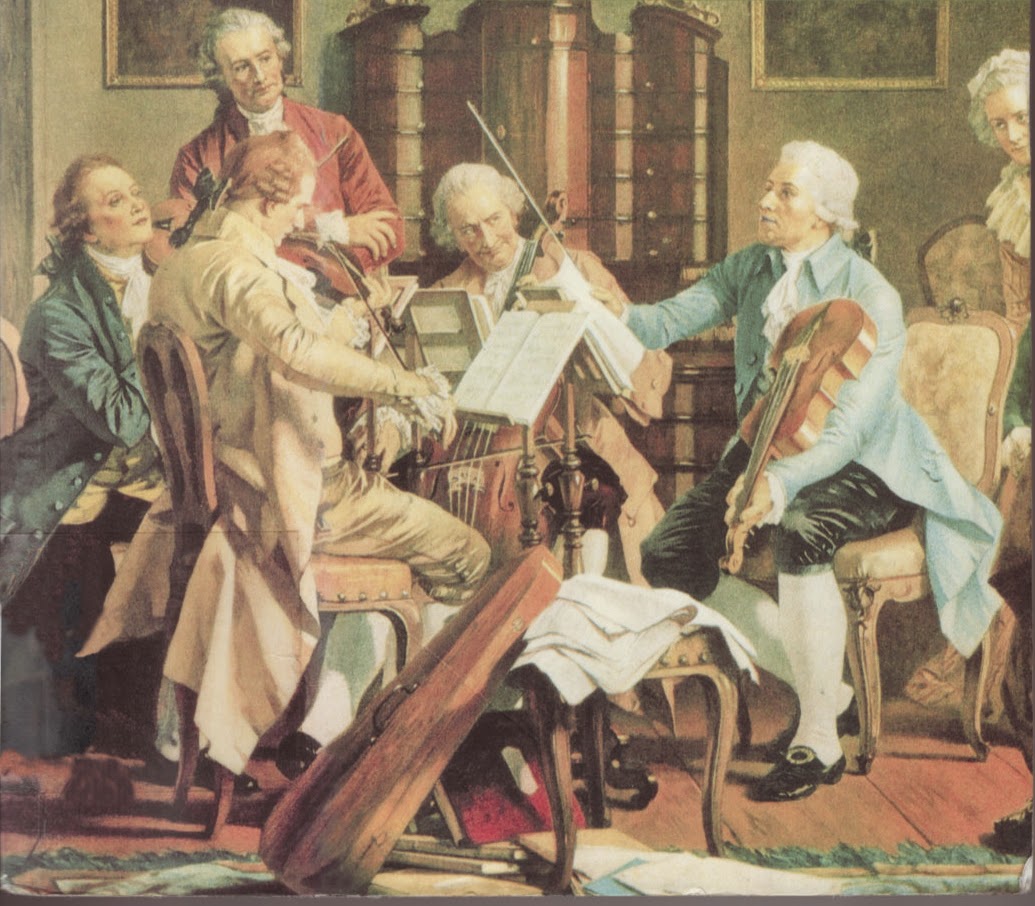
Sirotin, Ferents, Malina, Stepniak & Lee rehearse Schumann
 You may have heard Stepniak and Lee in the first concert of the series, Friday night's program of string trios by Mozart, Beethoven and Schubert, which you can read about, here.

This series of three concerts was inspired by the idea of what inspired these composers to the write these pieces: Mozart's string trio inspiring both Beethoven and Schubert; Schubert's Piano Trio inspiring Schumann when he later wrote this Piano Quintet; and, on the third concert - Wednesday at 6pm at Harrisburg's Civic Club - how a Mozart string quintet inspired Schubert when he wrote his own string quartet.

You can also read a few of my thoughts here about the importance of inspiration for a composer, looking especially at some influences on a composer familiar to the midstate, Jennifer Higdon.

The Schubert E-flat Piano Trio was one of Schumann's favorite pieces and he wrote about it in the music journal he founded. You can read more about his connections with Schubert and his music in this earlier post.

In this post, I thought I'd take you “up close and personal” with the piano quintet he wrote when he was 33, part of that productive summer of 1843 which also saw three string quartets and the piano quartet as well.

* * ** *** ***** ******** ***** *** ** * *

Here is a video of the Schumann Piano Quintet (complete in one clip) with pianist Daniil Trifonov and the Ariel String Quartet at the Arthur Rubinstein Piano Master Competition (Tel Aviv) in 2011. The Ariel Quartet will be performing on Market Square Concert's first concert of the new season, September 27th!
= = = = =

(Incidentally, Trifonov won the competition and also the special prize for "best chamber music performance")
= = = = =

You could probably say Robert Schumann was the first blogger - at least about classical music. The magazine he started in 1834, the Neue Zeitschrift für Musik, literally the New Journal for Music, was mostly a new music journal dealing with issues of the day, published twice weekly with four two-column pages per issue. Rather than focusing on writing reviews (at least in the traditional sense), he wrote about issues and concerns in the music world, countering the Philistine influence of the day’s stuffier critics. He and his writers, otherwise lacking the internet since Al Gore hadn’t been invented yet, offered a great deal of commentary and opinion. Schumann even supplied a few short stories now and then, often satirical, like the thinly disguised attack on his then ex-girlfriend Clara Wieck and her new boyfriend, Carl Banck.

Among the 300 articles he wrote over a period of ten years were discussions on musical and literary aesthetics by his alter-egos, Florestan and Eusebius. It was here he published his famous articles announcing the arrival of such new talents as Chopin and Brahms. Considering what the role of criticism has been in the traditional world of newspapers (and at least those today that still have music critics on staff), that’s more the sort of thing you’d find in the blogosphere, isn’t it? Sort of.

Schumann may never really have intended to be a composer any more than most pianists in those days wrote music for themselves to play. He only seriously began focusing on composing after he had injured his hand with one of Friedrich Wieck’s mechanical contraptions designed to strengthen the weak 4th finger during hours spent practicing. If he couldn’t keep him from marrying his daughter, Wieck at least managed to, however inadvertently, ruin Schumann’s career as a performer, so in a perverse way we owe thanks to him for knowing Schumann today as a composer.

All the music Schumann published in the years before his marriage were for solo piano, much of it intended for Wieck’s best pupil, Clara. There were also things like the little piece based on the letters ASCH, transformed into a musical theme (S is the German equivalent of E-flat, and H is B-natural), which was the home town of another piano student, Ernestine von Fricken, to whom he became secretly engaged while on the outs with Clara. This became a section of the suite Carnaval. A rather morose march by her father became the basis of the Symphonic Etudes which are really a set of variations (and even though Symphonic Etudes may be a slightly misleading title, it beats being known as the Fricken Variations). By the way, the engagement was broken off when Schumann and Clara got back together and when Schumann realized Ernestine was officially illegitimate (not that he was making much headway with this girl’s father, either).

Clara & Robert Schumann, 1850
After he and Clara were able to overcome the various legal hurdles her father put in their way, they were married in 1840, the day before her 21st birthday. So it’s rather surprising that he suddenly started composing other things than just piano music but all in concentrated bouts of feverish creativity – 1840 was a year of songs, followed by one of symphonies. And the next year, chamber music.

In his day, Schumann was probably better known as a writer about music than a composer of music. Actually, he was probably better known as Mr. Clara Schumann, trailing along on her fame to appear at her performances when she’d play some of his music. It was after one such tour resulted in a rather severe bout of depression that he composed his Piano Quintet. And also three string quartets and a piano quartet, all in about six months’ time, swinging from depression to a productive “manic” phase.

They had gone off together for a tour across northern Germany when it really hit him, this being in the shadow of his wife, so after a month he returned to Leipzig and his journal while Clara went on to Copenhagen without him. During her month-long absence, he studied fugue and counterpoint (again) and examined quartets by Mozart and Haydn, then later those by Beethoven. And he also drank a lot, slipping into a period of depression during which Old Wieck managed to spread the rumor that they’d separated and were heading for a divorce. Thoughts of a tour of America were shelved when Clara returned in April.

By June 2nd, he was sketching “quartet essays” and two days later began the 1st String Quartet. On the 11th, he began the 2nd Quartet even before the first one was finished. In between the 2nd and the 3rd Quartet, not begun until July 8th, he wrote a scathing article about Clara’s ex-boyfriend Carl Banck and his new composition (it was so nasty, Schumann did not include it later when he re-published most of his articles) and also ended up in a libel case which netted him a 6-day jail sentence which was commuted to “a five thaler fine” (whatever a thaler was worth, then, but an 1841 thaler recently sold on E-bay for $270). The 3rd Quartet was finished on July 22nd, seven weeks after he’d begun work on the first.

During August, there was a bit of a summer vacation - I should mention, without getting too personal, the Schumann’s second child was born nine months later - then back to Leipzig for rehearsals of the three quartets in early September. On the 23rd, then, he began work on the Piano Quintet which, after sketching it out in just five days, he completed on October 12th, 19 days after he started. Twelve days after that, he began the Piano Quartet which he finished in a month. In the next month, he also composed a piano trio which he later recast as the Phantasiestücke (Op. 88) and a work for two pianos, two cellos and horn that later became a set of variations for two pianos (Op. 46).

All of that in seven months! 

One of the curious things that most people forget today is that, before Schumann’s, there were no famous Piano Quintets. To Schumann’s, we would add those by Brahms and Dvořák, both famous (and equally over-played) but both later, as would be the less-well-known one by Cesar Franck and the most famous 20th Century one by Shostakovich. But when I mean “over-played,” it’s only because – how many masterpieces can a pianist and a string quartet, combining for a performance, play? There are no Piano Quintets by Mozart or Beethoven, though they wrote piano quartets, much less by their also-rans. Except for one by Prince Louis Ferdinand, who published one in 1803.

Also-ran he may be, but this prince, a nephew of Frederick the Great, King of Prussia (a great general and talented if not so great composer himself), played the piano “not like a prince but like a real pianist,” according to Beethoven (who dedicated his C Minor Piano Concerto to him). The Grove Dictionary entry for “piano quintet” indicates he was a student of Beethoven’s, but the dictionary’s biographical entry on the prince does not mention that fact.

Prince Louis was also considered a brilliant soldier, dying on a Napoleonic battlefield in 1806 about a month before his 34th birthday, killed by a French soldier after he refused to surrender. He wrote thirteen published works, his Piano Quintet in C Minor being his Opus 1, his only work published in his lifetime. There are three piano trios and two piano quartets, as well.

I suppose you could ask, since Schumann knew Prince Louis’ quintet and one could imagine him thinking “here’s a good idea that’s never caught on – take a string quartet and add a pianist,” what prompted Prince Louis to write one?

There are, basically, other works for keyboard and four string players – those by Padre Antonio Soler were intended for the organ, and those by J.C. Bach included the fortepiano or harpsichord more in its role of continuo, the traditional baroque duty of supplying the “harmonic filler” between the melody line and the bass line.

It was also the tradition, in the days before radios, television and stereos when people provided their own entertainment at home, that publishers made piano concertos available to the amateur public. Rather than deal with an orchestra (even the much smaller sized ones in Mozart’s day than the one we think of today), the orchestral part was either arranged or written for three or four string players. The piano here is purely a soloist and not, in the standard sense of chamber music, an equal partner to the strings.

Yes, while Mozart wrote two piano quartets with strings, he did write a quintet for piano and winds (not surprising, since he was delighted with the great wind players he found in Vienna), a work which Beethoven thought so highly of, he imitated it in one, himself. But Beethoven’s publisher also realized there were few opportunities for performances, given the number of wind players as opposed to the number of string players around, so he suggested Beethoven also arrange the work for strings and get more mileage out of it. But curiously, rather than arrange it for four strings, one to each wind part, he reworked it into the more standard format of piano quartet. Perhaps if he had decided on a string quintet, he might have written the first Piano Quintet and decided it was really a good medium and written an original one or two. And others may have come along and done the same. But, alas... another chapter in the great game of “What If...”

By the way, a “Piano Quintet” really means a piano with four other players, though it’s usually defined as a piano plus a string quartet (two violins, viola and cello) – or if you’re a string player, a string quartet plus a piano (since it’s more likely you’ll find a pianist being added to a string quartet program than vice-versa). To distinguish them, the two works with winds I mentioned by Mozart and Beethoven are called “Quintets for Piano & Winds.” And since the Trout Quintet by Franz Schubert uses one violin, viola and cello, then adds a double bass, it’s technically not a “piano quintet.” Fortunately, it can just be called the Trout Quintet on the fly rather than the official “Quintet in A Major for Piano & Strings.” But that’s another topic...

Dick Strawser
(reprinted largely from an earlier post in 2008)

Summermusic 2014: Schumann and Schubert's Piano Trio

Sirotin, Chang & Lee
The second performance of this season's Summermusic programs is Sunday afternoon at 4pm at Market Square Church and consists of two works – another work by Franz Schubert, whose String Trio of 1816 was included in Friday night's concert, and the only appearance in this series by Robert Schumann who, as a young man, was much attracted to Schubert's music at a time when it was not well known.

Ya-Ting Chang will be the pianist, joining Peter Sirotin and Cheng-Hou Lee for the Schubert Piano Trio. Stuart Malina will be the pianist, adding violinist Leonid Ferents and violist Michael Stepniak to the mix, for the Schumann Quintet.

(You can read my post about the Schumann, here, as well as earlier posts about the program of string trios by Mozart, Beethoven and Schubert, here.)

Schubert in 1827
Schubert's Piano Trio in E-flat was written in 1827 in the months following Beethoven's death; Schumann's Piano Quintet, also in E-flat, was only part of an amazing concentration of works composed in the “Chamber Music Year” of 1843.

Schubert was not yet 31; Schumann was 33.

Schubert would die the following year; Schumann attempted suicide when he was 43 and would die alone in an asylum not long after his 46th birthday.

When Schumann was a 16-year-old law student in Leipzig, he had discovered Schubert's music and would improvise every day and even began composing a piano concerto in F minor. The following year, he noted he was probably more enthusiastic about Schubert's music than Beethoven's, and even wrote Schubert a fan letter (“not sent”).

= = = = =
Pianist Dmitri Vinnik, violinist Sviatoslav Moroz, and the legendary cellist Natalia Gutman perform the 1st Movement of Schubert's Trio in E-flat, recorded in the Kremlin in 2009:


= = = = =

Schumann as a boy
In mid-August of 1828 – during the time Schubert was beginning the C Major Quintet and finishing a number of songs which would become Schwannengesang – Schumann, now 18, wrote about Schubert's “Wanderer Fantasy” (D. 760, November 1822) that “Schubert would like, in this work, to condense the whole orchestra into two hands, and the enthusiastic beginning is a seraphic hymn to the Godhead; you see the angels pray; the Adagio is a gentle meditation on life and takes the veil from off it; then [in the finale] fugues thunder forth a song of endless humanity and music.”

Despite promising his mother he would focus on his law studies, he improvised or composed every day and rarely (if ever) attended any lectures. That autumn, he began taking piano lessons with Friederich Wieck who had a daughter named Clara.

When he learned of Schubert's death that November, a friend noted that Schumann's sobbing could be heard throughout the night.

= = = = =
Vinnik, Moroz and Gutman continue with the 2nd Movement of Schubert's Piano Trio in E-flat:

= = = = =

He started the next year by beginning a “Schubertian” Piano Quartet in C Minor (which he called his Op. 5 though in fact it would never be published).

Then Schumann essentially “transferred” to another law university – this time in Heidelberg – where he continued to study music on his own, writing to Wieck that he was working on a Hummel sonata and asking him to send him all of the two-hand waltzes by Schubert he could find (“there are 10-12 sets of them,” he suggested).

In April the following year, having begun (but never finished) several symphonies, he also composed a series of waltzes clearly inspired by Schubert's.

Schumann's father, who'd died in 1826, had been a book-seller and publisher (as well as an author) and of all the major composers, Schumann was always the most literary-minded. In 1831, he began fashioning ideas for a novel of his own called Die Wunderkinder (“The Prodigies”) with characters like “Zilia” (based on Clara Wieck), her teacher “Master Raro” (on her father, Friederich Wieck) with himself as “Florestan the improviser” and in which Paganini (under a pseudonym) would play a major role.

He also began a series of “Sehnsucht” Waltzes initially called “Variations on a theme by Schubert” which he never finished but which supplied the opening material for “Carnival” which he began in 1833, finished two years later and published in 1837.

Meanwhile, there were more connections made with Schubert's music.

In 1836, he and Mendelssohn were listening to Schubert's “Hungarian Divertissement” for piano duet (D.818) when Mendelssohn “stamped his feet impatiently” at the repetitions. This was one of the few instrumental works of Schubert's available then, a piece which gave rise to numerous negative reactions to his music. An uneven work, it was only intended as an evening's entertainment for the daughters of his summer employer, Count Esterhazy at Zseliz in Hungary, a poor relation of the Princes who graced Haydn's life in earlier generations. It is hardly a masterpiece but it met the publisher's needs for the amateur market and for it, Schubert received 300 florins.

(Not sure by which currency standard this was as in 1811, during the French wars and the bankruptcy of the Austrian state, there was a currency devaluation that wreaked havoc on Beethoven precarious financial state, on his benefactors and the stipend three of them had guaranteed him: if these are “old” florins, it would be almost as much money as he earned from his benefit concert in March, 1828 – 320 florins – which made him feel quite flush, for a change.)

This would be like a future generation judging Beethoven, ignorant of everything else he had composed, solely on one work, Wellington's Victory (which also, by the way, made Beethoven feel quite flush, for a change, as well, following the recent financial devaluations).

Then in 1838: the Grand Duo, the name given the Sonata in C for Piano Duet (D.812, June 1824, in Zseliz), was published (and re-titled) by Diabelli  – “Sonata” being an unwelcome term in Vienna by then, scaring away the amateur market as being too learned, technical and old-fashioned – which the publisher dedicated to the pianist Clara Wieck (not yet Mrs. Schumann) and which prompted Schumann to see in it a “hidden symphony” (he would later call Brahms' first piano sonatas “veiled symphonies”). He was convinced it was Schubert's lost symphony from Gmunden-Gastein (which was probably the first sketches for the Great C Major Symphony which he returned to by March 1828 and completed that summer). Subsequently, Diabelli gave Clara the original MS which clearly indicated it was a duet sonata for piano four-hands but that didn't stop Schumann from thinking that Schubert still thought of it “in his own mind” as a symphony!

Schumann in 1839
By the time Diabelli finally decided to bring out Schubert's last three piano sonatas – all written one after the other in September, 1828 (these three incredible masterpieces all written in less than one month!) – ten years had passed (even though they'd been engraved as early as 1831) and Schubert's intended dedicatee, Johann Nepomuck Hummel (a piano student of Mozart's and the greatest pianist of the age), had died. So instead, Diabelli published them with a dedication to Robert Schumann.

This was probably more a marketing if not political move than an artistic one, given Schumann the influential critic and Schubert fan who would no doubt write favorably about them and boost their sales: otherwise, there wasn't much call for a largely unknown composer's virtuosic sonatas among the amateur market.

Also in 1838, Schumann wrote about the Piano Trio in E-flat (D.929, Op.100) in the Neue Zeitschrift für Musik (or the New Journal for Music): “It is about ten years since a trio by Schubert passed, like the portent of a stormy sky, over the disturbances of the contemporary musical scene.” This trio he finds “more stirring, virile and dramatic” than the B-flat Trio: in the E-flat Trio's 1st movement he saw a “deep indignation and a limitless nostalgia;” in the Andante with its march-like accompaniment and aching cello melody at the opening, there were “sighs that would rise and spread until they swell into the heart's anguish.” He felt Schubert was at his finest in the finale.

(Remember that: I'll get back to this, later...)

While I've not been able to find the original article, the biographer who quoted this tidbit didn't mention the scherzo which, again very Haydnesque, is built on a sprightly canonic theme, not that one would normally associate canons with sprightliness, something that would have been one of Papa Haydn's little jokes, too.

= = = = =
The Beaux Arts Trio - Menaham Pressler, Daniel Guilet, Bernard Greenhouse - with the 3rd Movement of Schubert's E-flat Piano Trio:

(the illustration for these last two clips is an illustration inspired by the collection of folk tales known as Des Knabens Wunderhorn or 'The Youth's Magic Horn' - it's by Moritz von Schwind, a close friend of Schubert's)
= = = = =

When Schumann was in Vienna in 1839, he made a point of finding Schubert's older brother, Ferdinand, usually described as a teacher and amateur violinist who looked after his little brother throughout his life, but especially in his final illness. Shortly after Franz's death, Ferdinand tried to locate as many of the manuscripts that his brother had left in other locations – with his friend (and frequent roommate) Franz Schober, with other members of the family and from the home they'd grown up in. Realizing Schumann was the great music critic who'd written glowingly about Franz's music, Ferdinand gave Schumann a box of manuscripts which included, among other things, the “Great” C Major Symphony which Mendelssohn then premiered the following year (players objected to the great length and especially the tiring repetitions in the finale).

(Again, remember this, as well...)

As a composer, then, these are just some of the connections between Robert Schumann and the music of Franz Schubert. Whatever inspired Schumann to compose and however he developed his own voice, Schubert was one of his “favorite composers” and had a direct influence on several of Schumann's early works.

We don't need to fast-forward much, now – to 1843 when Robert has finally been able to marry Clara (that in itself is worth a novel) and he has decided to write some chamber music.

I've written about that amazing summer when Schumann wrote three string quartets one after the other, followed by the Piano Quintet and the Piano Quartet (both in E-flat), all within the space of a few months – you can read a separate post about it, here.

Suffice it to say, Schumann who was considered “manic-depressive” when that term was in vogue – for that matter, the term might also apply to Schubert following his first bout with syphilis in 1825 (around the time he was working on the B Minor Symphony and the “Wanderer Fantasy,” speaking of material for a novel) and he had been experiencing another severe bout of depression when he'd completed this Trio and resumed work on his song cycle, Winterreise. Anyway, Schumann set about preparing for his own string quartets while in one of his "up" periods by studying the quartets of Mozart and Haydn. But was Schubert's music far from his mind? It's quite likely echoes of at least the E-flat Trio could still be buzzing around in his head, more than just the coincidence of the Piano Quartet and Quintet being in the same key.

Listening to these pieces today, I cannot help but think of Schumann the 33-year-old composer who'd written a fan letter to Franz Schubert when he was 18 but which he never sent... He, like many of us in similar situations, might have assumed there would be plenty of time to get in touch with his favorite composer in the future: after all, the man was only 31...

* * ** *** ***** ******** ***** *** ** * *

Remember what I'd said earlier about Schubert's long-windedness (something he and I have in common)?

Even friends of Schubert thought the E-flat Trio's finale was too long, too repetitive, too diffuse.

= = = = =
The Beaux Arts Trio plays the finale from Schubert's Trio in E-flat (I'm not sure which edition they're using but it feels like the original...)

= = = = =

“The finale, however, is the weakest movement” was a comment frequently lodged at Schubert's large-scale works, from piano sonatas to symphonies. Was he conscious his finales were “weak”? He was clearly trying to expand the form along the lines of Beethoven just as Beethoven himself was expanding his ideas on form and content with what we call the “Late Period” which began around 1818.

But if so many people thought that at the time, how did Schumann think otherwise?

In most of the “classical era” (the time of Mozart and Haydn as well as early-Beethoven and Schubert), the original idea of a symphony was a sonata movement to begin (usually with a slow introduction), the clear weight of the entire work resting in the intellectual drama of its structure (the material's exposition, development and its resolution in the recapitulation) followed by a slow movement followed by a light-hearted dance movement, a courtly minuet befitting the aristocratic audience for whom these works were composed, in the days before public concerts and which Beethoven replaced with a more down-to-earth scherzo, literally a “joke,” which would be more appealing to the middle-class concert-goer. As slow introductions became less common, the feeling grew that the form needed a more conclusive finale: Haydn added a rondo, still on the lighter side, to conclude. For some reason, Mozart, in writing his last symphony, the “Jupiter,” wrote a finale of intellectual virtuosity that still maintains the high spirits felt necessary for a “happy ending.”

Beethoven, certainly, changed that as he expanded his movements in the first place, especially the finale and specifically with his Third Symphony, the Eroica – the Harrisburg Symphony plays this at their first concert in the newly renovated Forum this fall – and then used the finale to resolve the drama of the first movement in his 5th. Certainly, by the time he got to his 9th Symphony, the massive “Choral” Symphony, in 1825, the finale was the clear goal of the entire piece, even though he had no idea what shape and scope his finale would take when he began work on the opening movement!

Schubert was still in the more Haydn-like mode of an entertaining, light finale often using child-like themes not unlike some of Mozart's last piano concertos – and the Divertimento in E-flat heard Friday night, also. After a dancing third movement (either minuet or scherzo) with a middle trio which often included some of Schubert's most pristine if not sublime moments, his finales were usually Haydn-like rondos that seemed to go on forever with more and more episodes going further and further afield, tonally. And they're also beastly difficult to make sound compelling enough to listen to: I've heard too many performances where it was just “I don't know what's going on here, but let's try to have fun, shall we?”

Only Michael Brown's performance of Schubert's D Major Sonata (D. 850 of 1825) captured (for me) the intimacy and playfulness – and above all the commitment – that made this music compelling and worth listening to. (You can read my comments about that Market Square Performance, here.) If he can do it, why can't other performers? Well, that's what interpretation is all about (ah, sweet mystery of art...).

But that is not something that Schubert should be blamed for, just because we now think the symphony or the sonata is what Brahms and later composers made of Beethoven's model.

Still, in comparison to those first two movements, the last two movements of almost any large-scale Schubert work might seem – in our hindsight – less significant, less intense, even inferior.

Schumann wrote of Schubert's “heavenly lengths” – his reaction to the repetition of Schubert's themes and especially the long, often rambling finales – considering most Germans took issue with these last movements. It might be comparable to people nowadays having issues with minimalism... Certainly in the 19th Century, it went against the general Romantic grid whether it's Mendelssohn's or Wagner's. When Mendelssohn took the “Great” C Major Symphony to London, the orchestra rebelled and refused to play it, as well, and so Mendelssohn retaliated by taking his own eagerly-anticipated music off the program.

So, here was Schubert planning to use one of these two piano trios he had recently completed – we assume the B-flat was written first (even Schubert suggested Op.99 for the B-flat and Op.100 for the E-flat despite when they were actually published years following his death) – and being told by his friends the last movement was too long (something people sometimes tell me about my blog posts, by the way). They'd now had a chance to hear the E-flat Trio twice, once at a December concert at the Musikverein (which for all its high-sounding German means only “Music Club”) and again at a party celebrating his friend Spaun's engagement to be married.

On top of that, his violinist friend Josef Slawjk had recently premiered his new “Fantasy in C” for violin and piano (D. 934) which also went on “forever” and at the end of an already long program, several people walked out of the hall. It turns out Slawjk's technique wasn't up to the piece and it was probably not being well played (frankly, I have heard few performances that kept my interest – even great musicians like Isaac Stern – and more than one violinist friend of mine refuse to play the piece).

Whether it was Slawjk's fault or the composer's, Schubert wanted to avoid having people walking out of his own concert, so he agreed to make cuts. Most sources say he cut 99 measures, others less. The problem comes when Probst of Leipzig published the parts (but not the score) with Schubert's cuts – and still people thought it too long – and then, in 1886, another publisher issued the score with most of the cuts restored. Apparently it was years later when Schubert's original intentions were finally published.

So, apparently, Schumann knew this long finale from the “cut version,” not the original version we're more familiar with today.

But even so, this creates nightmares when gathering musicians together to perform the piece. Peter Sirotin and Ya-Ting Chang, as members of the Mendelssohn Trio, used the “complete” edition, but when inviting Cheng-Hou Lee to join them for this performance, they discovered he uses one of the “not-quite complete” editions which makes it almost like learning a new piece since one player is used to this passage leading to that passage but, wait a minute, what's this?

Chamber Music, you see, is not all fun and games...

And by the way, I made several cuts to the first draft of this post – over 1,000 words – so, there...

Dick Strawser


Wednesday, July 16, 2014

Summermusic 2014: String Trios, Part Two - Beethoven & Schubert


 (This is a continuation of an introduction to the first program of for this year's Summermusic. You can read Part One here.)

As I mentioned in my introductory post (which you can read here), Beethoven had planned on going to Vienna, leaving his provincial hometown of Bonn behind, to study with Mozart. He had been to Vienna briefly, may have met Mozart, even may have played for him (the remark Mozart was supposed to have made about hearing him play is probably apocryphal, that “this youth may some day make a noise in the world” – Beethoven himself never mentioned having met Mozart).

Fanciful Painting of Beethoven playing for Mozart (pub. 1919)
Still, for many young musicians who knew what was going on in the greater musical world, Mozart was a name to reckon with even if Haydn was more famous and, on the whole, more successful.

Unfortunately, Beethoven couldn't stay in Vienna. He would be only 16 then, called back to Bonn after barely two weeks there once news arrived that his mother was dying.

Family obligations and a lack of financial backing delayed a return to Vienna, and Beethoven, who was developing more as both pianist and composer. One of the works he composed, the E-flat Major Piano Quartet (on of those “WoO” Pieces – never published and known by this abbreviation for “Work without Opus”) was clearly modeled on Mozart's G Major Violin Sonata K.379 – this is the one famous for Mozart's not having had time to write out the piano part in time for the scheduled performance, playing from a score which included the violin part and blank measures for the piano: no, he did not “make it up on the spot” as I've heard people say – he was merely remembering what he'd composed in his head before he'd gotten to the mundane process of writing it down, in itself no small feat). Published in 1781, it became the inspiration for several of Beethoven's themes for this piano quartet in 1785 – at least, his way of writing them – and though he never published it (perhaps because he felt it too imitative of Mozart's style), he did use certain ideas from it in no less than four of his Viennese piano sonatas, including the famous Pathétique. As many young composers have done before and since, Beethoven learned compositional details by imitating what he admired. It is quite possible other sonatas from this set of Mozart's supplied inspiration for the other two piano quartets Beethoven composed at the same time.

By now, things looked good to plan a return trip to Vienna for the following year – 1792. Unfortunately, Mozart had died in December of 1791.

But the pull of going to Vienna to prove himself and to find his career was too great to put aside: so instead, he went to Vienna to study with the next-best-thing – the great and more widely acclaimed Franz Josef Haydn.

And so that is how Count Waldstein's words came true: that he “might yet receive Mozart's spirit from Haydn's hands.” Beethoven arrived in Vienna within a year of Mozart's death. Unfortunately, Haydn turned out to be a not very good match for the young man from Bonn. It was doubtful if Haydn was really all that good a teacher in the technical sense: he seemed to miss many mistakes in Beethoven's counterpoint assignments, a fact much tittered about by Albrechtsberger who later took up Beethoven's lessons when Haydn took off for his second trip to London.

So Beethoven did was he could to “learn” from Mozart – by hearing his music, studying his scores and playing his concertos (he was well known for his performance of Mozart's C Minor Concerto which, presumably, influenced his own C Minor concerto a few years later).

Did he “imitate” Mozart's E-flat Divertimento when he came to write his own string trios?

It's unlikely he was unaware of it. There are four other trios before the C Minor one on this program, and it might be more effective to listen to them in chronological order to see how similar these earlier ones are to their possible model.

Here is the opening movement of the first string trio, Op. 3, with the autograph score!

= = = = =

= = = = =

Even here, this is obviously already Beethoven, not a slavish imitation of Mozart's style.

And while we don't know exactly what order the Op. 9 trios were written, it's quite possible the C Minor, like the third of the piano trios in the same key, was not the last to be completed.

While Beethoven might have “imitated” Mozart by taking his Quintet for Piano and Winds in E-flat, K.452 of 1784 and “doing likewise” in what became his quintet for the same instruments in the same key (Op. 16 of 1796-97), he might by now have assimilated enough of Mozart's style into his own not to need direct models.

Beethoven, perhaps before 1800
All of Beethoven's string trios were composed between 1796 and 1798 – the first two published as Op. 3 and Op. 8 (notice the Quintet of 1796 is Op. 16: opus numbers are never a source of chronology in Beethoven's works) and the last three as Op. 9. Even the first of Op. 9 still sounds like “entertainment” music, the divertimento style of the courtly classical composer typical of the 18th Century. It is the C Minor trio that steps beyond this and becomes a work more recognizable as the “mature” Beethoven. Indeed, this is the most “advanced” work Beethoven had so far composed – but that would change.

The first movement of the C Minor String Trio - like Mozart's E-flat Divertimento - opens with a brief unison statement. But from there, it goes off in a direction clearly Beethoven's. But there's much more Mozart beneath the surface than may seem obvious to the casual listener.

= = = = =

= = = = =

The following year, he would begin work on his first six string quartets which would mark the high-point of “Early Beethoven” and point the way forward into the new century.

* * ** *** ***** ******** ***** *** ** * *

Though the last in chronological order, Schubert's one movement String Trio in B-flat, D.471 (to distinguish it from another String Trio also in B-flat Major, D.581, a complete, four-movement trio written the next year) is second on the program and perhaps it's better that way. You can hear the more direct influence of Mozart on Schubert rather than Beethoven's intervening take on Mozart (written almost two decades earlier) which would have little or no influence on Schubert at this time.

= = = = =

= = = = =

Franz Schubert at 17
Compared to Mozart (and even Mendelssohn, later on), Schubert got a late start, though anyone who could compose “Gretchen am Spinnrade” at the age of 17 and the famous “Erlking” the next year, is no slouch in the prodigy department.

Like Mozart's early works, Schubert's are derivative of the age he lived in – barring Beethoven – and while many do not seem terribly innovative, even those two songs are enough to make us realize that here is a true and (already) original talent.

As a boy, Franz Schubert won a chance to sing in what became known as the Vienna Boys Choir – yes, that Vienna Boys Choir – in 1808. He had already “auditioned” for Antonio Salieri, the court composer – yes, that Antonio Salieri, the one “accused” of murdering Mozart – the year before. He already sang well (he was first in the auditions that year) and played the violin and piano. He had also begun composing, apparently had been as soon as he could read music: none of these compositions have survived – the first work in the catalogue, a piano duet, was written in 1811.

In the years leading up to 1816, young Schubert had written four masses, four symphonies (a fifth would be written in the weeks following this string trio), maybe a dozen or more string quartets (not all completed) for the family quartet to play – amateurs making their own music, what people did before the invention of TVs and sound systems – and some 248 songs.

One could hardly think these masses and symphonies and especially the quartets belong to the same years Beethoven was composing his 7th and 8th Symphonies and his last violin sonata which preceded a horrendously dry period which didn't seem to lift until he had regained some self-confidence with the popularity of Wellington's Victory in 1815 and eventually beginning what we call his “Late Period” with the Hammerklavier Sonata of 1818.

Salieri, as a teacher, was probably even more conservative than he was as a composer. Even during Mozart's day, he was considered a reactionary and the 25 years after Mozart's death didn't seem to change Salieri's viewpoint. He was a proponent of Italian lyricism and was genuinely not interested in Schubert's settings of German poems – which may be one reason many of the songs sound so completely different from most of his instrumental and choral works, especially those that he showed to his teacher.

In June of 1816, Salieri was celebrating the 50th Anniversary of his arrival in Vienna as a 16-year-old boy tagging along with his teacher Florian Gassmann, a student of the famed Padre Martini (who would also figure in the training of the teen-aged Mozart very briefly and who, incidentally, also figures in the list of those teachers I mentioned in Jennifer Higdon's compositional legacy in the previous post, here). Gassmann, by the way, had come to Vienna to produce his operas – which Mozart thought were so terrible, some of them not even making it as far as three performances, he wondered if Gassmann's goal wasn't to kill off German opera before it had even begun.

Nonetheless, in 1816, Salieri was in an expansive and reflective mood and for a celebratory gathering of his pupils, Schubert – just another of his students, though the only one whose name we'd recognize – wrote a small cantata (D.407) which they were to perform for their master at a “jubilee dinner.”

This brings to mind two diary entries. Now, Schubert was not a regular journal-keeper, but at this particular time, he made several entries over a period of a few days.

On June 13th (1816), he noted a visit to a musical salon where he was one of the performers. He doesn't say where this was or how much he was paid (if at all), but he heard a Mozart string quintet, “so to speak one of his greatest minor works.” As Elizabeth McKay writes in her biography,

= = = = =
“[h]e enthused over the beauties of the music and the unforgettable impression it made and praised the playing of the leader of the quartet [sic]. In the context of his aesthetic approach to music, he wrote of its power to raise the spirits, to lighten darkness with hope and confidence, bringing 'comforting images of a brighter and better life...'. For Schubert this was, as he began his entry: 'A clear, bright, fine day' which 'will remain [with me] throughout my whole life... O Mozart, immortal Mozart...'.”
(– Elizabeth McKay, “Franz Schubert: a Biography,” (p.61) Clarendon Press (Oxford) 1996.)
= = = = =

Schubert then performed a set of variations by Beethoven (presumably Op. 34 of 1802) and sang two of his own songs.

More telling is the entry he jotted down after returning home from Salieri's party and the performance of his cantata three days later:

= = = = =
It must be fine and enlivening for an artist to see all his pupils gathered around him, each one striving to give of his best for the master's jubilee, and to hear in all these compositions the expression of pure nature, free from all the eccentricity that is common among most composers nowadays, and is due almost wholly to one of our greatest German artists; that eccentricity which combines and confuses the tragic with the comic, the agreeable with the repulsive, heroism with howling and that which is most holy with harlequinades, without distinction, so as to goad people to madness instead of soothing them with love, to incite them to laughter instead of lifting them up to God. To see such eccentricity banished from the circle of his pupils and instead to look upon pure, holy nature, must be the greatest pleasure for an artist who, guided by such a one as Gluck [who had been one of Salieri's mentors], learned to know nature and to uphold it in spite of the most unnatural conditions of our age.
(quoted in McKay, ibid, p.63.)
= = = = =

The reference to “one of our greatest German artists” is a way of introducing Beethoven into the conversation without mentioning his name. Aside from the fact Schubert had just been celebrating the music of Salieri (and the influence of Gluck, long out of fashion in modern Vienna), remember the “craze” for Beethoven had fairly much petered out after his 7th Symphony: dealing with renewed symptoms of his deafness, Beethoven wrote no major works (counting Wellington's Victory as a “not major work”) since the end of 1812. When he would start producing new and what we consider “great” works again would not be until 1818, and even then, this Late Period style left more people confused than enthusiastic.

(While it might be only as a suggestion for light summer reading, I have my own purely fictional account of Beethoven's troubles at this time of his life in an excerpt from my novel, The Labyrinth of Klavdia Klangfarben, dealing with “The Tale of the Master and His Belovèd” which, I repeat, is entirely fictional.)

Incidentally, it's interesting to note that the next day, June 17th, 1816, Schubert wrote in his journal “today I composed for money for the first time... a cantata for the name-day of Professor Watteroth,” a highly respected law professor in Vienna. This cantata, Prometheus, unfortunately, has become lost, but imagine that Schubert, having already composed 450 works, has finally earned some money from his compositions!

That September, Schubert began writing a string trio, D.471, what is considered a one-movement work. However, there is also the start of a second movement which was abandoned after a few measures, so the work was neither a one-movement assignment or a work complete in one movement. Like many pieces he would begin – most of his operas, more than one symphony, as well as the “Quartetsatz” in C Minor – it would remain incomplete.

This was followed by his second commission, a cantata for a family “sponsor,” Joseph Spendou, who was the administrator of a charity to distribute money to the widows of school elementary schoolteachers which, that fall, was celebrating its 20th anniversary. Then there were some short choral pieces for his church choir, some piano pieces (including a sonata), some songs on Goethe's Wilhelm Meister poems, plus a new symphony – his 5th, the one “without trumpets and drums” – for his friends in an amateur society who frequently got together to read through orchestral music (Schubert led the viola section).

All of this during the month of September, 1816. And all of which espouse the ideals he heard in the music of Mozart, if not those championed directly by his teacher, Salieri.

However, Schubert's attitude toward Beethoven would change considerably as he also matured into his own “late period.” More of that when we hear the E-flat Piano Trio on Sunday's program and the incredible C Major String Quintet on the last program on Wednesday evening.

– Dick Strawser


Summermusic 2014: String Trios by Mozart, Beethoven & Schubert, Part One

The first program for this year's Summermusic is 8 pm on Friday evening at Market Square Church.

(You can read more about them in Ellen Hughes' article with the Patriot-News here, and in the initial post for this series, examining “inspiration” in the selection of the programs, here.)

All three works on this program – string trios by Mozart, Beethoven and Schubert – were written within a span of 28 years.

This would be not much different, if they were written in our lifetimes, to hear a rather derivative work composed by a promising student who might become a major name in a few more years, something he'd written earlier this year, along with a significant work by a well-known and much respected (if not financially successful) composer who died 25 years ago in 1989, a work written in 1986.

In between, there's a composer who's gone on to become one of the most innovative new names in the music world (though fallen on difficult times at the moment – written out? his fame has certainly already crested) but at the time was doing some startling things that set tradition-loving audiences back then on edge. An early work, it was written in 1995 back before anybody had ever really heard of him.

So the Mozart Divertimento in E-flat (K. 563) would be the equivalent of the one written in 1986... Schubert's String Trio in B-flat (D.471) would be the newest piece, written in 2014... and the Beethoven String Trio in C Minor (Op. 9, No. 3) would have come out just three years before his first real success, a set of string quartets and a symphony, written before the New Millennium.

Taking our time machine back to 1816, however, we'd be aware that Mozart had died in 1791 at the age of 35, just three years after this Divertimento; that Beethoven, a 27-year-old late-bloomer, had began his three string trios of Op. 9 in 1797, and was still unknown; and that Schubert, still a teen-ager, legally, when he was studying with a man named Antonio Salieri, started work on a string trio that might have been a composition assignment at a time when he was also unknown (and who, if the stories are accurate, would never really become well known in his lifetime).

* * ** *** ***** ******** ***** *** ** * *

While we don't come into this world with a “use-by” date stamped on our left butt-cheek, the term “mid-life crisis” is fairly vague when it comes to someone who died in their early- or mid-thirties. Mozart was hardly “middle-aged” when he was 17 or Schubert, when he was 15 (the earliest works we have by him come from a few months after his 13th birthday, a late-bloomer, compared to Mozart, whose first piece was jotted down when he was 5).

So it's amazing to consider that, between his 13th Birthday and his death a few months before he'd turn 32, Schubert produced almost 1,000 works – mostly songs and many short piano pieces, but also lengthy masterpieces like the “Great” C Major Symphony, those last three piano sonatas, two great piano trios (the E-flat Major trio's on Sunday's program), and the C Major String Quintet (on next Wednesday's program), all written in the last two years of his life.

If Beethoven died as young as Schubert did, we would know him as a student of Haydn's who'd composed a very nice set of six string quartets and a symphony that showed a great deal of promise. He didn't become “BEETHOVEN” as we think of him today until he'd written his Eroica Symphony (which the Harrisburg Symphony will be playing on its first concert this season) when he was 33. So if he'd only lived as long as Mozart, then, we'd know Beethoven as someone with considerable potential and then play the game we so often play with Mozart and Schubert – “What if...?

Of course, we know who Beethoven became – and he only lived to be 57, by the way – but we don't often think where he came from, so this program gives us an opportunity to put him in context. And in a fairly limited context: the rarified textures of a small ensemble that never became as popular as the string quartet and which never amassed the repertoire an additional player would bring to it.

Mozart's trio represents the culmination of a way of thinking about art – the balance and proportion that are the hallmarks of the Classical Age (at least, generally).

Beethoven's represents a way of thinking about that way of thinking about art by going beyond the acceptable limits of musical propriety, something he would do more openly in his later works but which were already evident to his contemporaries in his first piano trios, his Op. 1: we think of them as “Haydn-esque,” but Haydn thought the world wasn't ready for the C Minor Piano Trio and supposedly suggested it be held back a while (in any event, he suggested placing it third in the group so as not to put people off as the opening piece in the collection). As it was, they were published in 1795, at least a couple of years after they'd been completed.

As you listen to Beethoven's string trio after the Mozart, remember they're separated by only 9-10 years.

Schubert's, the last of these to be written – he was 19 at the time – would seem to ignore everything Beethoven was implying possible. And keep in mind, Beethoven began his trio the year Schubert was born. But Schubert, aside from still being a student, was more typical of Beethoven's contemporaries. If we examine other composers active in Vienna during his lifetime, Beethoven was never a composer who then everybody started imitating. In fact, many composers openly disliked Beethoven's “advancements” in music, including Schubert. Carl Maria von Weber, one of the more significant composers of the Early Romantic School, heard Beethoven's 7th Symphony (from 1812) and thought he was “ripe for the mad-house.” Though acclaimed and “popular,” Beethoven was not the idol he'd become to later generations.

And so, with Schubert, we'll hear what much of Vienna thought was “good music,” as if 20 years of Beethoven had never existed.

(Oh, and by the way, speaking of limitations, these three composers' works on this program not only represent a span of 28 years – they also represent only a small part of what today is downtown Vienna, not what was going on elsewhere in the musical centers of Europe. It is because of the concentration of composers like Haydn, Mozart, Beethoven and Schubert in the Imperial capital of Vienna that we can properly proclaim there was no other musical center like it at the time. And of these composers – and many after them – Schubert was the only one who could call Vienna his hometown.)

* * ** *** ***** ******** ***** *** ** * *

(Mozart (in light blue) playing the viola)
Since this post is primarily about the influence of Mozart on Beethoven and Schubert, I needn't spend a lot of time on the development of Mozart's style and how he came to write this particular piece.

Usually, we associate “divertimento” with a piece meant for light entertainment in the late-18th Century, something diverting and often used synonymously with “serenade” which at least specifically referred to an evening's entertainment. Another term we might come across for such music was “cassation.” Anyway, the scoring for such pieces could range from small orchestras to small ensembles – many such dinner-party pieces were for wind octets.

This one, composed in September of 1788, happens to be for string trio and while it seems a lengthy work for a concert piece, its six movements were very much like the serenades Mozart composed for Salzburg, multi-movement pieces which often lasted between 45-50 minutes. Lightness here refers to mood rather than content: it is a well-crafted piece and by no means a quick knock-off for mindless background music.

Here's the first movement of Mozart's "Divertimento" with the Grumiaux Trio (the score is an arrangement for piano):
- - - - -

- - - - -

The story behind it is fairly straightforward: Mozart, very talented at living beyond his means (he was never a very good manager of reality in general, always a sore spot between him and his often contentious father), was forced to borrow money from friends to make ends meet. Many of these letters survive and if nothing else show Mozart in an entirely different light, whether his straits are genuine (at least to that extreme) or he was also talented at turning the right phrases to win over his friends. The begging Mozart is a very different image from the otherwise care-free bon vivant we have from other sources.

But then his music so often has these two extremes even in a single phrase: all it takes, at this time in music history, is to suddenly inflect a lowered sixth scale degree to open up a whole world of emotional turmoil, a harmonic dissonance – this shadow of the minor key – that was so unusual to the music of the day. It didn't originate with Mozart: he borrowed it from Carl Philip Emmanuel Bach, the most famous of Bach's sons, whose “empfindsamer” or expressive style was full of such devices which rarely failed to cause an emotional twinge in the more attentive listener.

Whether this “divertimento” was written to pay off a debt or not, it was dedicated to Michael Puchberg who was one of Mozart's “frequent lenders,” a fellow Mason and a successful textile merchant. There are nineteen of these “begging letters” that have survived from Mozart to Puchberg, many of which were written after this string trio. It was suggested Mozart composed it for a dinner party Puchberg was giving and the viola part was written for Mozart himself to play. The other performers were probably Masonic brothers.

The 4th Movement, Variations:
- - - - -

- - - - -

In the last variation, beginning at 6:15, one can imagine Mozart having fun with the lot of the typical violist, playing a simple hymn tune in what sounds like “whole notes” in a counterpoint exercise while the first violinist gets to play rapidly running notes. Then, at 7:00 in the transition to the ending, the viola gets to whip off a few measures of his own rapidly running notes as if to say, “see, I can do that, too.” I can just imagine Mozart looking over at his violinist and smiling...

The last movement is one of those tunes of such child-like simplicity – similar to the last piano concertos' finales – that bring to mind the image of Mozart as the child who never grew up. Let's say, perhaps, the man who never lost track of his inner child:

- - - - -

- - - - -

By the way, Mozart composed his Divertimento just six weeks after he'd completed the Jupiter Symphony, the third of three symphonies he composed in the summer of 1788 for no reason at all – all in an unbelievable span of six weeks.

Writers about music often point to certain passages in Mozart – and this trio is full of them – which “point forward to Beethoven.” This is hardly justifiable, considering Mozart had no idea who Beethoven was - even if he did meet him or hear him play that spring of 1787 - or where he would take the musical style that was Mozart's creative voice.

We must keep in mind – especially in this concert's context – that Beethoven is looking back on Mozart. While he studied with Haydn and took the string quartet and symphony in directions Haydn never dreamed of (unless he had nightmares), Beethoven often took what Mozart had hinted at in his melodic and harmonic fingerprints and took them a few steps further. Somehow, I think the composer of the D Minor Piano Concerto (K.466) and Don Giovanni would have approved.

For Part Two - Beethoven and Schubert - click here.

- Dick Strawser

Sunday, February 23, 2014

Beethoven, Kreutzer and Bridgetower: Together Again

This Wednesday's program with Market Square Concerts features violinist Ray Chen and pianist Julio Elizalde at Whitaker Center – concert-time, 8pm – with a sonata written by a 22-year-old Mozart and another written by Beethoven at 32 (he was, by comparison, a bit of a late-bloomer, genius-wise). In between there's Pablo de Sarasate, one of the great 19th-Century virtuosos represented by his gypsy showcase, Zigeunerweisen or “Gypsy Airs.”

On the previous post, here, you can hear clips of the Mozart and Sarasate played by Gil Shaham, plus hear Chen play the finale of the Tchaikovsky Violin Concerto and some Paganini as well as talk about his “digital music stand” with its foot-powered page-turning device.

Beethoven in 1803
This post is about the Beethoven sonata on the program, as he called it on the manuscript's title page, “Sonata for Piano and Violin obligato in a very [brilliant] concertante style like a Concerto.” He soon crossed out the word “brilliant.”

It was published as the Violin Sonata in A Minor, Op.47. We know it as the “Kreutzer” Sonata.

When we think of “masterpieces,” we tend to imagine a composer taking his time with its creation – a great deal of forethought, careful planning, deep thoughts and considerable artistic concentration and conviction. Imagine Beethoven – with his wild hair, wilder expression, the Titan wrapped in Divine Inspiration. Think of “masterpieces” like his 5th Symphony, not to mention his 3rd or 9th...

Here's how it came down with this particular violin sonata.

First of all, there's the A Major Sonata, Op. 30, No. 1 – you can hear a classic performance with David Oistrakh and Lev Oborin, here  – composed between 1801 and 1802, shortly after he'd finished his first six string quartets and the 1st Symphony. It might not seem a very “great” work, compared to the one published as Op. 47, more in the tradition of Mozart and, to an extent, his teacher Josef Haydn.

The third movement is the key, in this connection.

Originally, Beethoven had composed a much larger, much more powerful and far less “classical” finale, a sonata-form movement of, by comparison, epic proportions, and it made the whole sonata lop-sided, so he put it aside and wrote the less assuming set of variations that now concludes this delightful work.

But what to do with this “rejected” movement? It needed a more powerful couple of movements to make sense of it and it clearly required a better class of performer when it came to that.

In early 1803, he met George Bridgetower, a “mulatto” violinist born in Poland but of English paternity.

Bridgetower in 1800
Bridgetower's father was of West Indian (possibly Barbadian) descent employed as a servant in the court of Prince Esterhàzy, the same Hungarian prince who employed Haydn. With a nod to “Fifty Shades of Downton Abbey,” Bridgetower's mother was a domestic servant in the household of a German princess who had married a Polish prince and it was at Prince Radziwill's estate in the fall of 1778 (some sources say 1779) that Bridgetower was born, most likely within the requisite time after a visit by the Radziwills to the estate of Esterhàza.

The term “mulatto” was a generic word for “mixed-race” and today, Bridgetower is usually referred to as an “African-English” violinist whose father was from England's American colonies, whose mother was German and who was born in Poland (borders being much more flexible politically than culturally in the 18th Century). Let's leave it at that.

He was already concertizing in 1789 – do the math – and by 1791 had gone to London where the Prince Regent (later King George IV) took an interest in his education. The Prince employed him as a violinist in his orchestra. Bridgetower gave 50 solo concerts in London during this decade. There is also mention of a performance given in Paris that was attended by the American, Thomas Jefferson (presumably without Sally Hemings in his entourage).

In 1802, young Bridgetower, now 24, visited his mother who now lived in Dresden with another son who was a cellist. While there, he traveled to Vienna to give some concerts and was introduced by one of his patrons, Prince Lichnowsky, to another artist the Prince supported, the composer Ludwig van Beethoven.

They apparently hit it off quite well.

They agreed to give a recital, scheduled for May 24, 1803, at Vienna's “Augarten,” a combination park and restaurant that often gave public concerts. This particular concert was set for 8:00am. That's “a.m.” as in morning. I can't imagine any self-respecting free-lance musician these days agreeing to play a concert at 8am even if it involved a free breakfast, but these were different times.

These were, however, quite popular concerts and were organized by no less a musician than Ignaz Schuppanzig, one of the best-known violinists in Vienna and leader of a quartet that would later premiere works by both Beethoven and Schubert. They were well attended and usually well received: performing at one of these concerts was a major public appearance.

Thank God that tradition has not survived, but I digress...

Anyway, how much time they had given themselves for this program seems to be lost to history – or for that matter, what else may have been on the program. But it remains famous because Beethoven decided to recycle that abandoned finale and write two new movements for a violinist as talented as Bridgetower, one who could match the virtuosity this discarded finale required.

Now, there are sketches for ideas that ended up in this sonata dating back to 1801 but that doesn't mean he began “writing” it then – that was not Beethoven's way. His piano student Carl Czerny said the first movement of this sonata was written in four days – very possible: we know Beethoven was on a tight deadline with Bridgetower's concert, but it might have been easier if he'd had some ideas already knocking around in his sketchbooks.

What he did with those ideas is where the creative process came into play.

But four days?

This would be called “white heat.” Listen to the first movement and imagine what it would have taken to get all this down on paper – long before the days of computer programs and the ability to cut-and-paste – in four days.

In this performance, Nathan Milstein is joined by pianist Georges Pludermacher:
= = = = =

= = = = =

Watching performers live is always a revelation: what did Pludermacher not like about the chord he played at 10:12?

This brings to mind the anecdote Bridgetower later relayed about that early-morning premiere. Near the beginning, Beethoven played a great wash of an arpeggio – at 1:48 in this performance. Though Milstein doesn't take the repeat, imagine that he played a big arpeggio the second-time-around at 1:38 instead of what's written, imitating what Beethoven would do a few measures later?

That's what Bridgetower did and, according to him, Beethoven looked up, rather surprised, but smiled his approval. (Notice, however, he didn't leave it in...)

So now he had a first movement and a last movement (the recycled finale from last year's Op. 30 No. 1 Sonata). All he had to do was finish a 2nd movement.

Given two sonata-form movements, the slow middle movement needed to be, for best contrast, a set of variations. Unfortunately, white-heat or not, the night before the recital, Beethoven had still not completed this movement.

In fact, it wasn't until 4:30am that Beethoven called in his student Ferdinand Ries and told him to get copying – Bridgetower needed his violin part for a concert scheduled to begin 3½ hours later.

Unfortunately, the part wasn't finished in time and so Bridgetower sight-read the part from Beethoven's hand-written score, standing behind him and looking over his shoulder.

Now, I've seen photos of Beethoven's original handwritten manuscripts and I can't imagine, writing at this speed, he was any neater than usual: here's the opening page of this sonata but whether it's the sketch or the later “fair copy” sent to the publisher isn't known. The original manuscript is reported as “lost” in other sources, so I'm guessing this is his “careful” hand-writing.

opening page of "Kreutzer" Sonata MS
Here's a manuscript of the Cello Sonata Op. 69 written a couple of years later which is more typical of Beethoven's calligraphy. Imagine trying to sight-read this?


Reportedly, Beethoven hadn't completely written out everything in the piano part, so whole measures were often blank (try following that!) but that didn't mean he was making it up on the spot: he knew how it would go, so he could just fill in the blanks.

Not so for the violinist...

Anyway, here's the 2nd Movement of the sonata, in this performance with Pinchas Zukerman (mispelled in the YouTube posting) with pianist Marc Neikrug:
= = = = =

= = = = =

Whatever we might imagine – the sight-reading, the calligraphy, the hour of the performance – the second movement went well enough.

The finale, of course, had been completed a year earlier and was already copied out and ready to go.

In this performance, it's Gidon Kremer and Marta Argerich:
= = = = =

= = = = =

Seeing that this is the Violin Sonata No. 9, it's easy to think it's a fairly late work – after all, he only wrote 10 violin sonatas, didn't he?

But it's actually a fairly early work, written when he was 32: composing it for this 1803 concert, he had just finished a large-scale oratorio in March, Christ on the Mount of Olives, and was at work on a new symphony, at this stage to be called the “Bonaparte” Symphony and which, after its completion, would be rechristened the Eroica.

Some sources call it the Sonata in A Minor and others, the Sonata in A Major. Truth is, the bulk of the first movement is in A Minor but it begins with a slow introduction where only the first four measures are clearly in A Major. So, technically, it should be the “Sonata in A Minor.”

More important might be the name we know this sonata by: the “Kreutzer” Sonata.

Admittedly, citing the low-level Austrian monetary unit at the time, the kreuzer which was the equivalent of 4 pennies, I nearly convinced a colleague that the sonata was written to repay a friend of Beethoven's who'd bought lunch.

There was also the famous catcall made at the premiere of the Eroica – “I'll give you another kreuzer if you'll make it stop!” Another time, I joked that remark had been made about this particular sonata and that's why it's called that - it's quite possible somebody would believe it.

And that was before the days of the Internet.

No, really, the sonata is known as “The Kreutzer Sonata” because Beethoven had a falling-out with Bridgetower not long after the premiere.

The original manuscript was not only dedicated to Bridgetower, he even light-heartedly inscribed on the score, “Sonata per un mulattico lunatico.”

But they were hanging out (perhaps right after this performance) when Bridgetower (himself a tall, handsome man) made an off-color remark about a woman it turns out was a friend of Beethoven's, and the composer, a man of conservative morals (witness his issues over his brothers' private-lives and especially the incident of the Sister-in-Law he nicknamed the “Queen of the Night”), took offense at this.

In fact, he was so offended, he asked to have the manuscript of his sonata back and threatened to withdraw the dedication when it would be published.

Despite all Bridgetower's protests and apologies, that's exactly what Beethoven did when he sent it to his publisher in 1805.

When dedications were often a way to “curry favor” among the aristocracy, the wealthy or the simply famous, “name-dropping” in the best (or worse) sense of networking, Beethoven apparently figured “Who was Bridgetower, after all?” and decided he would dedicate this grand sonata to the greatest violinist of the day – who happened to be Rodolphe Kreutzer.

Kreutzer
Now, Kreutzer lived in Paris and it seems, at this time, Beethoven, tired of the backwater that Vienna seemed to be becoming, was thinking he might pull up stakes and move to the French capital. He was writing a Bonaparte Symphony in honor of the French consul, Napoleon Bonaparte, and certainly an inside track with the city's foremost violinist wouldn't hurt.

Two things happened: Bonaparte became the Emperor Napoleon, the direct opposite of Beethoven's political inclinations, and the Symphony was recast as the Eroica instead.

Kreutzer, for his part, examined this odd piece sent to him and thought it unplayable (despite the fact it had already been played), claiming that Beethoven hadn't the least idea how to write for the violin. Consequently, he never performed it.

Today, Rodolphe Kreutzer is primarily known for having Beethoven's violin sonata dedicated to him. And George Bridgetower, who inspired at least the first two movements, died in poverty and completely forgotten, remembered today only in conjunction with this sonata's origins.

But of course, other sources indicate that when Bridgetower died, he left his rather considerable estate of ₤1,000 to his daughter, so who knows...?

(I'd give a kreuzer to know the facts...)

But hardly the stuff you'd expect would yield a masterpiece...

By the way, you can read my post about the novella written by Leo Tolstoy (a climactic moment in the plot takes place during a performance of this sonata, giving the book its title) and also the string quartet Leos Janáček composed inspired by it - at my blog Thoughts on a Train.

Dick Strawser

Thursday, July 19, 2012

Summermusic 2012: Beethoven, Before He Became a God

The first program of Market Square Concerts' Summermusic 2012 - Friday evening at 8pm, Market Square Church in Harrisburg - includes an early work by Ludwig van Beethoven, his Quintet for Piano & Winds, Op. 16.

Rehearsing Beethoven
Stuart Malina, conductor of the Harrisburg Symphony, will be the pianist for this collaboration with oboist Gerard Reuter, a regular guest at Summermusic, clarinetist Christopher Grymes, familiar to fans of Concertante, bassoonist Peter Kolkay, who played in the Harrisburg Symphony a few seasons ago, and hornist Geoffrey Pilkington, a recent addition to the current Harrisburg Symphony (one of the four soloists in February’s Schumann Concert-Piece).

Beethoven – the “Divine” Beethoven, as he is often imagined – is one of the cornerstones of the repertoire of classical music, his symphonies, sonatas and string quartets forming the foundation on which everything else seems to rest.

So it is perhaps interesting to people used to the “Titanic” Beethoven, the “Larger-than-Life” Beethoven, to hear a few works he composed in the first years of his pre-1800 apprenticeship. It was not a sudden breaking away from his teacher’s traditions that would herald the New Century, replacing efficient formal Classicism with the messy emotional Romanticism.

Music, like history in general, is too prone to such black-and-white observations. Beethoven did not erupt on the scene with his “Eroica” Symphony.

The Quintet for Piano and Winds, from the more “human side” of Beethoven, is not that well known. In fact, it would probably never be mistaken for a “great” work unless Beethoven had never written anything beyond his 2nd Symphony. It was consciously patterned after a similar quintet by Mozart (which Mozart regarded as one of the best things he had ever written at a time he was in the midst of writing the string quartets dedicated to Haydn) but because Beethoven’s is “not so original,” in hindsight, it is considered something of a student work.

Back in March, after Stuart Malina played Mozart’s “Kegelstadt” Trio and Schubert’s “Trout” Quintet as part of his annual “Stuart & Friends” concert with colleagues from the Harrisburg Symphony, I was thinking “wouldn’t it be great to do the Beethoven Quintet next year?” Not long afterwards, sitting in Stuart’s living room to record a pod-cast for an up-coming Masterworks Concert, I was delighted to see the score for the Beethoven Quintet on his piano’s music rack. At the time, I didn’t think it was for Market Square Concert’s Summermusic, but I was equally delighted to see it on the program. And there’s always the Mozart Quintet for Piano & Winds for the next time.

And this conjunction of the Mozart and Beethoven Quintets is not just accidental. Beethoven composed his around 1796 or so, about five years after Mozart’s death and only about a dozen years after Mozart had written his quintet.

This performance features another conductor at the piano – James Levine, best known as the music director of the Metropolitan Opera – with members of the Vienna and Berlin Philharmonics: oboist Hansjörg Schellenberger, clarinetist Karl Leister, hornist Günter Högner, and bassoonist Milan Turković.

= = = = =
1st Movement:

2nd & 3rd Movements:

= = = = =

The overall elegance and balance of the style and formal structure of the piece is evident in the first movement, from its regal slow introduction (something Beethoven would rarely use in the future) – especially with its harking back to the rhythm of the French Overture of Handel’s day leading to a very dramatic dialogue between the pianist and the winds – to the eloquence of the themes, not to mention an almost cursory development section (something Beethoven would later greatly expand) and avoiding the return to the home tonic without even a wink.

It might bring to mind some of the wonderful piano concertos Mozart had composed after he arrived in Vienna himself, back in 1781, where the wind players were so much better than the ones he worked with at home in Salzburg. But as chamber music, there is more interplay between the players than just juxtaposition of the piano against a small orchestra.

If the first movement reminded me of a piano concerto,the slow movement, the emotional core of the work, brings to mind many of the great arias Mozart composed for his best operas, several of which have prominent woodwind obligatos. There is a moment at 0:50-1:06, the closing fragment of woodwinds’ version of Theme 1, which sounded like… well, I couldn’t quite place it: was it a quote or a coincidence? It was one of those moments where you let the music that’s there go off in a slightly different direction when the light-bulb went off – the opening of the final duet, “Es ist ein Traum” (5:58-6:13, here) in the conclusion of Der Rosenkavalier which Richard Strauss composed in 1911!

Of course, Rosenkavalier is Strauss’ tribute to Mozart’s Marriage of Figaro, so the coincidence of this similarity would make sense. Both are invoking the spirit of Mozart, Beethoven from only a few years’ distance; Strauss, over a century later.

With the finale, we are back in the world of the concerto – as envisioned by Mozart. His themes often had an ebullient simplicity – child-like rather than childish – no matter how perfect the context was around it.

The story goes that at one performance with Beethoven at the piano and the great Friedrich Ramm playing the oboe (Mozart had written his Oboe Concerto for him), the composer took the liberty of taking off at what in a concerto would’ve been a soloist’s prerogative, improvising a short cadenza on a particular chord marked with a fermata. As the passage came around with each restatement, Beethoven would continue improvising: even though the wind-players began to anticipate this, it annoyed Ramm in particular.

Curiously, when the quintet was played in 1816 with Beethoven’s student, Carl Czerny, at the piano, Czerny did the same thing but Beethoven was so annoyed by this, he upbraided his student for his behavior - then sent him a letter of apology the next day.

Today, casual listeners might find Mozart and Haydn indistinguishable, both high points of the Classical Style (c.1750-1800) even if they couldn’t name another composer from the same era. But this is clearly a work inspired by Mozart right down to the turn of phrase and the smallest formal details. Haydn could never have written this piece: if the last movement makes you smile, it’s not the same sense of humor you would hear in a Haydn finale, lacking any overt jokes or musical puns. It is more the light-hearted spirit – that Viennese spirit that we call “joie de vivre” in French because “Wiener Blut” (“Vienna Blood”) sounds so ghastly – than outright humor, a smile rather than a chuckle.

The year after Mozart died and Beethoven was leaving Bonn to study with Haydn in Vienna, Beethoven’s friend and patron, Count Ferdinand Waldstein (for whom a later piano sonata would be named), wrote in his travel album, “With the help of assiduous labor, you shall receive Mozart’s spirit from Haydn’s hands.”

By studying and imitating the best of Mozart – what even Mozart thought was “the best of Mozart” – was this how Beethoven received Mozart’s spirit?

Not long after completing the Quintet – and also the three string trios later published as Op. 9 which, at the time, he thought were among his best works to date – he began his first string quartets (which became the six quartets of Op. 18) and his first symphony, all of which were first heard in 1800.

In 1802, as he was working on his Second Symphony, he told his friend Wenzel Krumpholz (for whom he often played through some new pieces), “I am only a little satisfied with my previous works. From today on, I shall take a new path.”

One of the works he began working on at that time would soon become his Third Symphony, the Eroica.

*** ***** ******** ***** ***

What was Beethoven’s life like at the time he was writing his homage to Mozart?

You can read a continuation of this post, here.

- Dick Strawser