Showing posts with label mozart. Show all posts

Tuesday, July 22, 2014

Summermusic 2014: Two C Major Quintets - Part 1: Mozart

(Mozart medallion, 1788)
The third and final concert of Summermusic 2014 is Wednesday evening at 6:00 – yes, that's six o'clock – at the Civic Club of Harrisburg with two great quintets by Mozart and Schubert on the program – Mozart's String Quintet in C, K.515 from 1787 and Schubert String Quintet in C, D.956, one of the greatest works in chamber music (and probably, by many accounts, music in general) and one that was directly inspired by the Mozart quintet on the first half.

If you've been to the two earlier concerts, you've already heard four of our performers – violinists Peter Sirotin (artistic director of Market Square Concerts) and Leonid Ferents (a friend of Peter's from schooldays in Moscow, Leonid's also a violin-maker and recently finished both the violins he and Peter will be playing), violist Michael Stepniak (Dean of the Shenandoah Conservatory of Music) and cellist Cheng-Hou Lee (a member of the Avalon Quartet, he'll be back with his colleagues for our November concert) – and to this we'll add two more: the violist Nicole Sharlow (a.k.a. Principal 2nd Violinist in the Harrisburg Symphony) in the Mozart and the cellist Nadine Trudel (principal cellist of the Sarasota Orchestra who recently premiered her husband's concerto for cello and bass in San Jose) in the Schubert.

If you're unfamiliar with the location or need directions, see the previous post – also if you're wondering what those K. and D. numbers mean. It also has video clips – further down – with live performances of both complete works as well as some background information.

Check here for information about parking in the Civic Club area.

This post is more about the 'biography' behind Mozart's Quintet and the time in his life it was written. You can read the post about Schubert's Quintet, written 41 years later, here. (I mean, the quintet was written 41 years later: the plan is to finish the Schubert post this afternoon.)

* * ** *** ***** ******** ***** *** ** * *

Mozart finished writing this quintet and added it to his “thematic catalogue” on April 19th, 1787. It was to be the first of three such string quintets – they would be offered to the public as a subscription which meant, basically, he would advertise them in the Viennese papers for sale, people would buy or “subscribe” to them and when the works were ready and printed, they would receive their copies of all three quintets. Today, it might be the equivalent of pre-ordering an up-coming release of a best seller on-line. Having completed the C Major, he immediately went to work finishing the G Minor Quintet.

But there were other things going on in Mozart's life at the time.

Perhaps the overriding concern was, as usual with Mozart and his wife, money. Another child – Johann Thomas Leopold – had been born the previous October and Constanze was occasionally ill. They lived in an apartment they could barely afford in Vienna's “Inner City,” a fashionable address close to everything important for Wolfgang's musical life as well as their social life. And Mozart's professional reputation was slipping a bit.

The previous year saw the premiere of his opera The Marriage of Figaro, a very bold new direction for opera at a time when most plots dealt with mythological settings and the main characters were either Greek gods or allegorical figures from the old myths. Even though Figaro is set in the castle of a Spanish nobleman of the 18th Century, the primary movers of the plot are the servants and – to make matters worse – it's the servants who win by outsmarting the aristocrats. The original play by Beaumarchais had been banned in Paris, so the Austrian court of Joseph II, Austrian and Holy Roman Emperor in Vienna, was not pleased when the Emperor allowed Mozart's projected opera based on it to go forward.

Keep in mind this fact: Mozart's opera premiered in 1786 and the Bastille fell in 1789.

The storming of a political prison in Paris marked the opening of the French Revolution after a long period of simmering dissatisfaction with the king's government and the wide separation between the aristocrats (say, the 1%) and the middle and lower classes. Also, keep in mind the queen, Marie Antoinette, was Joseph II's younger sister, whether she ever said “let them eat cake” or not. Plus, of course, there was the very real fear that if the French king would lose his throne, such events could spread to other countries across Europe.

Just briefly, the situation in the Austrian Empire – which covered a good deal of Central and Eastern Europe from what is now the Czech Republic and parts of Poland to northern Italy, Hungary and the Balkans to the borders of what was then the Ottoman Empire (Turkey) which also controlled Greece, Bulgaria, much of Romania and Serbia. In addition to an expensive, on-going war against Turkey, there was constant unrest in the Netherlands (part of the Austrian Empire brought about by those Renaissance marriage-treaties) and Hungary (which would continue simmering through the mid-19th Century until the Austrian Empire officially became the Austro-Hungarian Empire in 1867).

Emperor Joseph II
Joseph II was an “enlightened ruler” who initiated numerous reforms that – in our eyes – seemed progressive and necessary: freedom of speech and thought, religious toleration, “shattering the chains of serfdom,” improving medical care, “making bishops Imperial subjects” plus numerous economic and social reforms (even concerning burial practices) but which fought against centuries-old traditions.

In the mid-1780s – Mozart had arrived in Vienna permanently in 1781 – there were frequent protests against these imperial reforms from the city's conservative factions and it was difficult to avoid political pamphlets being distributed among the people bearing titles like “Why is the Emperor Not Belovèd by his People?”

(If any of this should strike a modern reader as somewhat familiar, you can read more about it in Volkmar Braunbehrens' Mozart in Vienna: 1781-1791, p.312, for more details: if you can find a copy of this book, I highly recommend it.)

In 1786, there had been a popular outcry against Franz Zallheim, a dissolute nobleman and convicted murderer, which resulted in his public execution in gruesome medieval fashion and took place in various locations of Vienna's Inner City. (The fact this went against the Emperor's reforms was also a topic of debate: attacked for his reforms, he was attacked by his supporters for allowing something that went so strongly against his reforms.) Supposedly, it was witnessed by 30,000 people.

The first stage – the reading of the sentence and the application of hot pincers to his flesh – took place a few hundred yards from Mozart's apartment. From there, Zallheim would be led to the “usual place for execution” to be broken on the wheel “from the legs up” until he died, his body then displayed on a gibbet.

That day, Mozart composed two new arias to be added to an impending revival of his 1781 opera, Idomeneo. It's unlikely he would not have been aware of what was happening on his own doorstep.

Mozart had been working on The Marriage of Figaro since the middle of the previous year. Its premiere would take place about seven weeks after Zallheim's execution, meaning the opera was not yet finished and the sprightly overture – one of the happiest pieces in the repertoire – was so far just a gleam in his brain.

Unfortunately, Figaro was not a great success, running for nine performances but not going over well with the bulk of the audience – members of the aristocratic class who, given memory of the popular reaction against Zallheim, one of their own even if he was a murderer, did not feel comfortable seeing another one of their class – the hapless if fictional Count Almaviva – made a fool of by his valet and his wife's maid.

Lorenzo da Ponte, New York, 1830
Fortunately, Mozart was invited to produce Figaro in Prague where, in fact, it was so great a success (fewer aristocrats in the audience, if nothing else) Mozart composed his “Prague” Symphony in gratitude and promised them a new opera for the following year, a second collaboration with a Jewish-born Italian priest who had a penchant for women and gambling named Lorenzo da Ponte (did you know he eventually emigrated to America and was, briefly, a merchant in Sunbury, PA?)

Once back in Vienna, Mozart set to work to rebuild his finances. 1786 had not been a good year, earning 2600 florins, a 30% drop from 1784 which had been a good year. In the fall of '86 he had taken up the idea of a German or English tour but with two small children, this was a challenge.

Then somebody mentioned to him something that had been going on back home in Salzburg, which brings us to the second major issue affecting Mozart's life at this time.

* * ** *** ***** ******** ***** *** ** * *

Leopold & his Children
Leopold Mozart was one of the most (in)famous “stage parents” in music, exploiting his two children – Wolfgang and his sister Maria Anna known to history as Nannerl – taking them around to perform before the crowned heads of Europe from Vienna to Paris and London and the Netherlands. There were numerous trips to Italy, Munich and again Paris – not to mention frequent visits to Vienna – in hopes of finding Wolfgang, now a teenager having outgrown his prodigyhood, a cushy court job (ostensibly a cushy court job for Leopold which would include, as a bonus, his brilliant son). Nannerl, by this time, had gone from being a piano prodigy to being a girl with no professional prospects.

When Mozart broke away from his father in 1781 to move to Vienna (Leopold could not risk following him for fear of losing his job with the Prince-Archbishop of Salzburg who, despite history's view of young Mozart, was glad to be rid of the upstart Wolfgang). When Leopold found Wolfgang was interested in marrying a daughter of the Weber family, his primary concern seemed to have been the potential loss of the fortune Mozart might make, the influence the Webers would have over his son instead of him, which was then followed by the concern what dissipation married life might bring would lessen that potential fortune in the second place.

Needless to say they had a serious falling out. Their correspondence was often strained and less frequent.

Meanwhile, Nannerl married a much older nobleman already twice widowed with five children who had an estate outside Salzburg. When her son was born, he was named Leopold after his grandfather, and who remained in his grandfather's house while his mother returned to her husband to raise her five step-children. It was her father's idea to turn “Little Leopold” into another Mozart prodigy: this was to keep this a secret from her brother.

A friend from Salzburg, unaware of this secrecy, mentioned to Wolfgang in passing about his nephew (born in July, 1785) still living with Mozart's father a year later. Whatever Mozart's reaction was to this, it was like the presentation of a solution: he and Constanze could go off to England and leave their two children with Leopold (along with some money and a servant to help cover expenses).

Curiously, the father who planned on turning his daughter's son into a New Mozart was not interested in raising his son's son. In fact, he wrote to Nannerl he was incensed at the idea: why, he fumed, they might decide to stay in London or they might die and he would be stuck with them, and so on in similar fashion.

Now, it's easy to turn Leopold into a monster – certainly Maynard Solomon's biography of Mozart makes the case for it and Peter Schaffer's play and the film based on Amadeus would indicate Mozart had psychological reasons to fear his father. But in these letters, it's quite clear – aside from missing the point of having his own prodigy's son to turn into the Next Generation Prodigy – he was more concerned about the expense of raising his grandchildren than his son dying at an early age in a distant country!

Leopold's response was firm and no doubt disappointing. Plans for a London visit – keep in mind, Haydn's first trip to London wasn't until 1790 – had to be put off if not canceled.

For whatever reason, Mozart did not inform his father of the death of his own recently born son, also named after his father, a second “little Leopold” who suffocated in his crib barely a month after his birth.

* * ** *** ***** ******** ***** *** ** * *

Then news arrived from Salzburg that his father was ill and, it eventually came out, dying. Leopold was 67 and though not well, he described himself in a February letter to Nannerl as just getting older. Even in early May, he wrote to her that he was “no worse” and looking forward to warmer weather and fresh air.

Mozart, recently affected by the death of a fellow Mason, wrote to his father with some alarm and urging him not to keep any news from him, that he would “fly to your arms as quickly as is humanly possible.” This letter was dated April 4th, 1787.

Mozart was not always good about keeping his correspondence so no reply to this letter survives. At any rate, it was the last letter he wrote to his father.

He finished the C Major Quintet on April 19th and on May 16th, the G Minor Quintet, a stormy work as you'd expect in that key (if C Minor was Beethoven's “stormy” key, G Minor was Mozart's – he wrote only two symphonies in a minor key and they are both dramatic and indeed stormy works in G Minor).

Leopold Mozart died on the 28th of May. Though we don't know how long it took the news to reach Vienna, there is no record of Mozart's reaction or his grief, but several days later, there was another death in the Mozart household: his pet starling, the one who could whistle the rondo theme from his G Major Piano Concerto K.453 (although with an inserted sharp where it didn't belong). On June 4th, he wrote a poem about the bird – and was working on a serenade known as Eine kleine Nachtmusik. Shortly after receiving news of his father's death, he wrote its companion piece which he called Ein musikalischer Spass, “A Musical Joke.”

Don Giovanni, punished
The main work of the summer was the new opera, a tragi-comedy called Don Giovanni or Il dissoluto punito which was premiered in Prague at the end of October. In the romantic 19th Century, this was perhaps Mozart's most famous work with its dark undercurrents and especially the whole business of the Statue of the Commendatore (killed by Giovanni in the first act) coming to life and dragging his killer off to Hell.

Enter the pop-psychologists (no pun intended)...

* * ** *** ***** ******** ***** *** ** * *

Anyway, back to the quintet. I had mentioned it was being written for this subscription but as he was finishing up the G Minor quintet in May, Mozart was forced to realize his reputation has sunk far enough that, as a business venture, his offering up three – count 'em, three – major pieces of chamber music, following on the success of the six quartets dedicated to Haydn published in 1785, there was not enough money coming in to warrant continuing the offer.

So he had take to the humiliating route of placing an ad in the newspaper announcing the subscription was canceled.

He did not bother writing a third quintet!

What was happening to Mozart? Though Figaro was a success in Prague, it went over poorly in Vienna. He was giving fewer concerts now and his income had fallen sharply – by 30%, as I'd mentioned, comparing figures from 1784 and 1786. Given the initial success of Abduction from the Seraglio and his having written other if shorter operas, he was still only the seventh most performed composer in Vienna – unfortunately, I can find no record in the biographies I have that mention who the top six were. Certainly they won't be names we would've heard in our modern concert halls and opera houses much less even recognize.

But that's for a continuation of the story – perhaps the C Major Quintet is one of the last happy pieces he could compose in happy circumstances.

Five days after he completes K.515, he, Constanze and his surviving son, Karl Thomas, moved into more affordable quarters in a still stylish but cheaper suburb of Vienna.

* * ** *** ***** ******** ***** *** ** * *

Oh, and one other event occurred between April 4th, when he wrote that last letter to his father, and April 19th, when he completed the Quintet in C Major.

A young fellow from Bonn arrived in Vienna on April 7th, a 16-year-old pianist and composer (and apparently quite an impressive improviser) named Ludwig van Beethoven. Too young to be on his own, yet, Beethoven's primary goal from this trip was to make himself known, meet Mozart and play for him and perhaps arrange at some future point a chance to study with him.

Mozart had, after all, taken on a young pianist – Johann Nepomuck Hummel, an 8-year-old prodigy – as a live-in student during the previous year.

Unfortunately, before two weeks had passed, Beethoven received a letter from his father saying his mother was dying and so the trip was cut short: Beethoven immediately returned to Bonn.

Whether Mozart actually heard Beethoven play is not known though there are many legends about it – especially from some of Beethoven's friends, though Beethoven himself never mentioned it. And surely, if he had, wouldn't you think he'd be bragging that even the great Mozart had said of him, “Surely here is someone who will someday make a noise in the world”?

By the time Beethoven was able to settle things with his family (his father, being incompetent and an alcoholic, was unable to care for his three sons and so Ludwig became the family bread-winner), he once again planned on going to Vienna to study with Mozart. Only by that time, Mozart had died. So he did the next best thing – he studied with the other great composer we know from this period, Franz Josef Haydn.

But it's very clear, looking at Beethoven's early works between 1792 and 1800 (if not beyond) that he learned much more from studying and performing Mozart's music.

And how did Mozart's C Major Quintet – on the first half of Wednesday's concert – impact Franz Schubert's C Major Quintet on the second half?

Read the post about Schubert's Quintet here, including an example of "borrowing" from the Mozart Quintet.

- Dick Strawser

= = = = = = =
image credits: the original Mozart boxwood medallion from 1788 disappeared during World War II - this photo is of a copy made from the original; the portrait of Lorenzo da Ponte, painted in New York in 1830 by Thomas Morse, hangs in the New York Yacht Club and was found at the DaPonte Center's website in Austria; the photo of the Commendatore's visit to Don Giovanni's for dinner is from the Metropolitan Opera production of Mozart and Da Ponte's opera and was found (apparently uncredited) at Minnesota Public Radio's 2012 posting re:the Met broadcast.

Monday, July 21, 2014

Summermusic 2014: Two Quintets - An Introduction

Summermusic 2013 Glazunov Quintet at the Civic Club
The final concert of this year's Summermusic is Wednesday evening at 6:00 at the Civic Club on Front Street in Harrisburg and will feature two great string quintets – one by Mozart, the other by Schubert – and both in C Major.

And the personnel for this third concert also expands if not exactly geometrically, at least from the opening string trios to the six people required for these two quintets: in addition to violinist Peter Sirotin, violist Michael Stepniak and cellist Cheng-Hou Lee, now add violinist Leonid Ferents, violist Nicole Sharlow and cellist Nadine Trudel.

But first, let's clarify the location: if you already know where it is, scroll ahead...

The Civic Club is, historically, the only building on the river side of Riverfront Park in Harrisburg, located below Forster Street and the Harvey Taylor bridge to its north and State Street and its plaza (with that man who sits on a park bench in all kinds of weather) to its south.

If you're approaching from Harrisburg and points east, be aware you can't make a left turn onto Front Street from Forster (for out-of-towners, this is for some reason pronounced Foster). To approach the Civic Club from Forster Street, it might be better to turn right onto 2nd Street, left onto Boas Street (Boze to the natives) and then left onto Front. (Like I'd heard back in the '60s, "all the streets in Harrisburg are one way the wrong way," the local variant of the New Englander's "you can't get there from here.")


The Garden at the Civic Club
 Parking is also limited – and a reminder that recent changes in the city's Parking Authority rules mean the new parking meters will be in effect until 7pm, so be advised. On-street parking is available on State Street and on 2nd Street as well as other side streets – at least, it's not a club nite – but we are told there will be limited parking available on the grass in the park itself just below the stone wall of the Civic Club.

Check this post for information about parking in the area around the Civic Club.

If I haven't mentioned it before, the concert is at 6:00.

* * ** *** ***** ******** ***** *** ** * *

Though the concert is indoors, the weather forecast is, unfortunately, not a pleasant one – the hottest day of the week with a possibility of scattered afternoon storms – so dress accordingly and bring the umbrella (you never know). We've been lucky with the weather for the first two concerts – a far cry from the sweltering festivities at the Glen Allen Mill when, as I recall one Sunday afternoon, it was in the upper-90s with humidity to match and more people were probably thinking about going swimming in the Yellow Breeches Creek than listening to quartets played by musicians who looked like they already had...

Like the 2nd concert with its Schubert Piano Trio and the Schumann Piano Quintet (you can read previous posts about those works, here), two major works which made it feel like a concert with two second halves, this program features two of the great works of the string quintet repertoire – Mozart's Quintet in C Major, K.515 and Schubert's Quintet in C Major, D.956.

Usually, a quintet is a “string quartet plus one.” The Schumann Piano Quintet adds a piano just as Mozart's Clarinet Quintet adds (obviously) a clarinet.

But string quintets are not so obvious: five strings, but which strings? Actually, if it weren't for the Schubert Quintet we'd probably just say “a string quintet is 2 violins, 2 violas and a cello.” But Schubert wrote his for 2 violins, 1 viola and 2 cellos, upsetting the definition or breaking the mold. The thing is, even the most familiar string quintets that came later are still primarily “viola quintets” (the otherwise little-known Glazunov Quintet performed at last year's Civic Club Summermusic Concert notwithstanding). Schubert's is the exception but it is, in every way as well, an exceptional work.

For those used to things like Op., K. and D. numbers, scroll ahead...

You're probably used to seeing something like “Schumann's Piano Quintet in E-flat Major, Op.44” or “Beethoven's String Quartet in C Major, Op.59 No. 3.”

The Opus Number – usually assigned by the publishers – refers to a work in a composer's catalog where works would be listed in the order they're published. This developed during the 19th Century when music publishing became part of the “music business,” bringing a composer's music to a wider audience. In many cases, it's not really necessary to identify a work – Beethoven's 5th Symphony is always Beethoven's 5th Symphony, and he only published nine of them, anyway.

But there are 41 symphonies by Mozart and many of them in C Major, so how to tell them apart? The most famous one has been nick-named the “Jupiter” and other C Major Symphonies could be known by their numbers – No. 34 – or by other nicknames, like the “Linz.”

With Schubert, some of his works were published during his lifetime but most of them didn't see the light of day until well after his death. Keeping track of so many pieces – almost 1,000 written between the age of 11 and 31 – was a nightmare.

Enter two famous catalogers: for Mozart, it was an amateur botanist-turned-musicologist named Ludwig Köchel; for Schubert, a man named Otto Deutsch. Therefore, works in the Mozart Catalog by Köchel, published in 1862, are given numbers like K.515; works in the Schubert Catalog of Deutsch, published only in 1951, show up on programs as D.956.

That means these two string quintets are the 515th work in the more-or-less chronological catalog by Köchel, and the 956th work in the mostly chronological catalog by Deutsch.

To a non-musician, overhearing music-lovers or performers saying something like:
“Did you hear them do 59 #3?”
“Yes, but a mess in the development of 515!”
must sound like they're eavesdropping on spies speaking in code...

* * ** *** ***** ******** ***** *** ** * *

Since the basis of the programs this summer has been “composers and their inspirations” (fairly difficult to describe, actually), the premise here is that Schubert was inspired to write his C Major Quintet by Mozart's C Major Quintet.

It doesn't mean that you'll hear imitations of Mozart in Schubert's work – completed only about two months before he died, this is about as mature as Schubert gets and by this time in his life, he had assimilated a lot of what had come before him and what was going on around him.

If you remember the string trio program (which you can read about here), hearing Schubert's student trio – he was 19 at the time and studying with Antonio Salieri (yes, that Salieri, the one traditionally accused of murdering Mozart) – which even though it might be imitative of Mozart's style is never derivative.

Just before Schubert composed that little one-movement (otherwise unfinished) trio in the summer of 1816, he had performed at a music salon where he heard other performers play a Mozart string quintet.

In his journal (one of the few journal entries he made – he was not one to leave only symphonies unfinished), he began by saying “A clear, bright, fine day” that “will remain [with me] throughout my whole life... O Mozart, immortal Mozart...” before continuing about the quintet he heard at this musicale, writing (as Elizabeth McKay writes in her biography) “he wrote of its power to raise the spirits, to lighten darkness with hope and confidence, bringing 'comforting images of a brighter and better life...'”

Though he was a “classical” composer out of the 18th Century traditions of Mozart and Haydn – and, of course, his teacher, Salieri – he was writing down the thoughts of a “romantic” composer of the 19th Century. “Classical” is basically inspired by logic, balance, proportions (essentially, the intellect and abstract forms) and “Romantic” in this context is basically inspired by the emotions, personal reactions and a greater flexibility with if not outright disregard for the old standard-operating-procedures of the previous decades, music that is often pictorial, suggesting images or stories (we call this, basically, “program music”) but above all meant to evoke an emotional response.

Both Beethoven's and Schubert's careers fall clearly around the end of the Classical Era and the beginning of the Romantic Era, starting in the traditions of the one before they became composers with the newest ideas of what was then “contemporary music.” In many respects, they weren't really the followers, then: Beethoven certainly was a trail-blazer (much to the dismay of his old-fashioned contemporaries) and Schubert was still in the process of figuring out where his own voice fit into all of this.

Had both of them lived longer, who knew where this trail might have taken them? Beethoven was 57 when he died, but Schubert, dying the next year, was not quite 32. And who can possibly imagine what Mozart might have been writing if he were still alive in 1827, the year Beethoven died? Mozart would have been 71 – imagine! Haydn, after all, lived to be 77...

I'll write more about the background of each piece in a later post, but here is a complete performance of Mozart's Quintet (with its two violas), K.515, one of Mozart's most expansive chamber works. It's performed by members of the Delft summer festival in the Netherlands:

= = = = =

= = = = =

Without getting into too much detail, listen to the “textures” Mozart creates from his five instruments – violin melody, cello bass-line with frequent bouts of dialogue (as at the very opening, sometimes exchanging roles later on) while the other three chug away playing the inner harmonies; violins moving in pairs; violas moving in pairs and sometimes a dialogue between violin(s) and viola(s).

If you can't sit and listen to the whole piece and read the blog, though I'm loathe to suggest it, you can always let the video play in this window and open up the second post in another window and read along. At least this way you'll “hear” the music while you're “reading” about it which is better than just having it on in the background while you balance your checkbook or scroll through Facebook (oh, look, that's not a real puppy, is it?)...

* * ** *** ***** ******** ***** *** ** * *

Schubert's Quintet is usually described by many musicians as “one of my favorite pieces” – whether it's a top 10 list or, as Peter Sirotin mentioned at the last concert, one of the Top 3. Certainly, it's one of mine, as well. If the “Great” C Major Symphony earned its nickname only because it's technically “ein grosse Symphonie” in the sense of being written for a larger than normal orchestra (which in the late-1820s meant “with trombones”) – people are usually disappointed to discover the origin of that nickname – one could call this quintet the “Sublime” Quintet because that is probably the most frequently heard adjective used to describe the slow movement.

While I'll write more about the historical and biographical background of the piece in a subsequent post, here's the Harlem Quartet (playing Strads for a Chamber of Congress concert) joined by New York Philharmonic principal cellist, Carter Brey:

= = = = =
First Movement


Second Movement, Adagio


Third Movement, Scherzo

Fourth Movement, Finale

= = = = =

Why did Schubert use two cellos instead of the usual two violas – especially if he was “inspired” by Mozart's quintet?

There's not much precedent for a quintet with two cellos – Boccherini wrote several but then he was a cellist and most of them are essentially little chamber concertos for a cello with the accompaniment of a string quartet. Also, Boccherini (who died in 1805) was well-known for his ability to play in the highest register of the instrument – so it was more a counterpart to the prominent, often concerto-like first violin part.

Whether Schubert knew the Boccherini Quintets, I don't know – I doubt they were very well known in Vienna (Boccherini lived in Madrid and Paris and performed for the cello-playing Prussian King in Berlin) and it's unlikely there were other cellists around at the time up to the mark to play them.

The best known cellists in Vienna then were the Krafts, father and son – Anton Kraft had been Haydn's principal cellist at Esterhazy (for whom Haydn composed at least his D Major concerto). Anton Kraft was the cellist in the first public performance of Mozart's Divertimento, the string trio K.563 from Summermusic's first concert and either Anton or his son Nikolaus played the first performances of Beethoven's Op. 9 trios in Vienna in 1798.

But we know that Josef Linke was the cellist who premiered both of  Schubert's piano trios - the E-flat trio at least three times after it was completed and once more at a memorial concert following Schubert's death later that year. Linke had long been a member of Schuppanzigh's quartet, premiering several Beethoven quartets and also the Op. 70 trios. Did Schubert have Linke in mind for some performance of this new quintet?

Whoever he wrote it for or whatever occasion it might have been composed for, Schubert's Quintet was never heard until 1850, some 22 years after his death, and it wasn't published until three years after that. So if there was a personnel consideration for including a second cellist, it did not help get the work performed shortly after it had been completed.

In terms of sonority, it certainly gives the ensemble a “bass-heavy” sound, darker that it would be with just one cello. It also gives Schubert another way of subdividing his instruments – remember how Mozart handled his quintet with layers of duos? – again with 1st violin and 1st cello paired melodically, while the 2nd violin and the viola fill in the harmony and the 2nd cello carries the harmonically important bass-line. But there are also violin duets and cello duets, making for a richer, deeper contrast.

Remember, Schubert was using Mozart's quintet not as something to imitate but as a starting point: if anything, it inspired Schubert to even greater heights.

Read the posts about the Mozart Quintet here... which also includes a link for the post on the Schubert Quintet.

- Dick Strawser

Wednesday, July 16, 2014

Summermusic 2014: String Trios, Part Two - Beethoven & Schubert


 (This is a continuation of an introduction to the first program of for this year's Summermusic. You can read Part One here.)

As I mentioned in my introductory post (which you can read here), Beethoven had planned on going to Vienna, leaving his provincial hometown of Bonn behind, to study with Mozart. He had been to Vienna briefly, may have met Mozart, even may have played for him (the remark Mozart was supposed to have made about hearing him play is probably apocryphal, that “this youth may some day make a noise in the world” – Beethoven himself never mentioned having met Mozart).

Fanciful Painting of Beethoven playing for Mozart (pub. 1919)
Still, for many young musicians who knew what was going on in the greater musical world, Mozart was a name to reckon with even if Haydn was more famous and, on the whole, more successful.

Unfortunately, Beethoven couldn't stay in Vienna. He would be only 16 then, called back to Bonn after barely two weeks there once news arrived that his mother was dying.

Family obligations and a lack of financial backing delayed a return to Vienna, and Beethoven, who was developing more as both pianist and composer. One of the works he composed, the E-flat Major Piano Quartet (on of those “WoO” Pieces – never published and known by this abbreviation for “Work without Opus”) was clearly modeled on Mozart's G Major Violin Sonata K.379 – this is the one famous for Mozart's not having had time to write out the piano part in time for the scheduled performance, playing from a score which included the violin part and blank measures for the piano: no, he did not “make it up on the spot” as I've heard people say – he was merely remembering what he'd composed in his head before he'd gotten to the mundane process of writing it down, in itself no small feat). Published in 1781, it became the inspiration for several of Beethoven's themes for this piano quartet in 1785 – at least, his way of writing them – and though he never published it (perhaps because he felt it too imitative of Mozart's style), he did use certain ideas from it in no less than four of his Viennese piano sonatas, including the famous Pathétique. As many young composers have done before and since, Beethoven learned compositional details by imitating what he admired. It is quite possible other sonatas from this set of Mozart's supplied inspiration for the other two piano quartets Beethoven composed at the same time.

By now, things looked good to plan a return trip to Vienna for the following year – 1792. Unfortunately, Mozart had died in December of 1791.

But the pull of going to Vienna to prove himself and to find his career was too great to put aside: so instead, he went to Vienna to study with the next-best-thing – the great and more widely acclaimed Franz Josef Haydn.

And so that is how Count Waldstein's words came true: that he “might yet receive Mozart's spirit from Haydn's hands.” Beethoven arrived in Vienna within a year of Mozart's death. Unfortunately, Haydn turned out to be a not very good match for the young man from Bonn. It was doubtful if Haydn was really all that good a teacher in the technical sense: he seemed to miss many mistakes in Beethoven's counterpoint assignments, a fact much tittered about by Albrechtsberger who later took up Beethoven's lessons when Haydn took off for his second trip to London.

So Beethoven did was he could to “learn” from Mozart – by hearing his music, studying his scores and playing his concertos (he was well known for his performance of Mozart's C Minor Concerto which, presumably, influenced his own C Minor concerto a few years later).

Did he “imitate” Mozart's E-flat Divertimento when he came to write his own string trios?

It's unlikely he was unaware of it. There are four other trios before the C Minor one on this program, and it might be more effective to listen to them in chronological order to see how similar these earlier ones are to their possible model.

Here is the opening movement of the first string trio, Op. 3, with the autograph score!

= = = = =

= = = = =

Even here, this is obviously already Beethoven, not a slavish imitation of Mozart's style.

And while we don't know exactly what order the Op. 9 trios were written, it's quite possible the C Minor, like the third of the piano trios in the same key, was not the last to be completed.

While Beethoven might have “imitated” Mozart by taking his Quintet for Piano and Winds in E-flat, K.452 of 1784 and “doing likewise” in what became his quintet for the same instruments in the same key (Op. 16 of 1796-97), he might by now have assimilated enough of Mozart's style into his own not to need direct models.

Beethoven, perhaps before 1800
All of Beethoven's string trios were composed between 1796 and 1798 – the first two published as Op. 3 and Op. 8 (notice the Quintet of 1796 is Op. 16: opus numbers are never a source of chronology in Beethoven's works) and the last three as Op. 9. Even the first of Op. 9 still sounds like “entertainment” music, the divertimento style of the courtly classical composer typical of the 18th Century. It is the C Minor trio that steps beyond this and becomes a work more recognizable as the “mature” Beethoven. Indeed, this is the most “advanced” work Beethoven had so far composed – but that would change.

The first movement of the C Minor String Trio - like Mozart's E-flat Divertimento - opens with a brief unison statement. But from there, it goes off in a direction clearly Beethoven's. But there's much more Mozart beneath the surface than may seem obvious to the casual listener.

= = = = =

= = = = =

The following year, he would begin work on his first six string quartets which would mark the high-point of “Early Beethoven” and point the way forward into the new century.

* * ** *** ***** ******** ***** *** ** * *

Though the last in chronological order, Schubert's one movement String Trio in B-flat, D.471 (to distinguish it from another String Trio also in B-flat Major, D.581, a complete, four-movement trio written the next year) is second on the program and perhaps it's better that way. You can hear the more direct influence of Mozart on Schubert rather than Beethoven's intervening take on Mozart (written almost two decades earlier) which would have little or no influence on Schubert at this time.

= = = = =

= = = = =

Franz Schubert at 17
Compared to Mozart (and even Mendelssohn, later on), Schubert got a late start, though anyone who could compose “Gretchen am Spinnrade” at the age of 17 and the famous “Erlking” the next year, is no slouch in the prodigy department.

Like Mozart's early works, Schubert's are derivative of the age he lived in – barring Beethoven – and while many do not seem terribly innovative, even those two songs are enough to make us realize that here is a true and (already) original talent.

As a boy, Franz Schubert won a chance to sing in what became known as the Vienna Boys Choir – yes, that Vienna Boys Choir – in 1808. He had already “auditioned” for Antonio Salieri, the court composer – yes, that Antonio Salieri, the one “accused” of murdering Mozart – the year before. He already sang well (he was first in the auditions that year) and played the violin and piano. He had also begun composing, apparently had been as soon as he could read music: none of these compositions have survived – the first work in the catalogue, a piano duet, was written in 1811.

In the years leading up to 1816, young Schubert had written four masses, four symphonies (a fifth would be written in the weeks following this string trio), maybe a dozen or more string quartets (not all completed) for the family quartet to play – amateurs making their own music, what people did before the invention of TVs and sound systems – and some 248 songs.

One could hardly think these masses and symphonies and especially the quartets belong to the same years Beethoven was composing his 7th and 8th Symphonies and his last violin sonata which preceded a horrendously dry period which didn't seem to lift until he had regained some self-confidence with the popularity of Wellington's Victory in 1815 and eventually beginning what we call his “Late Period” with the Hammerklavier Sonata of 1818.

Salieri, as a teacher, was probably even more conservative than he was as a composer. Even during Mozart's day, he was considered a reactionary and the 25 years after Mozart's death didn't seem to change Salieri's viewpoint. He was a proponent of Italian lyricism and was genuinely not interested in Schubert's settings of German poems – which may be one reason many of the songs sound so completely different from most of his instrumental and choral works, especially those that he showed to his teacher.

In June of 1816, Salieri was celebrating the 50th Anniversary of his arrival in Vienna as a 16-year-old boy tagging along with his teacher Florian Gassmann, a student of the famed Padre Martini (who would also figure in the training of the teen-aged Mozart very briefly and who, incidentally, also figures in the list of those teachers I mentioned in Jennifer Higdon's compositional legacy in the previous post, here). Gassmann, by the way, had come to Vienna to produce his operas – which Mozart thought were so terrible, some of them not even making it as far as three performances, he wondered if Gassmann's goal wasn't to kill off German opera before it had even begun.

Nonetheless, in 1816, Salieri was in an expansive and reflective mood and for a celebratory gathering of his pupils, Schubert – just another of his students, though the only one whose name we'd recognize – wrote a small cantata (D.407) which they were to perform for their master at a “jubilee dinner.”

This brings to mind two diary entries. Now, Schubert was not a regular journal-keeper, but at this particular time, he made several entries over a period of a few days.

On June 13th (1816), he noted a visit to a musical salon where he was one of the performers. He doesn't say where this was or how much he was paid (if at all), but he heard a Mozart string quintet, “so to speak one of his greatest minor works.” As Elizabeth McKay writes in her biography,

= = = = =
“[h]e enthused over the beauties of the music and the unforgettable impression it made and praised the playing of the leader of the quartet [sic]. In the context of his aesthetic approach to music, he wrote of its power to raise the spirits, to lighten darkness with hope and confidence, bringing 'comforting images of a brighter and better life...'. For Schubert this was, as he began his entry: 'A clear, bright, fine day' which 'will remain [with me] throughout my whole life... O Mozart, immortal Mozart...'.”
(– Elizabeth McKay, “Franz Schubert: a Biography,” (p.61) Clarendon Press (Oxford) 1996.)
= = = = =

Schubert then performed a set of variations by Beethoven (presumably Op. 34 of 1802) and sang two of his own songs.

More telling is the entry he jotted down after returning home from Salieri's party and the performance of his cantata three days later:

= = = = =
It must be fine and enlivening for an artist to see all his pupils gathered around him, each one striving to give of his best for the master's jubilee, and to hear in all these compositions the expression of pure nature, free from all the eccentricity that is common among most composers nowadays, and is due almost wholly to one of our greatest German artists; that eccentricity which combines and confuses the tragic with the comic, the agreeable with the repulsive, heroism with howling and that which is most holy with harlequinades, without distinction, so as to goad people to madness instead of soothing them with love, to incite them to laughter instead of lifting them up to God. To see such eccentricity banished from the circle of his pupils and instead to look upon pure, holy nature, must be the greatest pleasure for an artist who, guided by such a one as Gluck [who had been one of Salieri's mentors], learned to know nature and to uphold it in spite of the most unnatural conditions of our age.
(quoted in McKay, ibid, p.63.)
= = = = =

The reference to “one of our greatest German artists” is a way of introducing Beethoven into the conversation without mentioning his name. Aside from the fact Schubert had just been celebrating the music of Salieri (and the influence of Gluck, long out of fashion in modern Vienna), remember the “craze” for Beethoven had fairly much petered out after his 7th Symphony: dealing with renewed symptoms of his deafness, Beethoven wrote no major works (counting Wellington's Victory as a “not major work”) since the end of 1812. When he would start producing new and what we consider “great” works again would not be until 1818, and even then, this Late Period style left more people confused than enthusiastic.

(While it might be only as a suggestion for light summer reading, I have my own purely fictional account of Beethoven's troubles at this time of his life in an excerpt from my novel, The Labyrinth of Klavdia Klangfarben, dealing with “The Tale of the Master and His Belovèd” which, I repeat, is entirely fictional.)

Incidentally, it's interesting to note that the next day, June 17th, 1816, Schubert wrote in his journal “today I composed for money for the first time... a cantata for the name-day of Professor Watteroth,” a highly respected law professor in Vienna. This cantata, Prometheus, unfortunately, has become lost, but imagine that Schubert, having already composed 450 works, has finally earned some money from his compositions!

That September, Schubert began writing a string trio, D.471, what is considered a one-movement work. However, there is also the start of a second movement which was abandoned after a few measures, so the work was neither a one-movement assignment or a work complete in one movement. Like many pieces he would begin – most of his operas, more than one symphony, as well as the “Quartetsatz” in C Minor – it would remain incomplete.

This was followed by his second commission, a cantata for a family “sponsor,” Joseph Spendou, who was the administrator of a charity to distribute money to the widows of school elementary schoolteachers which, that fall, was celebrating its 20th anniversary. Then there were some short choral pieces for his church choir, some piano pieces (including a sonata), some songs on Goethe's Wilhelm Meister poems, plus a new symphony – his 5th, the one “without trumpets and drums” – for his friends in an amateur society who frequently got together to read through orchestral music (Schubert led the viola section).

All of this during the month of September, 1816. And all of which espouse the ideals he heard in the music of Mozart, if not those championed directly by his teacher, Salieri.

However, Schubert's attitude toward Beethoven would change considerably as he also matured into his own “late period.” More of that when we hear the E-flat Piano Trio on Sunday's program and the incredible C Major String Quintet on the last program on Wednesday evening.

– Dick Strawser


Summermusic 2014: String Trios by Mozart, Beethoven & Schubert, Part One

The first program for this year's Summermusic is 8 pm on Friday evening at Market Square Church.

(You can read more about them in Ellen Hughes' article with the Patriot-News here, and in the initial post for this series, examining “inspiration” in the selection of the programs, here.)

All three works on this program – string trios by Mozart, Beethoven and Schubert – were written within a span of 28 years.

This would be not much different, if they were written in our lifetimes, to hear a rather derivative work composed by a promising student who might become a major name in a few more years, something he'd written earlier this year, along with a significant work by a well-known and much respected (if not financially successful) composer who died 25 years ago in 1989, a work written in 1986.

In between, there's a composer who's gone on to become one of the most innovative new names in the music world (though fallen on difficult times at the moment – written out? his fame has certainly already crested) but at the time was doing some startling things that set tradition-loving audiences back then on edge. An early work, it was written in 1995 back before anybody had ever really heard of him.

So the Mozart Divertimento in E-flat (K. 563) would be the equivalent of the one written in 1986... Schubert's String Trio in B-flat (D.471) would be the newest piece, written in 2014... and the Beethoven String Trio in C Minor (Op. 9, No. 3) would have come out just three years before his first real success, a set of string quartets and a symphony, written before the New Millennium.

Taking our time machine back to 1816, however, we'd be aware that Mozart had died in 1791 at the age of 35, just three years after this Divertimento; that Beethoven, a 27-year-old late-bloomer, had began his three string trios of Op. 9 in 1797, and was still unknown; and that Schubert, still a teen-ager, legally, when he was studying with a man named Antonio Salieri, started work on a string trio that might have been a composition assignment at a time when he was also unknown (and who, if the stories are accurate, would never really become well known in his lifetime).

* * ** *** ***** ******** ***** *** ** * *

While we don't come into this world with a “use-by” date stamped on our left butt-cheek, the term “mid-life crisis” is fairly vague when it comes to someone who died in their early- or mid-thirties. Mozart was hardly “middle-aged” when he was 17 or Schubert, when he was 15 (the earliest works we have by him come from a few months after his 13th birthday, a late-bloomer, compared to Mozart, whose first piece was jotted down when he was 5).

So it's amazing to consider that, between his 13th Birthday and his death a few months before he'd turn 32, Schubert produced almost 1,000 works – mostly songs and many short piano pieces, but also lengthy masterpieces like the “Great” C Major Symphony, those last three piano sonatas, two great piano trios (the E-flat Major trio's on Sunday's program), and the C Major String Quintet (on next Wednesday's program), all written in the last two years of his life.

If Beethoven died as young as Schubert did, we would know him as a student of Haydn's who'd composed a very nice set of six string quartets and a symphony that showed a great deal of promise. He didn't become “BEETHOVEN” as we think of him today until he'd written his Eroica Symphony (which the Harrisburg Symphony will be playing on its first concert this season) when he was 33. So if he'd only lived as long as Mozart, then, we'd know Beethoven as someone with considerable potential and then play the game we so often play with Mozart and Schubert – “What if...?

Of course, we know who Beethoven became – and he only lived to be 57, by the way – but we don't often think where he came from, so this program gives us an opportunity to put him in context. And in a fairly limited context: the rarified textures of a small ensemble that never became as popular as the string quartet and which never amassed the repertoire an additional player would bring to it.

Mozart's trio represents the culmination of a way of thinking about art – the balance and proportion that are the hallmarks of the Classical Age (at least, generally).

Beethoven's represents a way of thinking about that way of thinking about art by going beyond the acceptable limits of musical propriety, something he would do more openly in his later works but which were already evident to his contemporaries in his first piano trios, his Op. 1: we think of them as “Haydn-esque,” but Haydn thought the world wasn't ready for the C Minor Piano Trio and supposedly suggested it be held back a while (in any event, he suggested placing it third in the group so as not to put people off as the opening piece in the collection). As it was, they were published in 1795, at least a couple of years after they'd been completed.

As you listen to Beethoven's string trio after the Mozart, remember they're separated by only 9-10 years.

Schubert's, the last of these to be written – he was 19 at the time – would seem to ignore everything Beethoven was implying possible. And keep in mind, Beethoven began his trio the year Schubert was born. But Schubert, aside from still being a student, was more typical of Beethoven's contemporaries. If we examine other composers active in Vienna during his lifetime, Beethoven was never a composer who then everybody started imitating. In fact, many composers openly disliked Beethoven's “advancements” in music, including Schubert. Carl Maria von Weber, one of the more significant composers of the Early Romantic School, heard Beethoven's 7th Symphony (from 1812) and thought he was “ripe for the mad-house.” Though acclaimed and “popular,” Beethoven was not the idol he'd become to later generations.

And so, with Schubert, we'll hear what much of Vienna thought was “good music,” as if 20 years of Beethoven had never existed.

(Oh, and by the way, speaking of limitations, these three composers' works on this program not only represent a span of 28 years – they also represent only a small part of what today is downtown Vienna, not what was going on elsewhere in the musical centers of Europe. It is because of the concentration of composers like Haydn, Mozart, Beethoven and Schubert in the Imperial capital of Vienna that we can properly proclaim there was no other musical center like it at the time. And of these composers – and many after them – Schubert was the only one who could call Vienna his hometown.)

* * ** *** ***** ******** ***** *** ** * *

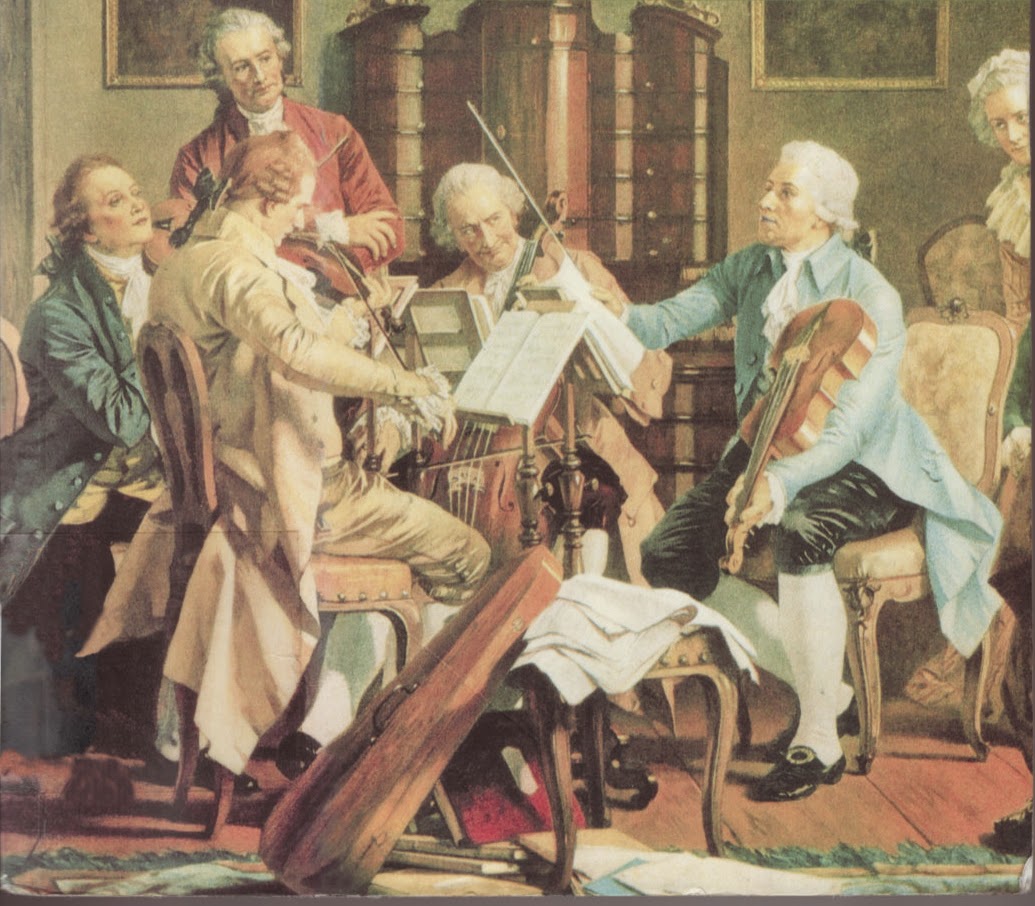
(Mozart (in light blue) playing the viola)
Since this post is primarily about the influence of Mozart on Beethoven and Schubert, I needn't spend a lot of time on the development of Mozart's style and how he came to write this particular piece.

Usually, we associate “divertimento” with a piece meant for light entertainment in the late-18th Century, something diverting and often used synonymously with “serenade” which at least specifically referred to an evening's entertainment. Another term we might come across for such music was “cassation.” Anyway, the scoring for such pieces could range from small orchestras to small ensembles – many such dinner-party pieces were for wind octets.

This one, composed in September of 1788, happens to be for string trio and while it seems a lengthy work for a concert piece, its six movements were very much like the serenades Mozart composed for Salzburg, multi-movement pieces which often lasted between 45-50 minutes. Lightness here refers to mood rather than content: it is a well-crafted piece and by no means a quick knock-off for mindless background music.

Here's the first movement of Mozart's "Divertimento" with the Grumiaux Trio (the score is an arrangement for piano):
- - - - -

- - - - -

The story behind it is fairly straightforward: Mozart, very talented at living beyond his means (he was never a very good manager of reality in general, always a sore spot between him and his often contentious father), was forced to borrow money from friends to make ends meet. Many of these letters survive and if nothing else show Mozart in an entirely different light, whether his straits are genuine (at least to that extreme) or he was also talented at turning the right phrases to win over his friends. The begging Mozart is a very different image from the otherwise care-free bon vivant we have from other sources.

But then his music so often has these two extremes even in a single phrase: all it takes, at this time in music history, is to suddenly inflect a lowered sixth scale degree to open up a whole world of emotional turmoil, a harmonic dissonance – this shadow of the minor key – that was so unusual to the music of the day. It didn't originate with Mozart: he borrowed it from Carl Philip Emmanuel Bach, the most famous of Bach's sons, whose “empfindsamer” or expressive style was full of such devices which rarely failed to cause an emotional twinge in the more attentive listener.

Whether this “divertimento” was written to pay off a debt or not, it was dedicated to Michael Puchberg who was one of Mozart's “frequent lenders,” a fellow Mason and a successful textile merchant. There are nineteen of these “begging letters” that have survived from Mozart to Puchberg, many of which were written after this string trio. It was suggested Mozart composed it for a dinner party Puchberg was giving and the viola part was written for Mozart himself to play. The other performers were probably Masonic brothers.

The 4th Movement, Variations:
- - - - -

- - - - -

In the last variation, beginning at 6:15, one can imagine Mozart having fun with the lot of the typical violist, playing a simple hymn tune in what sounds like “whole notes” in a counterpoint exercise while the first violinist gets to play rapidly running notes. Then, at 7:00 in the transition to the ending, the viola gets to whip off a few measures of his own rapidly running notes as if to say, “see, I can do that, too.” I can just imagine Mozart looking over at his violinist and smiling...

The last movement is one of those tunes of such child-like simplicity – similar to the last piano concertos' finales – that bring to mind the image of Mozart as the child who never grew up. Let's say, perhaps, the man who never lost track of his inner child:

- - - - -

- - - - -

By the way, Mozart composed his Divertimento just six weeks after he'd completed the Jupiter Symphony, the third of three symphonies he composed in the summer of 1788 for no reason at all – all in an unbelievable span of six weeks.

Writers about music often point to certain passages in Mozart – and this trio is full of them – which “point forward to Beethoven.” This is hardly justifiable, considering Mozart had no idea who Beethoven was - even if he did meet him or hear him play that spring of 1787 - or where he would take the musical style that was Mozart's creative voice.

We must keep in mind – especially in this concert's context – that Beethoven is looking back on Mozart. While he studied with Haydn and took the string quartet and symphony in directions Haydn never dreamed of (unless he had nightmares), Beethoven often took what Mozart had hinted at in his melodic and harmonic fingerprints and took them a few steps further. Somehow, I think the composer of the D Minor Piano Concerto (K.466) and Don Giovanni would have approved.

For Part Two - Beethoven and Schubert - click here.

- Dick Strawser