Thursday, February 23, 2017

Shostakovich and a Quartet In Spite of War-Time

The Dover Quartet in concert at Rice University
Who: The Dover Quartet
What: Caroline Shaw's "Plan & Elevation (The Grounds of Dumbarton Oaks)", Bedřich Smetana's String Quartet No. 1 in E Minor ("From My Life"), and Dmitri Shostakovich's String Quartet No. 2 in A Major
When: Sunday afternoon, February 26th, at 3:00, with a pre-concert talk by Dr. Truman Bullard at 2:15
Where: Temple Ohev Sholom, on N. Front Street in uptown Harrisburg between Seneca & Emerald Streets.
= = = = = = = =

This weekend, the Dover Quartet, latest winner of the Chamber Music Society's Cleveland Quartet Award, finds time in its busy schedule to pass through Harrisburg and bring with them three works: the most recent was premiered only a little over a year ago by Caroline Shaw. The closest thing to a war-horse on the program is the Smetana. The program concludes with a rarely-heard work by Dmitri Shostakovich whose string quartets in general do not figure as frequently at American concerts as they should.

And this one, incidentally, he composed while living in a reconverted hen house!

While you can read about Ms. Shaw's new work in this earlier post, here, and about the autobiographical quartet Smetana called “From My Life” here, this post is about Dmitri Shostakovich, his 2nd Quartet (complete with two different performances you can listen to), and the context in which it was composed – or perhaps I should say “contexts,” since there's the events going on around the time he composed it in 1944 and then, to conclude, how it fits into the context of the other works he had written up to that time.
 
It has been said that to totalitarians, all music is "program music." That is, it tells a story whether the composer intended it or not, and this story needs to support those in political power if it is to be found acceptable. This struggle between art and reality is at the heart of much of Shostakovich's career.

* * ** *** ***** ******** ***** *** ** * *

Dmitri Shostakovich
The String Quartet No. 2 in A Major by Dmitri Shostakovich was composed in 1944 in just 19 days during a summer stay at Ivanovo, something of a “writer's colony” for composers (see below). It's in four movements: the first, called an “Overture” is really a traditional sonata-form, however driven (and almost constantly marked forte, loud); the second, much longer movement, is a series of “recitatives” (from an operatic convention distinguishing between near-spoken presentation and the lyrical essence of the aria) within a slow movement's “romance” (in Russian, the term “romance” also means “song,” like lied in German or chanson in French); the third is a waltz but far removed from a Viennese waltz, a darker, hushed, more mysterious soulful wisp of a dance in the not always soothing night; the finale is a set of Theme and Variations (after an introduction) but in the key of A Minor (not the happy ending the party would have preferred in a good proletarian work) on a theme that sounds vaguely like something out of folk song or, at least, Mussorgsky's Boris Godunov.

The slow movement of the 2nd Quartet is nearly as long as the first three movements of the 1st Quartet combined. In fact, the entire quartet remained his longest quartet until he wrote the last one in 1974, a year before his death.

Here are two recordings of the complete 2nd Quartet. The one with the score is interesting for those who read music and wish to follow along. But I don't care for the interpretation. The first one is by the Borodin Quartet who not only performed the work for Shostakovich, the violist in this ensemble is the son of the friend Shostakovich dedicated the quartet to!

The Complete “String Quartet No. 2” by Dmitri Shostakovich, with the Borodin Quartet:

= = = = = = = =

and with the Fitzwilliam Quartet (with score):

= = = = = = = =

Perhaps, to avoid alerting the authorities to his Western heresy, he marked the 1st movement “overture” rather than “sonata” (I mean, why point that out?).

Do the long recitatives in the slow movement (solo passages of considerable rhythmic flexibility, mostly for the violin over sustained chords) represent some kind of inner drama? While everyone waits for the lovely arias in an opera, the real “action” of the drama takes place in the speech-like patterns of the recitatives, easier to understand and not beholden to conventions of repetition and the focus on beautiful melody – certainly the “romance” that follows lets the melody unfold in long lyrical lines. Could it be a kind of farewell to the operatic stage since Shostakovich, after the denunciations of 1936 never returned to the operatic stage except to write light-hearted works that are more akin to what we'd call “musical comedies” (like Moscow, Cheryomushsky, a satirical operetta about the housing shortage, in 1958).

The waltz has been described as “mechanical” and “menacing,” certainly a far cry from what the word “waltz” brings to mind (even a Russian raised on Tchaikovsky and Glinka). How one interprets this may vary with the phrasing, the dynamics, but certainly it's in a dark key – E-flat Minor (6 flats) – which happens to be a tritone away from the registered tonality of the quartet: the tritone is the interval of an augmented fourth (or diminished fifth) that the Medieval age used to call “the devil in music,” an interval that was generally “banned” in good music and which, to the 19th Century romantics, had a whiff of brimstone about it. Certainly, the Borodin Quartet's reading of it is much “spookier” (indeed hair-raising in the middle) than the Fitzwilliam's more controlled approach: beginning at 22:00, though “edgy” and “spiky,” the English quartet lacks a certain fear and drive one hears in the Russians' performance (beginning at 21:30). Same notes, same dynamics – but it becomes an almost entirely different piece! Hmmm...

The finale's variations, once it moves from its E-flat Minor introduction to the accepted center of A – well, A minor but the most proletarian of listeners would expect it to finally resolve to A Major by the end, right? – is based on a folksy theme that Shostakovich introduced in the Piano Trio No. 2's first movement, but seemed to discard. Perhaps he realized it had more potential and he decided not to “throw it away” entirely. Certainly, the flavor of folk-music would curry favor with those who expected something of Socialist Realism in their art? He had completed the Piano Trio in mid-August and immediately began work on the 2nd Quartet which he finished the following month, so this tune was still on his mind.

While most musicians writing about the 2nd Quartet describe it as “far removed” from the War going on around him, perhaps they're not listening to performances like the Borodin Quartet's? When I hear the middle section of that waltz and dramatic moments of the variations (from around 30:00 to 32:30 in the Borodin's recording), I wonder if the anxiety of the war hadn't reached him after all?

* * ** *** ***** ******** ***** *** ** * *

It is impossible for us, living in the United States or any country of Western Europe in the 21st Century, to appreciate the social and political environment that grew out of an event that happened 100 years ago and became known as the Bolshevik Revolution, political turmoil that had long been brewing in Russia, and finally erupted in November of 1917 to overthrow the old aristocratic Imperial society and replace it with the Soviet Union and its Communist ideology. The impact of that context on the arts is one thing to read about, but another thing to have lived and created in. I'm not saying that it would have been better for Shostakovich (or any of the others) to have lived in the West or if Russia's revolution had replaced an autocratic tsar with a benign Western democracy, once the Soviet Union collapsed in 1991 history seems to have proven that one autocrat has merely replaced another.

Without getting into the impact Stalin and his regime had on Shostakovich's career and creative mindset, much less his life, let's just focus on the historical implications leading up to the summer of 1944 when he composed his 2nd String Quartet with a few statistics to place it into some perspective.
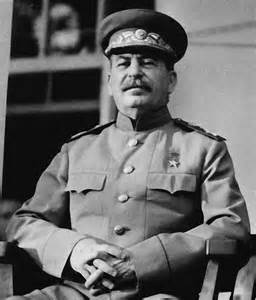
Stalin, 1943
Since Joseph Stalin came to power in 1922 as General Secretary of the Communist Party's Central Committee, he consolidated his power following the death of Lenin in 1924 and ruled as the nation's dictator until his death in March of 1953. Through his “cult of personality” and controlling the people through political repression and the use of the secret police, purging the party of any opposition to achieve his goals, millions of people died.

Shostakovich was himself a victim of Stalin's displeasure and feared for his life as several friends and colleagues were “disappearing” during the Purges – known as “The Great Terror” – between 1936 and 1938. Anyone not familiar with the story behind his Symphony No. 5, “A Soviet Artist's Practical Response to Just Criticism” as someone dubbed it, and how it placed him once again in the Party's favor can read more about it in my blog-post, “Music & Politics: Shostakovich's 5th & 10th Symphonies,” here

Firmly rehabilitated, Shostakovich composed, among other works, his famous Piano Quintet in 1940. It was originally intended to be a string quartet but he felt he needed to add a piano, joking with friends that, as string quartets would tour and want the composer to play the piano part, he would finally get a chance to do some traveling.

Unfortunately, events would intervene.

Hitler engulfed Europe in war beginning in 1939 with his invasion of Poland, but then the Nazis invaded their former ally the Soviet Union in June of 1941. Three months later, the siege of Leningrad (now St. Petersburg) began and would last for 872 days until January of 1944. Over a million Red Army soldiers died or were declared missing, another almost 2.5 million were wounded or sickened. During the siege, 642,000 civilians died, mostly due to starvation and disease, with another 400,000 of the nearly 2 million people who'd been evacuated.

Shostakovich, composing the "Leningrad" Symphony during the siege
On August 9th, 1942, Shostakovich's 7th Symphony, known as “the Leningrad Symphony,” was performed by the surviving members of the Leningrad Radio Orchestra. Most of the musicians were starving (several collapsed and three died during rehearsals). Though the composer had been trapped in the city during the course of the siege when he composed the piece, he managed to be evacuated before its performance.

Meanwhile, from August of 1942 to February of 1943, the Nazis also laid siege to Stalingrad (now Volgograd) in Southern Russia. The Axis forces suffered 850,000 casualties (killed, wounded and captured) but the Soviets, ultimately “decisively” victorious, suffered over 1,000,000.

During World War II – known as the “Great Patriotic War” in Russia – there were about 10,600,000 casualties in the Soviet armies plus another 10,000,000 civilian deaths due to military activity and “crimes against humanity” (this would include Soviet victims of the Holocaust) and yet another 6,000,000 due to war-related famine and disease, a total of 26 million people or a little less than 14% of the country's total population.

Shostakovich writing at Ivanovo, 1943
In the summers of 1943 and 1944, Dmitri Shostakovich was allowed to go to a former country estate northeast of Moscow in the town of Ivanovo (pronounced i-VAN-uh-vuh) where the Composers' Union had just established something of a government-supported artist's colony – if one thinks of such things comparable to the MacDowell Colony or Yaddo in the United States. Opened only the year before, this “House of Creativity and Rest for Composers” (it is sometimes described as a “rest home for musicians,” but not in the modern American sense!), it was being renovated from a country estate once owned by a relative of Nadezhda von Meck, the famous patron of Tchaikovsky in the 1870s and '80s. The house survived the collapse of the Soviet Union: the present-day Union of Composers and its Music Foundation still, apparently, have maintained it since 1991.

Shostakovich and a number of other composers lived, worked and played in relative isolation from the reality of the war while staying at Ivanovo, able to create without distraction. Here, Shostakovich composed his 8th Symphony in 1943, two chamber works during August and September of 1944, his Piano Trio No. 2 and his Second String Quartet. Most of what became his 9th Symphony was written there in 1945. He would return the following year with his children, Galina and Maxim.

A more recent cabin at Ivanovo (1997)
As Aram Khachaturian later recalled, “the musicians lived there [at Ivanovo] enjoying great freedom, without any limitations as to how long they stayed, coming and going as they pleased. Huts were rented and barns repaired for us to work in. I worked in a little log cabin, and Shostakovich in a poultry barn. And how we worked! ...As we worked, we played our music for each other, sought advice and exchanged opinions... Were we influenced by nature and our surroundings? Or was it the feeling of victory around the corner? [The first news of Nazi defeats were only just arriving.] Or simply that we were getting properly fed?”

In Moscow, not long after the premiere of his war-ravaged 8th Symphony in November, 1943 (it had been composed mostly at Ivanovo earlier that summer) and after learning of the sudden death of his close friend, Ivan Sollertinsky, Shostakovich had begun writing his 2nd Piano Trio – the famous one: hardly anyone knows the first one – but completed the last three movements at Ivanovo on August 13th, 1944. He had already read news about the uncovering of the concentration camps at Treblinka in the wake of the Nazi retreats, how Jewish victims “were being forced to dance on the graves they had just dug.” The opening of the 4th Movement takes on a whole different meaning when viewed in this light, with its use of Jewish folksongs. (Listen to a riveting performance by Sviatoslav Richter, Oleg Kagan and Natalia Gutman, here.)

Shortly after that, he began work on his next piece, a string quartet.

In the earlier post for this concert, I had written about how composers work when faced with realities that often seem to belittle anything an artist could possibly create: how does one "make" art with all of this weighing down on you? As Alex Ross points out in his New Yorker article, “Making Art in a Time of Rage,” an artist can either engage – as Shostakovich did with his 7th and 8th Symphonies and the 2nd Piano Trio – or disengage. This is apparently what he chose to do with the Quartet No. 2 in A Major. It has no program, no title, no indication of the world that existed outside his former poultry barn in a little town on the edge of a birch forest, miles from Moscow.

Mikhail Meyerovich, a composer no one in the West would likely recognize, had recently graduated from the Moscow Conservatory where Shostakovich had been the chairman of his examination committee. As a result of the good review he got from this committee, Meyerovich was allowed to attend Ivanovo and spent a month there at the end of summer, 1944. He recalls:

= = = = = = =
When I arrived I saw Shostakovich, who was still a comparatively young man [he would've been 38 years old]. Shostakovich was not too fond of the other composers of his own age and he spent most of his time with me and my friend, his former pupil Yuri Levitin; we were the youngest composers there. He used to search us out and suggest we play some four-hand piano music. We took walks together. ...I discovered him to be a very lively man who was always in motion and could not spend a minute without some occupation. Now he played billiards, now he played football [that is, soccer]. He insisted we join him in a game of football; he played with passion, throwing himself wholeheartedly into the game. Once I inadvertently knocked his glasses off his nose. I was embarrassed, but he said, 'That's all right. That's what the game is about.'

Composer, Daughter & Friends, 1946
It was a mystery to me how he managed to compose so much music at the same time. He had just finished his famous Piano Trio and was working on his Second String Quartet. I wondered when he did the actual composing. The Trio took him a month. The quartet was written in under four weeks [most sources say 19 days] before my very eyes. But nobody saw him at a desk or at the piano. I was intrigued and began to observe him closely. He would play football and fool around with his friends; then he would suddenly disappear. After forty minutes or so, he would turn up again. 'How are you doing? Let me kick the ball.' Then we would have dinner and drink some wine and take a walk, and he would be the life and soul of the party. Every now and then, he would disappear for a while and then join us again. Towards the end of my stay, he disappeared altogether. We didn't see him for a week. Then he turned up, unshaven and looking exhausted. He said to me and Levitin, 'Let's go to an empty cottage with a piano in it.'

He played us the Second Quartet. He had only just completed it, as the score had that very day's date on it. He played it somewhat haltingly, as if sight-reading.”

[an interview quoted in Elizabeth Wilson's Shostakovich: A Life Remembered.]
= = = = = = = =

Shostakovich completed the quartet on September 20th and dedicated it to his friend, the composer Vissarion Shebalin (best known for writing string quartets) “in honor of the twenty years of their friendship.” Earlier that month, he had written to Shebalin,

= = = = = = =
“I worry about the lightening speed with which I compose. Undoubtedly this is bad. One shouldn't compose as quickly as I do. Composition is a serious process, and in the words of a ballerina-friend of mine, 'You can't keep going at a gallop!' I compose with diabolical speed and can't stop myself. ...It is exhausting, rather unpleasant, and at the end of the day you lack any confidence in the result. But I can't rid myself of this bad habit.”
= = = = = = =

Both Quartet and Trio were premiered on the same concert on November 14th, 1944 in Leningrad. The Trio had an instant success and would go on to become one of his most performed works, winning a “Stalin Prize” (the Soviet equivalent of a Pulitzer) which amounted to 100,000 rubles in 1946. The 2nd Quartet was well-enough received but has always been overshadowed by the Trio.

* * ** *** ***** ******** ***** *** ** * *

Dmitri Shostakovich is best known for his symphonies – he wrote fifteen of them – particularly (in this country) his 1st (written when he was still a teen-ager), his 5th (viewed as a kind of “Fate” Symphony though at the time referred to as “a Soviet Artist's Reply to Just Criticism”), sometimes the 9th (a light-hearted disappointment to his critics who were expecting, at the end of World War II, a vast triumphant paean to Stalin) and then after that probably the 10th (which appeared after Stalin's death) and maybe the 7th (written during the Siege of Leningrad) and the 8th (another tragic war symphony, it was composed in the summer of 1943).

The 2nd and 3rd are usually dismissed as propaganda pieces, written to celebrate the recent revolution. The 2nd, premiered in 1927, is called “To October!” with “Proletarians of the World, Unite!” inscribed over the score's first page. The 3rd, written in 1930, celebrates “May Day,” a brief one-movement work ending with a chorus celebrating the Revolution and urging workers of other countries to join in.

The 4th was... well, given the hot water Shostakovich found himself in in 1936 following Stalin's condemnation of his already popular opera, Lady Macbeth of the Mtsensk District (“Muddle Instead of Music”), the 4th, a giant leap forward in what a symphony could be in a modern post-revolutionary country, presumably scared the composer into withdrawing it from rehearsal and not presenting it until 1961, seven years after Stalin's death (for a hair-raising bit, check out this brief excerpt, here). It takes nearly an hour to perform and calls for a huge orchestra, is a purely abstract work, unlike more “proletarian” symphonies being premiered in the '30s by Nikolai Myaskovsky (#16, “The Aviators”) and Vissarion Shebalin (a song-symphony called “The Heroes of Perekop”), and lacks any redemptive apotheosis in the view of party politics. His earlier two symphonies were now being disavowed because their propaganda value was negated by a musical style too far advanced for the proletariat.

Whether the 4th was withdrawn because of the composer's fears over official criticism or whether it was canceled by disapproving party officials, a more palatable and certainly more conventional symphony appeared in 1937, his 5th, which not only “rehabilitated” the young composer in the government's eyes, but made him famous world-wide.

Gone, now, was the enfant terrible of the post-Revolution's avant-garde with his spiky dissonances and the idea of pushing the instruments (and the listener) past their limitations. Gone were the stories – like his operas, Lady Macbeth and The Nose – meant to shock.

Six months later, Shostakovich began a kind of exercise in “quartet writing,” wanting to see what he might do with a medium that, until then, had usually been dismissed in Russia as an outlet for dilettantes (too Western an art-form, it was frowned upon by Nationalists like the “Russian 5” as well as the Communist party operatives looking to inspire the people). This C Major Quartet became a short, traditional, certainly “classical” work in four brief movements and when he finished it in mid-July, he wrote, concerned people would compare it to his recent symphony and find it lacking: “Don't expect to find special depth in this, my first quartet opus. In mood it is joyful, merry, lyrical. I would call it 'spring-like'.”

It also lacks any kind of propaganda value, no proletarian inspiration behind its mood or “story” (the “what's it about?” syndrome so many listeners have). It's purely an abstract work in the tradition of great composers like Haydn, Mozart and Beethoven. And yet it's odd for a composer accused of “Western formalism” to write something so typically Western and form-based! But there was the difference between the public world of the symphony with its need for popular approval and the more private world afforded by chamber music with its smaller, more elite and intellectual audience.

Plans for a second quartet began to take shape not long afterwards, but he decided it should become a piano quintet instead, perhaps his best known chamber-work, which he premiered in 1940. An actual second quartet didn't appear until that summer of 1944, a year after he'd completed the vast and tragic 8th Symphony.

In all, Shostakovich would write 15 string quartets as well as 15 symphonies, though the quartets don't follow the same career-long span his symphonies do: one could argue that, having written the 2nd when he was 38 after writing eight symphonies, and in his remaining 30 years he composed seven more symphonies but thirteen more quartets, there are really no “early” quartets as we think of a composer learning his craft and finding his stylistic way.

After the 2nd Quartet, there followed a period of a couple years of relative peace and a chance for Shostakovich to enjoy his fame. Then in 1947 came “The Zhdanov Affair” in which a cultural minister, perhaps at Stalin's orders, condemned several of the leading Soviet composers of the obscure charge of “formalism” – too much of an interest in Western European forms that went against the grain of what was considered good “socialist realism,” art that spoke to the people.

This time, rather than write “an artist's reply to just criticism,” he simply stopped publishing his music. It was difficult to make a living – shunned by his colleagues, unable to teach as he would like, and lacking any income from commissions for new works or royalties from performances of most of his old ones. It wasn't until things began to thaw following Stalin's death in 1953, but that is another story.

Dick Strawser

Wednesday, February 22, 2017

Caroline Shaw & the Gardens of Dumbarton Oaks

Who: The Dover Quartet
What: Caroline Shaw's "Plan & Elevation (The Grounds of Dumbarton Oaks)", Bedřich Smetana's String Quartet No. 1 in E Minor ("From My Life"), and Dmitri Shostakovich's String Quartet No. 2 in A Major
When: Sunday afternoon, February 26th, at 3:00, with a pre-concert talk by Dr. Truman Bullard at 2:15
Where: Temple Ohev Sholom, on N. Front Street in uptown Harrisburg between Seneca & Emerald Streets.
= = = = = = = =

"How do you capture the tragic, beautiful loneliness of existence, and the complete, ecstatic joy of existence?" asks composer Caroline Shaw. “The way that I am able at least to get at some of that stuff for myself is through music. What is it about music that is different from other things?”


Considering the work following her “Dumbarton Oaks” quartet on this weekend's concert with the Dover Quartet – officially, it's Plan & Elevation (The Grounds of Dumbarton Oaks) – is the quartet Bedřich Smetana subtitled “From My Life,” ending with its famous evocation of his impending deafness, perhaps this might be a good question to preface the entire program: music can entertain, but it can also bring meaning to our existence – and it can bring meaning and expression to the lives of its composers.

We tend to think of composers who get up in the morning and write a piece of music which we will listen to and think “that's nice” or “I didn't like that so much as that other one” often without imagining these composers exist within time, within a period of history during which things happen, during which events affect our lives, during which people who create create in response to events either by engaging them or by disengaging from them.

It is interesting and perhaps curious, 16 years later, to look back on what artists thought about their art and their role as creative artists after September 11th, what impact anything they could create might have in a world changed by current events, events that perhaps trivialize everything else. Now, with political and social events unfolding daily around us with the new administration in Washington, artists are again wondering “how to respond” (I recommend Alex Ross's New Yorker article, “Making Art in a Time of Rage”).

This weekend, the most recent winners of Chamber Music America's Cleveland Quartet Prize, the Dover Quartet, will come to Harrisburg for a concert that includes three works – none of them by Beethoven, Mozart, Haydn or any other of those typical great Classical composers one expects to find on programs of chamber music: there's a new work (though premiered in 2015, the first work has occasionally been listed as “Commissioned Work TBA”) by a composer who is described as the “youngest winner of a Pulitzer Prize” in Music; the closest thing to a war-horse on the program is Smetana's Quartet “From My Life”; and the second half is the second of Shostakovich's 15 string quartets which rarely get performed in this country (except for the autobiographical No. 8).

(You can read about Shostakovich's 2nd Quartet in this post and Smetana's Quartet “From My Life” in this one.)

But the Dover Quartet – who do perform Beethoven and Mozart and the rest – have chosen a program that may be more thought provoking than mere entertainment, but then “entertainment” is a loaded term in itself that doesn't have to mean “banal” to be entertaining. Whether you remember television being described as “a vast wasteland” in a speech by President Kennedy's newly appointed FCC chairman in 1961 or not, with its string of “game shows, formula comedies about totally unbelievable families, blood and thunder, mayhem, violence, sadism, murder, western bad men, western good men, private eyes, gangsters, more violence, and cartoons” (today, one could replace the Western with, say, Reality TV shows), you might wonder “what is the world coming to?” You might add, with the help of the arts, we have found a way to survive the past.

In this context, we might find Smetana's Quartet “a touch of reality” as it describes various points in its composer's life as Smetana seeks to express “tragic, beautiful loneliness of existence, and the complete, ecstatic joy of existence.” And Shostakovich, writing his quartet at the height of World War II and the Nazi invasion of the Soviet Union, as an example how a composer “disengages from reality” to create something that transcends it and by its very nature finds in the act of creation a way to resist.

And how does Shaw's tribute to “Dumbarton Oaks” fit into this?

Actually, I've no idea, not having heard the work, except to know that any artist these days contends with so much reality – both hopeful and distressing: again, the very act of creativity is to resist and transcend that reality – perhaps by turning chaos into order, by finding beauty in things easily overlooked, by finding ways of expressing joy or catharsis, art reminds us that, despite everything going on around you, you still have a soul.

* * ** *** ***** ******** ***** *** ** * *

Say to a musician or music-lover “Dumbarton Oaks” and a Bach-like string of notes comes cascading out of a work by Igor Stravinsky, his Concerto in E-flat for chamber orchestra which had been commissioned by Robert and Mildred Bliss to celebrate their 30th Wedding Anniversary at their estate in Georgetown, Washington D.C., a place they called “Dumbarton Oaks.” Hence the subtitle by which Stravinsky's three-movement, classically-inspired work is always known.

Caroline Shaw was the first “Early-Career Musician in Residence” at Dumbarton Oaks which is now operated as a museum and research center by Harvard University to whom the Blisses gave the house with its grounds and gardens in 1940. Ms. Shaw was commissioned to write a piece to celebrate the museum's 75th Anniversary while working in the house which has its own rich history.

Originally part of a grant from Queen Anne to Colonel Ninian Beall in 1702, which he called the “Rock of Dumbarton” after his homeland in Scotland, the central part of the existing house was built around 1801 and served as the residence for Vice-President John C. Calhoun in the 1820s. It was enlarged in the mid-19th Century and named “The Oaks.” In 1920, the Blisses bought it and combined the names as “Dumbarton Oaks,” embarking on a renovation and expansion project for both the house and its grounds.

During the late summer and early fall of 1944, at the height of World War II – also the same exact time Shostakovich was composing his 2nd String Quartet – the mansion hosted a conference that resulted in the founding of the United Nations.

Currently under further renovation, the museums will not be open to the public until the Spring of 2017, but the gardens are still open during public hours.

a screen capture of the garden in autumn from the Dumbarton Oaks website

In this clip, Caroline Shaw and Dumbarton director Jan Ziolkowski talk about her being the “Early Career Musician,” what being “in residence” at Dumbarton Oaks meant and how she was preparing to write a new piece for its 75th Anniversary:


“Before her new work’s performance, Shaw explained briefly that the title Plan & Elevation carries a double meaning. It refers not just to architects’ drawings of structures from above and on each side, but also to how Fellows at Dumbarton Oaks, in Shaw’s words, often 'have a plan that develops and changes over their time here in ways they didn’t expect.' Plan & Elevation takes inspiration from the Dumbarton Oaks Gardens – you can explore them with this link, here – and consists of five movements, each named after one of the 'rooms' of the gardens: the Ellipse, the Cutting Garden, the Herbaceous Border, the Orangery, and the Beech Tree (Shaw’s personal favorite).”

It may be February, in fact it may be warm for February, but what nicer way to spend a Sunday afternoon than wandering through the gardens of a historic house like Dumbarton Oaks, musically as well as metaphorically?

* * ** *** ***** ******** ***** *** ** * *

As I mentioned earlier, Caroline Shaw, a triple-threat of a composer, violinist (who plays the viola), and singer, won the Pulitzer Prize in Music in 2013 for her "Partita for 8 Voices,"  written for her a capella vocal group, Roomful of Teeth. There's a curious dichotomy, here: with a name like "Roomful of Teeth," the title "Partita" seems rather out-of-place, not just because a "partita" is an 18th-Century instrumental form being performed, here, by singers. 

A partita is, among many things, a "suite" in Baroque days, and usually a suite of formulaic and often stereotypical dances, bringing to mind the sarabandes and gavottes that populate much of the instrumental music of the early-1700s, not all of them masterpieces offered to posterity compared to Bach's Partitas for keyboard or for solo violin (or the suites for solo cello or the Orchestral Suites, for that matter). And like Bach's D Minor Partita for solo violin which ends with that magnificent Chaconne (originally a dance-form), Shaw ends her four-movement suite, following an Allemande, a Sarabande and a Courante, with another similar old dance, a Passacaglia, however brief.

Sounds very old-fashioned, no? Until you listen to it.

Partita,” the composer explains, “is a simple piece. Born of a love of surface and structure, of the human voice, of dancing and tired ligaments, of music, and of our basic desire to draw a line from one point to another. It was written with and for my dear friends in Roomful of Teeth. Inspired by Sol LeWitt’s Wall Drawing 305.”

“This is a deceptive sort of music,” blogger J. Bryan Lowder writes, “with an elegant, easy smoothness built from distinct and fascinating bits-and-pieces. Listening to it is a little like examining a great mosaic, both from a distance and occasionally with a magnifying glass, the better to see the grout between the tiles. Perhaps coincidentally, one of Shaw’s idiosyncratic style guidelines is “silk shoes gliding over marble mosaic.” She’s trying to tell her musicians how to sound, but she might as well have been telling us how to listen—no description could be more apt.” (Read the entire post from Slate's Culture Blog, here.) 

Here is just the final movement of the Partita, recorded at its World Premiere in 2009 by Roomful of Teeth with the composer, third from the left.


Keeping in mind that not all works by one composer necessarily sound alike, style and "voice" aside, and that the challenges of writing for an 8-voice a capella group and for a string quartet each have their different inspirations and their problems-to-solve (technical and aesthetic), I think whatever you may think of this music you will recognize she has an exceptional creative voice (puns intended) and I look forward to hearing this more recent piece to see how she expresses herself further, with or without the considerable pressure of having won a Pulitzer Prize so early in her career.

- Dick Strawser


"Stay tuned" for further posts on the quartets by Shostakovich and Smetana.


Friday, January 20, 2017

Chamber Music with Friends and a 35th Anniversary with Schubert's Trout

A generation ago, it was common for famous musicians, known primarily as orchestral players or soloists, to step onto the concert stage in chamber music programs where the other players for these especially formed ensembles were advertised as friends of the main performer. While it became a bit redundant in the mid-1970s when the New York Philharmonic concertmaster held a “Rodney Friend and Friends” concert, the idea continues today when the Harrisburg Symphony's Stuart Malina plays chamber music with members of the orchestra, an annual series called, simply, “Stuart and Friends.”

For Saturday's special anniversary concert, the current directors of Market Square Concerts – performers in their own rights – decided to celebrate thirty-five seasons of MSC by giving a performance of their own and asking some of their friends to join them.

Jeremy Gill
Composer Jeremy Gill – originally from Harrisburg (his oboe teacher when he was in high school was Thomas Rowe, oboist in the Harrisburg Symphony), he's lived in Philadelphia and now in Boston – is not only a composer, conductor and pianist and a friend of past directors Lucy Miller Murray and the late Ellen Hughes as well as Peter Sirotin and Ya-Ting Chang, he is known for being a wonderful cook, and our directors swear that he can make a killer Martini!

His “Duo for Violin and Piano” was commissioned by MSC founding director Lucy Miller Murray and her husband, Martin Murray, for the current directors to perform at this concert: you can read more about in the previous post, here.

Geoffrey Pilkington
Another friend on the program is Geoffrey Pilkington, principal horn of the Washington National Opera at the Kennedy Center where he recently was involved in a complete cycle of Wagner's Ring with its very demanding horn parts (he had already played it in San Francisco). In the past, he has played in the horn section of the Harrisburg Symphony, starting in 2011, and joined MSC for the Beethoven and Mozart quintets for piano and winds with pianist Stuart Malina for two previous Summermusic festivals. Geoffrey and his wife, Kathryn, just welcomed their second son, Colin, into their family a week ago. Congratulations, Geoffrey and Kathryn!

He'll be joining Peter and Ya-Ting for the Horn Trio by Johannes Brahms, and you can read more about the Brahms in the previous post as well.

The second half of the program adds three more friends to the mix for Schubert's Quintet which was written for an amateur cellist Schubert had met while on a summer holiday, something he could play with his friends. You can read more about Schubert and his “Trout” by scrolling down just a little further...

Stepniak talks about Mozart
Michael Stepniak, a dear friend since Peter and Ya-Ting's Peabody Conservatory days, will return to celebrate MSC's 35th Anniversary on Saturday at Whitaker Center. When Michael is not playing viola, he wears his educator-administrator hat as the Dean of Shenandoah Conservatory in Winchester, Virginia. Michael writes beautifully and gives talks and lectures filled with insight, humor and unexpected revelations on various topics. Michael is a proud father of three beautiful young adults, and enjoys reading, attending arts-related events, and most of all, traveling the world with his wife, Anne, whenever time allows. Here is a video of Michael interviewing American Icon, Wynton Marsalis during his residency at Shenandoah Conservatory.

Fiona Thompson and Zaree
Recently, Michael gave a talk about Albert Einstein and Mozart, before playing Mozart's amazing Divertimento in E-Flat, K.563 with Peter Sirotin and Fiona Thompson at the Hershey Medical Center, part of an MSC "Soundscape" Outreach program earlier this month.

Cellist Fiona Thompson is originally from the UK and is principal cellist of the Harrisburg Symphony, where, a few seasons ago, she was the soloist in Richard Strauss' Don Quixote. When she is not busy performing with the Mendelssohn Piano Trio along with Peter and Ya-Ting or with other musicians in the region, or, in addition to all that, teaching, Fiona enjoys reading, spending time with her husband, Rob and her beautiful horse, Zaree.

Devin Howell in the Mountains
Just two weeks ago, bassist Devin Howell, a Harrisburg native and resident, was the soloist for Nino Rota's Divertimento Concertante with the Harrisburg Symphony Orchestra where he is also principal bass. Devin plays with many other established orchestras and musicians in the region and teaches privately as well as at several regional universities. One of his students, now attending the Curtis School of Music, recently won an audition for an opening in the HSO bass section and is now her teacher's stand-partner! During the summer, Devin also plays with the Lake Placid Sinfonietta in the Adirondacks where he manages to fit in some hiking. Like many musicians, he also enjoys good food!

Peter Sirotin & Food
So, other than doing the administrative work to run Market Square Concerts, practicing, performing, teaching and traveling, what else do our directors like to do?

As you might gather from his Facebook posts, Peter Sirotin has a massive sweet tooth. During his first two months in the US as a graduate student, he had sampled all flavors of ice cream available at a grocery story near the Peabody Conservatory. Peter also loves to read, write and have conversations with friends and family about current issues.

Ya-Ting Chang cooking food
As for Ya-Ting Chang, our executive director, her #1 dream is for there to be 48 hours in each day. She would then be able to find time to enjoy cooking, tending to her orchids, spending time with their 14 year-old cat, Tiger, and visiting her 4 year-old niece, Clarissa.

Occasionally, over the years, Market Square Concerts has offered prefatory performances by young performers. This concert will officially begin with a 14-year-old pianist playing the Scherzo No. 2 in B-flat Minor by Frederic Chopin. Pianist Zev Malina is also a composer – his setting of a favorite children's book, Robert McCloskey's “Blueberries for Sal!”, for narrator and chamber ensemble, was performed as part of a Bar Mitzvah project to benefit the Dauphin County Library System. You can hear the entire work in this YouTube video in which Zev is the narrator. Among the performers you might recognize violinist Peter Sirotin, bassist Devin Howell, and pianist Stuart Malina, the composer's father. And in addition to dealing with homework and other realities of being a 14-year-old, Zev also plays the bassoon and is a member of the Harrisburg Symphony Youth Orchestra where his sister, Sara, is the principal cellist.

* * ** *** ***** ******** ***** *** ** * *

Here is a performance of Schubert's "Trout" Quintet with a Hungarian ensemble that, for lack of space, could be called "Zoltan Koscis and Friends" recorded in 1982. Pianist Koscis is certainly the one internationally known member of the group. He would later also become well known in Europe as a conductor and composer (he died this past November at the age of 64).

The Quintet, scored for piano, violin, viola, cello and bass - because the strings include a double bass rather than a second violin to make it an actual string quartet, officially it can't be called by definition a "Piano Quintet" - is in five movements, the fourth of which is a set of variations on one of Schubert's most popular songs, Die Forelle or - the Trout!

= = = = = = = =

= = = = = = = =

Schubert's Quintet was written following a delightful summer vacation in an old Austrian city located between two idyllic rivers in eastern Austria. It has nothing to do with the joy of trout fishing and no one plays an instrument called "the trout" (though there is an instrument called "the serpent" which is not used here, either.) Let me explain...

In 1815, Schubert, then 18, met the singer Johann Michael Vogl, a baritone who sang major roles at one of Vienna's major opera houses: the year before, he had created the role of the villain Pizzaro in Beethoven's latest revision of Fidelio. Reluctantly agreeing to meet the young composer, he sang through of a pile of songs, his reactions going from “not bad” to “you have something special in you, but as yet you are too little of the actor and showman; you have fine ideas but should make more of them.”

Vogl was a tall and imposing man. Schubert was about 5'1”. One of Schubert's friends drew a wicked caricature of the two, reflecting Vogl's stature in the arts community and Schubert's relative insignificance.

In those days, singers didn't give “song recitals.” Composers – even Mozart and Beethoven – wrote songs primarily for the domestic market, meaning amateurs to perform at home, back in the days before the invention of stereos, radios and TVs when people made their own entertainment rather than watched or listened to it. If you read any novels of the time – like Jane Austen's Pride & Prejudice, written in 1813 – there will likely be references to the young unmarried daughters of the house who would play the piano and sing for their friends and family: a girl's talent was considered a marriageable trait.

These, then, were the performers Schubert's contemporaries had in mind except Schubert often wrote songs setting “deeper” poems with more difficult piano accompaniments and requiring more vocal technique. Vogl appreciated this and took Schubert and his songs around to his friends and sang this music for them. Without being published, Schubert would build a reputation as a composer of songs. It was, however, not a very good kind of reputation: opera was “where it was at.”

And that's probably why Schubert's friends arranged for Herr Vogl to meet their young friend. Money was to be made not in writing songs for pretty daughters to warble after dinner but in getting operas performed. That was the mark of a professional composer. In 1820, Vogl would sing the parts of twin brothers in Schubert's opera Die Zwillingsbrüder, written just for him. One of the few operas Schubert would complete or even see on the stage, it was a failure. One of music's great mysteries is that Schubert, an expert dramatist in the miniatures he wrote – Gretchen at the Spinning Wheel, for instance, written when he was 16 – seemed incapable of finding the dramatic moment in extended scenes on the operatic stage.

Perhaps Schubert's most popular song is Die Forelle, “The Trout.” He wrote this during the spring of 1817. There's a famous story that, in the midst of drinking a good deal of wine on a Saturday night, Schubert sat down and (while everybody else was talking) wrote Die Forelle. The manuscript certainly looks like it, but the truth is, he was visiting a friend whose younger brother very much liked Schubert's songs, and so Schubert sat down and from memory wrote out a copy of this one for him – it was the third time he'd copied out this same song, but keep in mind it was also in the days before there were photocopiers.

This video (with nice pictures) of Schubert's song and the lyrics is sung by the incomparable Dietrich Fischer-Dieskau, with his equally incomparable collaborator, Gerald Moore:
= = = = = = = =

= = = = = = = =

In 1819, Vogl was going on an extended vacation to his hometown of Steyr, an industrial town about 2/3s of the way between Vienna and Salzburg (it would celebrate its 1,000th Anniversary in 1980) and he decided to take his young friend Schubert with him. Schubert stayed at the home of a “cultured lawyer” who had three sons and eight daughters and whose nephew, Anton Stadler, an old school friend of Schubert's, also lived there. He would meet Vogl for meals at the home of Josef Koller, an iron merchant whose daughter was a talented pianist named Josephine. It was there Schubert, Vogl, Josephine and Stadler performed Der Erlkönig as a trio (Schubert sang the part of the father). That month, Schubert also wrote a piano sonata just for Josephine – the Sonata in A Major, K.664. Another piece of music associated with that vacation was a little cantata written for Vogl's 51st birthday – Schubert was again one of the singers – and performed at the Kollers' house.

More public music making took place at the home of a wealthy mining official, Sylvester Paumgartner, a bachelor who was a local patron of the arts and an amateur wind player and cellist. The best musicales in Steyr took place either in the music room or the larger 2nd floor salon of his home on the city's town square (see photo). Vogl, sort of a local hero having gone off to a great career in the Big City, was the center of attention and being a bit of a prima donna would not always feel like singing: on occasion Paumgartner had to get down on his knees and beg him to sing. Schubert was very much in the “back seat,” sitting at the piano, but still, people admired his songs, though they more openly enjoyed Vogl's singing of them. One of the favorites was Die Forelle. Paumgartner owned a copy of Johann Nepomuck Hummel's Septet in an arrangement for the unusual combination of piano, violin, viola, cello and double bass (the first 'real' and enduring piano quintet, consisting of the now standard string quartet plus piano, wasn't written until Schumann wrote his in 1842). In order to have something else for this group to play, he asked Schubert to write a little something for him and, if he wouldn't mind, include a set of variations on the song Die Forelle as one of the movements. And so that's how Schubert came to write this Quintet in A Major for Piano & Strings - which has always been known as “The Trout Quintet.”

Since the original manuscript is lost and no one (not even his school friend Stadler) ever mentioned the performance in a letter or subsequent memoirs, it's hard to say when it was written or premiered. The going story is that he wrote it then and there and in a matter of days everybody played it and loved it.

Unfortunately, that's not true. There were two other visits to Steyr – 1823 and 1825 – but because of the style of the piece compared to its contemporaries, it's more likely it was written after this first visit when Schubert was 22.

What actually happened was that the request was made before Vogl and Schubert left, the piece was composed that autumn in Vienna, Stadler copied the parts and sent them back to Paumgartner. Unfortunately, Schubert overestimated Paumgartner's abilities as a cellist: apparently, the work was played through (perhaps not even performed), then put away on the shelf. It wasn't published until 1829, a year after Schubert died at the age of 31. Today, it is probably one of the most popular pieces in the chamber music repertoire.

So, ironically, Schubert's friends' attempts to accelerate his career as an opera composer, introducing him to one of the leading singers in Vienna at the time, didn't work out, at least in the sense of any operatic success (of course, what might have happened had Schubert lived to be in his 60s, one can only imagine). But it did produce a great champion of Schubert's music, especially his songs, and someone who managed to introduce this music to an audience that might not otherwise have heard it.

Oh, and there was one instrumental work we can thank this friendship for: without Vogl's introduction to an amateur cellist he knew, we would never have had the "Trout" Quintet.


- Dick Strawser

Thursday, January 19, 2017

Celebrating 35 Years with the Music of Brahms, Schubert, and a World Premiere by Jeremy Gill

Ya-Ting Chang & Peter Sirotin; Jeremy Gill
This Saturday at 8:00 at Whitaker Center – with no blizzards on the horizon, this year – a special performance celebrates thirty-five seasons with Market Square Concerts as the current directors Artistic Director (and violinist) Peter Sirotin and Executive Director (and pianist) Ya-Ting Chang are joined by several friends for a concert with the music of Schubert and Brahms and the world premiere of a work by a composer familiar to Harrisburg, Jeremy Gill, commissioned for the occasion by the founding director of Market Square Concerts and her husband, Lucy and Martin Murray.

Gill had been commissioned to compose a string quartet to celebrate the 25th Anniversary of Market Square Concerts, a work he called, understandably, “25”, performed here in 2007 by the Parker Quartet. For the 30th Anniversary, his “Three Songs About Words,” setting poems by Lucy Miller Murray, were premiered in 2012.

And so, in keeping with the tradition, as the 35th Anniversary came around, Lucy and Martin Murray commissioned a new work for violinist Peter Sirotin and pianist Ya-Ting Chang, the current directors of Market Square Concerts, for this weekend's concert!

In an interview with WITF's Cary Burkett, performer Peter Sirotin and composer Jeremy Gill talked about the new piece, how it was inspired by a passage in Claudio Monteverdi's "Vespers" written in 1610, something composed over 400 years ago. (Think "if it's over 200 years since Beethoven composed his Eroica Symphony, Monteverdi's "Vespers" was written 200 years before that!").

"The movement itself has a single soprano voice," Gill says, "and she sings 11 times the same phrase, 'Saint Mary, hear us.' Never changes the pitches, rarely changes the rhythm, but all around her the instruments are changing textures constantly. For me there's this implication if you have the soprano singing over and over again the same thing. And it's a request, right?  'Saint Mary, hear us.' Why does she have to say it so many times and in the same way? There's this implication of desperation there. She's not being heard."

Expanding on this sense of an unanswered prayer, Gill makes the desperation and longing even more pronounced.

"I used those notes that she sings and the rhythms in which she sings them in the violin part. That, towards the end of the work creates a pretty dramatic climax in which by the end she's just sort of screaming out this invocation. And there's never a satisfying answer."

This sense of communication - or lack of it - is no doubt something today's audiences could relate to.

(You can hear the entire interview, here.)

Gill's Duo for Violin and Piano, completed well ahead of schedule – no last-minute “will-he-finish-it-in-time” worries, here – is only the latest work of his to be heard in his hometown: his Capriccio was enthusiastically received when the Parker Quartet performed it here in 2013 before they recorded it for the Innova label. (You can read about that concert in this earlier post on the Market Square Concerts blog.) Before that, the Harrisburg Symphony performed his Clarinet Concerto (officially, the Notturno Concertante) with Christopher Grymes in 2014 (you can read my blog-post about it, here), his Symphony No. 1 from 1999 which they performed in 2009, and before that, having commissioned “Novas,” premiered it in 2002. 

You can also read my interview with Jeremy here, talking about his life as a composer both when he wrote that 1st Symphony and ten years later when it was being performed by his home-town orchestra. A great deal has happened in the eight years since then, too, the work being premiered this weekend only the latest in a longer string of works we in Harrisburg have had a chance to hear, following his career.

In addition, there was a large-scale song cycle, Helian; the comparatively diminutive “Eliot Fragments (for Carter)”, a piano solo inspired by lines of T.S. Eliot to commemorate the 100th Birthday of American composer Elliott Carter; his “Variations” for String Quartet premiered by the Cassatt Quartet on a Market Square Concerts program in 2001; and the Eight Variations and Toccata on 'Betzet Yisrael' for organ, given its premiere here in 2011.

I'm probably forgetting a few, but you get the picture. By following the links to Gill's website, you can hear samples from these and other works, as well as find out information about recordings and more up-coming performances.

Rehearsing Mozart (or was it Beethoven?)
Composer Jeremy Gill is only one of the Directors' Friends on the program. Among those friends performing will be hornist Geoffrey Pilkington, familiar to symphony goers for the performance of the Schumann Konzertstück for Four Horns and Orchestra with Stuart Malina and the orchestra, but also from two different series of Summermusic concerts in which Pilkington joined pianist Stuart Malina and clarinetist Christopher Grimes, oboist Gerard Reuter, and bassoonist Peter Kolkay for the two quintets for piano and winds by Mozart and by Beethoven. (That's Pilkington on the far right...)

Pilkington is now a principal horn with the Washington National Opera Orchestra at the Kennedy Center. Last season, he was heavily involved (as any principal horn player would be) with the opera company's “Ring Cycle” (actually, the second one he's performed: the other, in San Francisco), all four operas of The Ring of the Nibelung by Richard Wagner. Here's an interview with WETA's David Ginder (speaking of local connections, for those who remember the early days of WITF-FM when David Ginder was a familiar voice of classical music here in Central Pennsylvania).

He will be joining Peter and Ya-Ting for a performance of Johannes Brahms' “Trio in E-flat for Violin, Horn and Piano in E-flat Major, Op. 40,” more lovingly known as the Horn Trio. In fact, one could say The Horn Trio.

For the second half of the program, Peter and Ya-Ting will be joined by violist Michael Sheppard, a frequent collaborator of theirs and one often heard at past Summermusic performances; cellist Fiona Thompson, principal cellist of the Harrisburg Symphony who completes the Mendelssohn Piano Trio with Peter and Ya-Ting; and bassist Devin Howell, principal bassist of the Harrisburg Symphony with whom he was soloist two weeks ago in the delightful “Divertimento Concertante” (a concerto for Double Bass and Orchestra in all but name) by Nino Rota.

You can read a little bit more about the performers on the next post, here, which also includes some information about the work that concludes the program.

The celebration concludes with a perennial favorite and one of the most charming masterpieces in the chamber music repertoire (as one cannot always pair “charming” with “masterpiece”), the “Quintet for Piano, Violin, Viola, Cello and Bass in A Major, D.667” by Franz Schubert, a work better known simply as “The Trout Quintet.” Do not ask who plays the Trout.

I have written occasionally about The Trout Quintet: I'll repost the one from Summermusic way back in 2009 where, I discover, all the video clips have, like so many fish hung out to dry, expired. So check out the next post, here, for information about the Schubert as well.

* * ** *** ***** ******** ***** *** ** * *

This post, then, continues with the Brahms Horn Trio, a work Peter Sirotin told me was one of his favorites. There are many performances available on YouTube with the usual caveat about recording sound or video quality, but one of my favorites, despite its old mono sound, is this amazing 1957 recording with the incomparable Dennis Brain, one of the greatest horn players ever, recording shortly before his death in an automobile accident. Though you may not have heard of his colleagues, pianist Cyril Preedy and violinist Max Salpeter, I hope you'll find the performance as vital as I did when I first heard it years ago. Alas, it is only available in individual movements:

= = = = = = = =
1st Movement (Andante)

2nd Movement (Scherzo)

3rd Movement (Adagio)

4th Movement (Finale)

= = = = = = = = =

Brahms in the mid-1860s
Johannes Brahms had moved away from his native Hamburg to become – eventually – a famous composer and pianist in Vienna but, like a good son, he kept in touch with his family, especially his mother whom he idolized, particularly after his father, following 34 years of marriage, decided to move out. Not much is known about Christiane Brahms except she was 17 years older than her husband, a seamstress who was otherwise “hardly known outside the house.” Brahms interrupted his summer in 1864 to return home for a visit, helping his father set up a new place to live (and, incidentally, finding him a job as a bass player in the Hamburg Philharmonic) and consoling “two weeping women,” his disconsolate mother and her dependent elder daughter, Elise, the only one of the three children still living at home.

The youngest child, Fritz, long supported himself as a pianist who taught and performed in Hamburg, even playing Brahms' “Handel Variations” in public which Clara heard and reported were “totally beyond him.” (Small wonder: I could say the same of many pianists I've heard play them...)

Christiane Brahms in 1862
The following winter, Christiane wrote a long rambling letter to “Hannes,” worried about her weakening eyes and her hands becoming unsteady (a major concern for any seamstress, even one now in her mid-70s).

Three days after she'd mailed the letter, Fritz sent his brother a telegram: “If you want to see our mother again, come at once.” He hurried home to Hamburg but arrived two days after she had died suddenly of a stroke.

He wrote to his friend, Clara Schumann, who volunteered to come to Hamburg if she could be of any help, but Brahms hardly knew what to do himself, after getting his sister situated with friends (she, who never had a job, never had anything of her own beyond a tiny allowance from her mother, never knowing what to do without her mother telling her). When he returned to Vienna a week after the funeral, a friend stopped by to visit and found the composer playing Bach's Goldberg Variations. Without stopping, through his tears he told his visitor about his mother's death – and then after that rarely spoke of her publicly again.

Meanwhile, Clara, after taking a treatment for her arthritic hands called “animal baths” (“plunging her hands into the entrails of some freshly killed creature” – who knew?!), resumed her concertizing, a London tour because she needed the money. As he often did with a new work, Brahms sent her some sketches for “a so-called German Requiem” but not one setting the traditional liturgical text. Coming so soon after his mother's death, it would be easy to assume it was written in her memory but he had been thinking about it for some time. Even the melody he had used for the movement, “All Flesh is as Grass,” was a sarabande originally from his first attempt at a symphony (if you can imagine that sombre dance as the substitute for a scherzo!) begun shortly after his mentor Robert Schumann, Clara's husband, threw himself into the Rhine a decade earlier (that symphony's opening theme had already found a home in the first movement of his D Minor Piano Concerto).

Then it was time for his annual summer vacation – a working vacation when Brahms, just turned 32 and recently moved to Vienna where he'd become the director of the Vienna Singverein, escaped the urban distractions in order to compose. This summer he chose a village outside Baden-Baden, a quaint town near the Rhine deep in the Black Forest, mostly because Clara Schumann and her family were there and had recommended it. His day consisted of a fairly predictable schedule, awaking at dawn, then taking a walk after some strong coffee, followed by four hours of composing, then lunch either at Clara's or at a local inn, more work, then more coffee, and another visit to the Schumanns' where he usually stayed for dinner. From the windows of his rooms, he could see the forest-covered mountains just beyond the road into town.

the modern "French" Horn
While he finished two works that had been on the front burner for a couple of years – the G Major String Sextet and the E Minor Cello Sonata – the new work he began in those rooms, between walks and coffee, looking out over that forest, was a trio for horn, violin and piano, not a very typical combination for chamber music. The way most composers made their money, now that the days of being a paid employee of some wealthy, music-loving aristocrat had passed, was writing works that could be purchased and performed by amateur musicians in their own homes, not necessarily by professional musicians in concert halls. There would be little demand for a piece like this, Brahms knew, especially since he specified it should be played on the old-fashioned natural German waldhorn (or forest horn) which without valves had a limited range of possible notes it could play, already made obsolete by the modern valved instrument we know for some reason as the “French” horn, capable of playing everything within the chromatic scale. As it is, beyond its premiere, the work is rarely performed as Brahms intended though horn players today are sensitive to the differences between the instruments, especially the “color” of the tone when playing what are called “stopped notes.”

Natural Horn (with a bunch of crooks)
In order for the natural horn to play notes outside its single overtone series – a horn in E-flat was limited only to notes within the E-flat Major scale or those in common with a key like, say, G Major – the player would then have to add a length of tubing to the instrument called a “crook” to change the home key of the horn so it could now play in that key. But this left out any quick modulations between keys because one would have to take out one crook, put it quietly aside, then insert the next crook and then re-tune the instrument (a risky venture mid-performance). So either the composer would change only to keys the horn could play in with its few possible pitches the keys had in common – or did without the horn in the new key. In some orchestral works, two pairs of horn-players, pitched in different keys, could solve the problem, but Haydn, for instance, always tried to avoid such a solution because it was an added expense which the Prince frowned upon.

This is the reason why all four movements of Brahms' trio are in E-flat, rather than branching off into any number of possible related keys for variety's sake, meaning once set-up and tuned, the horn player didn't have to deal with additional, extraneous lengths of pipe. Now, while a horn could play the pitch G in the key of E-flat Major, it could not play the pitch G-flat which you'd need for E-flat Minor. But in order to manage this and other such notes, a horn player would insert his hand deeper into the instrument's bell and “stop” the pitch, which required additional control of the emboucher (the pressure of the lips on the mouthpiece) in order to “lower” the played pitch. This gave the note a distinctly darker tone, one the modern valved (“French”) instrument would not have. But Brahms wanted this effect specifically and it is most tellingly used in the third movement, the slow, mournful movement in E-flat Minor.

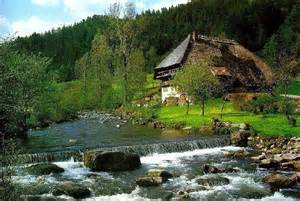
A scene in Germany's Black Forest
There is a natural (no pun intended) sound especially in the opening movement if we remember that the dawn of German Romanticism in the early-19th Century often evoked hunting calls from deep in the German forests (like the mysterious Black Forest around Baden-Baden) – think of the whole story behind Carl Maria von Weber's opera Der Freischütz with, its sinister elements aside, all those hunting choruses full of the folksy sound of men's voices and the more prevalent sound of the horn both as a solo instrument and as a quartet. Bringing such an instrument into a small concert space – much less a family's living room – would have been very different from having a violin or a piano imitating these very sound effects. But it is only in the finale that Brahms lets the horn “go,” romping through the woodlands – off on the hunt! – with a barrage of traditional horn-calls.

Yet, coming back to that odd slow movement where the player has to “stop” the note to play the darker minor third of the key – the G-flat – that is the very pitch Brahms chose to end the movement with and he would not have done that if he didn't specifically want that “veiled” tone (he could just as easily have ended the horn on an E-flat and avoid this different sounding note). The whole movement is a mournful dirge and though he may not have specifically said so, how could it not have been inspired as a gentle memorial to his mother who'd died only six months earlier?

And why the horn in the first place? His publisher would only agree to the piece if he allowed an “alternate” version with a viola instead of a horn since, viola-jokes aside, there were more violists for family musicales than there would be horn-players. The same thing would happen almost 30 years later when his late Clarinet Sonatas also entered the world as Viola Sonatas despite originally being inspired by the brilliant playing of clarinetist Richard Mühlfeld for whom he'd composed them (as well as the Clarinet Trio and that indescribable Clarinet Quintet, another masterpiece of the chamber music repertoire), sounding so different when played with a viola (no matter how well) instead.

As far as I can tell, there is no mention of a famous horn player to inspire Brahms to write this trio in 1865, like the musician Josef Leutgeb for whom Mozart composed at least five concertos in the 1780s.

So why did Brahms choose to write a Horn Trio? Why not a Piano Trio (he had already written at least one of those)? He had already completed two Piano Quartets (the third, begun earlier, wasn't finished for another ten years), not to forget the unforgettable Piano Quintet, another masterpiece, published the previous year (it was originally a sonata for two pianos before it became a string quintet before Brahms decided it should really be a quintet for one piano and strings!).

Or, if he were writing a tribute to his mother and he was now the conductor of the finest choir in Vienna, why not a choral work? Ah, yes, well... there's the German Requiem (for a time, he considered calling it “A Human Requiem”) which would find its final form three years later when he added the last movement to be composed, the soprano solo setting the text “You now have sadness” and ending with “I will comfort you as one whom his mother comforts.”

Perhaps – and this is only a matter of conjecture since Brahms never mentioned the connection and would likely have scoffed at the suggestion (he usually brushed off any reference to his mother's death inspiring such music in the first place) – it is because, when Brahms was a child, his father played the old natural horn and taught his son Hannes how to play it as well (in addition to the piano, the boy also took cello lessons). There are few surviving references to his mother in the family history anyway, but perhaps there was some memory, something he recalled – did she like the way he played the horn? something he played on it that she especially enjoyed? – that made the connection a personal one, not just the idea “why, I think I'll write a horn trio”?

Brahms who loved his family now saw his family in a shambles: his father had left his mother and not long after that, coincidentally one assumes, she died. His elder sister Elise needed caring for but his younger brother Fritz was not so inclined and so it was Hannes, writing from Vienna, who made what arrangements she needed and sent money to her. Not long after their mother died, he and Fritz (never close) had a further falling out and rarely communicated.

Perhaps the loss of his family is more behind the Horn Trio than just the death of his mother? Again, pure conjecture – but what goes through one's mind in the quiet times of such situations?

Who has not been there, metaphorically in Brahms' shoes, receiving a long and loving letter only to find out it is too late to respond? Such news rocks the very foundation of our world and those things you think of, things you should have done, could have done, perhaps put off doing, maybe recalling an argument or something that could have been better handled, even a chance to say good-bye, continue to haunt us. But now it is too late.

In October, then, back from Baden-Baden with a completed Horn Trio in his suitcase, Brahms receives a three-page letter from his usually tongue-tied father. In a long round-about way, Johann Jakob introduces Karoline Schnack, the woman he has cautiously asked to marry him (he is 59; she is 18 years younger). Brahms, fortunately, took the news gladly and developed a warm relationship with his new step-mother, soon even calling her “Mother.” Her own son, also named Fritz, with his frail health was a special concern for her and, calling him “the Second Fritz,” Hannes in his quiet generosity saw to it he was also cared for.

Clara Schumann, of course, had dealt with the death of her husband Robert nine years earlier, kept from seeing him during the last years of his life after that horrible afternoon when he suddenly threw himself off that bridge and was then locked away in an asylum outside Bonn which might as well have been half a world away.

Later, Brahms had returned to Vienna after his mother's funeral when Clara wrote to call off an intended visit. He'd half-expected the news, he replied, joking how he'd even cleaned up his room, bought new coffee cups, cleaned the plates and ordered fireworks and preserves (!). That she was well and “bracing [her]self with all sorts of edifying things such as philosophy” was, however, good to hear, even if he meant it ironically.

“The world is round,” he continued, “and it must turn; what God does is well done; consider the lilies [the equivalent of “stop to smell the roses”], etc; or better still, don't think at all, for things cannot be altered and a wise man repents of nothing.”


– Dick Strawser